

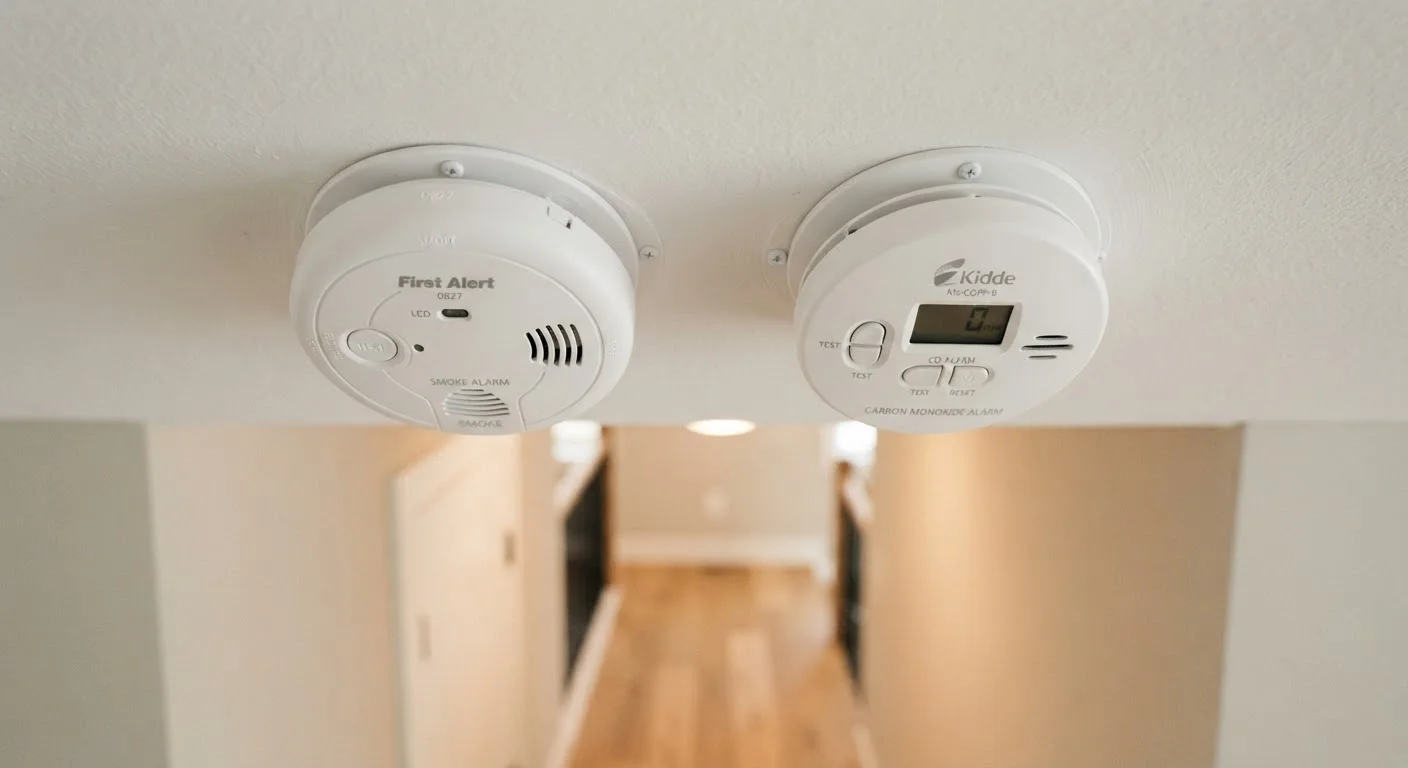
| Smoke alarm placement | Every level, inside each bedroom, outside sleeping areas (U.S. Fire Administration guidance) |
| CO detector height | Any height; within 10 feet of each bedroom door (General industry guidance - check manufacturer instructions) |
| Smoke alarm lifespan | Replace every 10 years (National Fire Protection Association (NFPA)) |
| CO detector lifespan | Replace every 5-7 years (Varies by manufacturer; check back-panel date) |
| Testing frequency (alarms) | Monthly (NFPA 72 recommendation) |
| Minimum kitchen extinguisher rating | 2-A:10-B:C (NFPA 10 standard) |
What Each Device Actually Does
These three devices serve distinct purposes and cannot substitute for one another. Understanding the difference helps you place them correctly and respond to alerts with confidence.
Ionization sensor
A type of smoke alarm sensor that uses a small amount of radioactive material to detect charged particles produced by fast-flaming fires. These alarms respond quickly to open flames but may be slower to detect smoldering fires.
Photoelectric sensor
A smoke alarm sensor that uses a light beam to detect smoke particles. It is more sensitive to slow, smoldering fires and generates fewer cooking-related false alarms than ionization types.
Carbon monoxide (CO)
A colorless, odorless gas produced by the incomplete combustion of fuels such as gas, oil, wood, or charcoal. At elevated concentrations it is dangerous and can be life-threatening without warning.
Fire extinguisher rating (e.g. 2-A:10-B:C)
A standardized label indicating what fire classes an extinguisher can suppress. 'A' covers ordinary combustibles (wood, paper), 'B' covers flammable liquids, and 'C' indicates it is safe for electrical fires. The number before each letter indicates extinguishing capacity.
Smoke alarms detect combustion particles in the air - either through ionization sensors (which respond quickly to fast-flaming fires) or photoelectric sensors (which are better at detecting slow, smoldering fires). Dual-sensor alarms combine both technologies and offer broader detection. Carbon monoxide (CO) detectors measure the concentration of carbon monoxide gas in parts per million (ppm). CO is colorless and odorless, produced by any fuel-burning appliance - furnaces, gas stoves, fireplaces, generators. Without a detector, there is no reliable way to know CO is present. Fire extinguishers are the only device of the three that requires you to take active action. They suppress a small, contained fire before it spreads - they are not a substitute for evacuation and should only be used when the exit behind you is clear and the fire is small enough to control safely.
For renters, note that landlords in most U.S. states are legally required to install working smoke alarms at the start of a tenancy. See what every renter should know about home maintenance for a fuller breakdown of your rights and responsibilities.
Placement: Where Each Device Belongs
| Smoke alarm placement | Every level, inside each bedroom, outside sleeping areas (U.S. Fire Administration guidance) |
| CO detector height | Any height; within 10 feet of each bedroom door (General industry guidance - check manufacturer instructions) |
| Smoke alarm lifespan | Replace every 10 years (National Fire Protection Association (NFPA)) |
| CO detector lifespan | Replace every 5-7 years (Varies by manufacturer; check back-panel date) |
| Testing frequency (alarms) | Monthly (NFPA 72 recommendation) |
| Minimum kitchen extinguisher rating | 2-A:10-B:C (NFPA 10 standard) |
Smoke alarms should be installed on every level of the home, inside each bedroom, and outside each sleeping area. Mount them on the ceiling or high on a wall (between 4 and 12 inches from the ceiling). Avoid placing them near cooking appliances, bathrooms, or HVAC vents - these locations generate false alarms and steam that can damage the sensor.
CO detectors belong on every level of the home and within 10 feet of each bedroom door. Because CO disperses evenly in air (it weighs nearly the same as air), detectors can be mounted at any height, though manufacturer guidance on your specific unit should take precedence. Do not place CO detectors directly above or beside fuel-burning appliances.
Fire extinguishers should be kept in the kitchen (the most common origin point of home fires), the garage, and any workshop area. Mount them on the wall near an exit - not tucked in a cabinet where access is slowed in an emergency. The kitchen extinguisher should be rated at minimum 2-A:10-B:C, which indicates it is safe for ordinary combustibles, flammable liquids, and electrical fires. Those rating labels are printed on the extinguisher body.
Integrating these checks into a broader routine is easier than it sounds. Our seasonal home maintenance guide maps alarm testing and extinguisher checks to specific times of year so nothing is missed.
Testing, Replacing, and Maintaining All Three
Ownership isn't enough - every device needs regular attention to remain effective.
When a CO Alarm Sounds: Don't Ignore It
A sounding CO detector is not a drill - leave the building immediately, get fresh air, and call emergency services from outside. Do not re-enter until responders have declared it safe. CO poisoning symptoms (headache, dizziness, nausea) can be subtle and are easy to attribute to other causes, which is part of what makes it dangerous.
Smoke Alarms
- Test monthly by pressing the test button until the alarm sounds.
- Replace batteries annually (or when the low-battery chirp begins) unless the unit uses a sealed 10-year battery.
- Replace the entire unit every 10 years. Sensors degrade over time regardless of battery status. Check the manufacture date printed on the back of the unit.
- Vacuum the vents gently once or twice a year to remove dust that can impair the sensor.
Carbon Monoxide Detectors
- Test monthly using the test button.
- Replace batteries on the same schedule as smoke alarms.
- Replace the unit every 5 to 7 years - CO sensors have a shorter lifespan than smoke sensors. The end-of-life date is usually printed on the back or base of the device.
Fire Extinguishers
- Check the pressure gauge monthly. The needle should sit in the green zone. A reading in red means the extinguisher needs to be recharged or replaced.
- Have it professionally inspected annually - many fire departments and hardware stores offer this service.
- Replace or recharge after any use, even partial discharge.
- Check the manufacture date on the label. Most extinguishers are rated for 5 to 12 years depending on type; follow the manufacturer's guidance.
Keeping all three devices in working order is one of the highest-impact habits you can build. For a broader look at which upkeep habits prevent the costliest home problems, see home maintenance habits that prevent the most expensive problems.