

Key Takeaways
Transferable Skills
Transferable skills are abilities you develop in one job, role, or context that remain useful in completely different ones. Unlike technical skills tied to a specific tool or job function, transferable skills cross industry lines - think communication, critical thinking, and project management. They're what let a former teacher excel in corporate training, or a retail supervisor thrive in operations management.
In workforce development research, transferable skills are sometimes categorized as 'portable competencies' - measurable capabilities that retain value across occupational clusters as defined by frameworks like O*NET.
Why Transferable Skills Hold Their Value
Job markets shift constantly - entire roles get automated, industries contract, and new fields emerge faster than degree programs can keep up. What stays stable? The underlying human capabilities that make someone effective in any organized work environment.
Employers hiring for roles that didn't exist five years ago still need people who can communicate clearly, manage competing priorities, and think through ambiguous problems. That's why transferable skills aren't just a fallback for career changers - they're a core part of what makes any candidate hireable, promotable, and resilient over the long run.
This matters especially for young adults who may feel their experience is limited. The truth is that experience in almost any setting - retail, campus clubs, caregiving, freelance gigs - builds genuine, nameable skills. The gap is usually in recognition and articulation, not the skills themselves.
92%
Employers prioritizing soft/transferable skills
According to a LinkedIn Workplace Learning Report, the vast majority of talent professionals say soft skills matter as much as or more than hard skills when evaluating candidates.
Top 3
Most in-demand skills: communication, teamwork, problem-solving
The National Association of Colleges and Employers (NACE) consistently identifies these three transferable competencies as priorities for employers hiring recent graduates.
74%
Workers who say they'll need to learn new skills to stay employable
A Pew Research Center survey found nearly three-quarters of US workers believe ongoing skill-building - much of it transferable in nature - is essential to staying competitive in the modern labor market.
The Skills That Travel Furthest
Not all transferable skills carry equal weight. Some are genuinely universal - valued in virtually every professional context. Others are more field-adjacent and only cross certain industry lines. Here are the categories that consistently matter most:
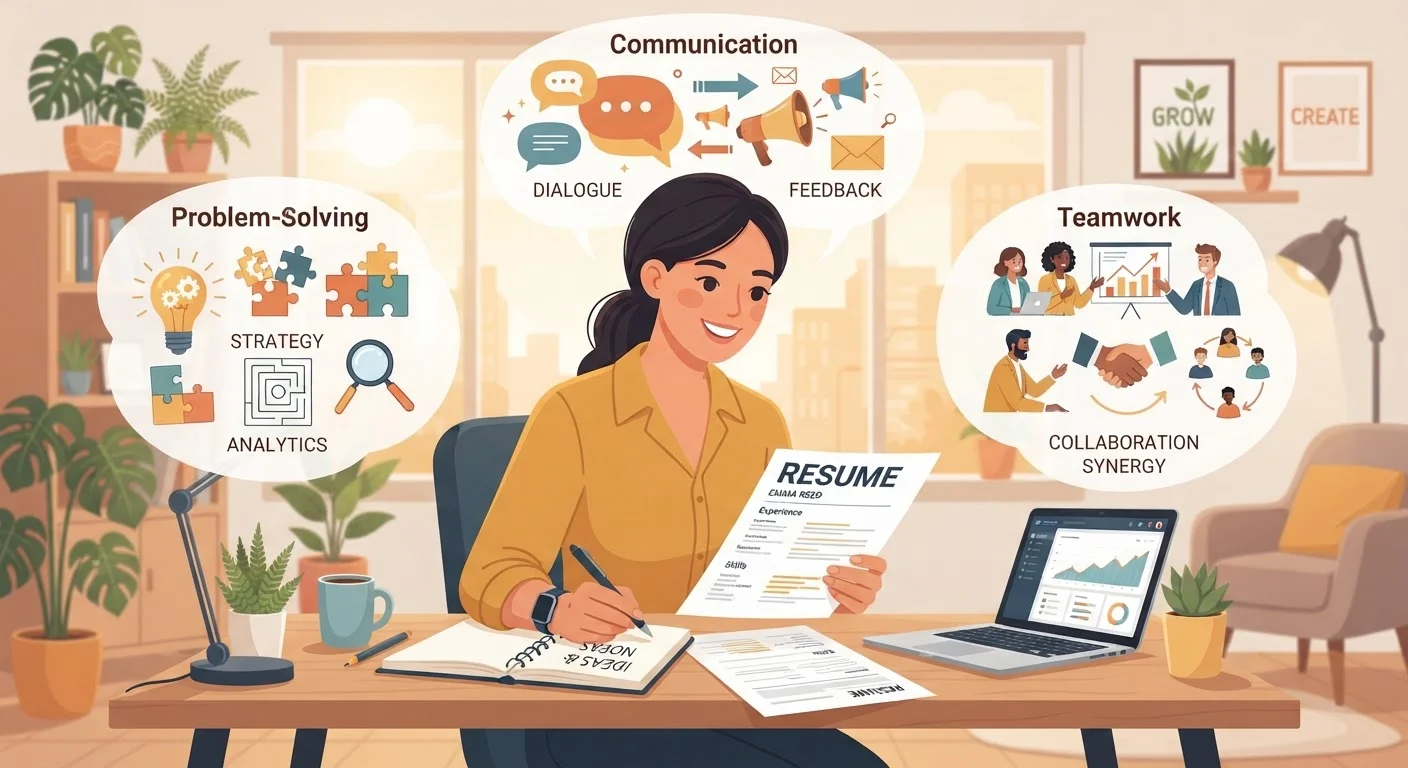
- Communication: Written, verbal, and increasingly digital. This includes the ability to adjust your message for different audiences - a skill as valuable in a nonprofit as in a tech firm.
- Critical thinking and problem-solving: The ability to break down a situation, weigh options, and act decisively. Employers across sectors list this as a top gap in recent hires.
- Collaboration and teamwork: Working effectively with people who have different roles, backgrounds, and communication styles is foundational in almost every workplace.
- Adaptability: The willingness to learn new tools, adjust to changing priorities, and stay productive through uncertainty has become a baseline expectation, not a bonus.
- Project and time management: Delivering work on time, coordinating multiple tasks, and keeping others informed are skills that scale from entry-level to executive roles.
For a deeper look at how these interact with role-specific abilities, our guide on hard skills vs. soft skills breaks down the distinctions clearly.
“The most durable career capital is not expertise in a single tool or platform - it's the ability to learn, communicate, and solve problems in new contexts. Those capacities are what employers actually compete to hire.”
— Beverly Kaye, Career development author and workforce learning consultant
How to Identify the Transferable Skills You Already Have
Most people undersell themselves because they think in job titles rather than competencies. A useful exercise: for each role or major responsibility you've held, write down three things you regularly did, then ask what underlying skill each action required.
For example:
- Trained new coworkers → instructional communication, patience, process documentation
- Resolved customer complaints → conflict resolution, empathy, problem-solving under pressure
- Organized a campus fundraiser → event coordination, stakeholder communication, budget tracking
Once you see the pattern, you can name the skill in employer-friendly language. The skills audit checklist is a practical tool for making this process systematic, especially before applying for a new role or asking for a promotion.
Also worth considering: skills you've built outside formal employment. Freelance projects, caregiving, coaching youth sports, or contributing to open-source projects all build real competencies. The workplace origin matters less than your ability to describe what you did and what it achieved.
Turn Your Audit Into Resume Language
After listing the tasks you've performed and the skills behind them, write one bullet point per skill using this format: action verb + what you did + measurable result. For example: 'Coordinated scheduling for a 12-person team, reducing shift conflicts by 30%.' This framing works across industries and makes transferable skills concrete and credible to hiring managers.
Presenting Transferable Skills So Employers Notice Them
Identifying your skills is step one. Getting employers to recognize them in a resume or interview is step two - and where many candidates fall short.
The most effective approach is the situation-action-result structure: briefly describe the context, explain what you specifically did, and state the measurable or observable outcome. This format works in both written applications and interviews because it turns abstract skills into concrete evidence.
Equally important is matching your language to the job posting. If a description calls for 'cross-functional collaboration,' don't write 'worked with other teams' - use their language and back it with your example. Our guide on reading a job description like a recruiter explains exactly how to decode what employers are actually asking for beneath the formal phrasing.
One often-overlooked area: the skills young professionals don't know to highlight at all. Our article on skills young professionals overlook covers the competencies that tend to matter far more than candidates expect - and that are frequently transferable.