

Key Takeaways
Option A
Cohort-Based Courses
The structured, community-driven learning experience.
Best for: Learners who thrive on accountability, peer interaction, and fixed deadlines to stay on track.
Option B
Self-Paced Courses
The flexible, go-at-your-own-speed alternative.
Best for: Busy adults who need to fit learning around irregular schedules and prefer independent study.
If you struggle to finish courses you start on your own
Cohort-Based Courses
Fixed deadlines, peer check-ins, and live sessions create external accountability that makes it significantly harder to quietly drop out.
If your work or family schedule changes week to week
Self-Paced Courses
You can study at 11pm on a Tuesday or during a lunch break - no missed sessions, no falling behind a group.
If networking and peer feedback matter to your goal
Cohort-Based Courses
Cohort learners often build lasting professional contacts and receive critique from peers working toward the same objectives.
If cost is a primary concern
Self-Paced Courses
Many high-quality self-paced options are free or low-cost, whereas cohort programs typically charge a premium for live instruction and facilitation.
If you want to explore a new topic before committing deeply
Self-Paced Courses
Low-stakes, flexible formats let you sample a subject without committing to a multi-week cohort schedule or a significant upfront fee.
How Each Model Actually Works
Understanding the mechanics of each format prevents mismatched expectations - one of the most common reasons online learners abandon courses before finishing.
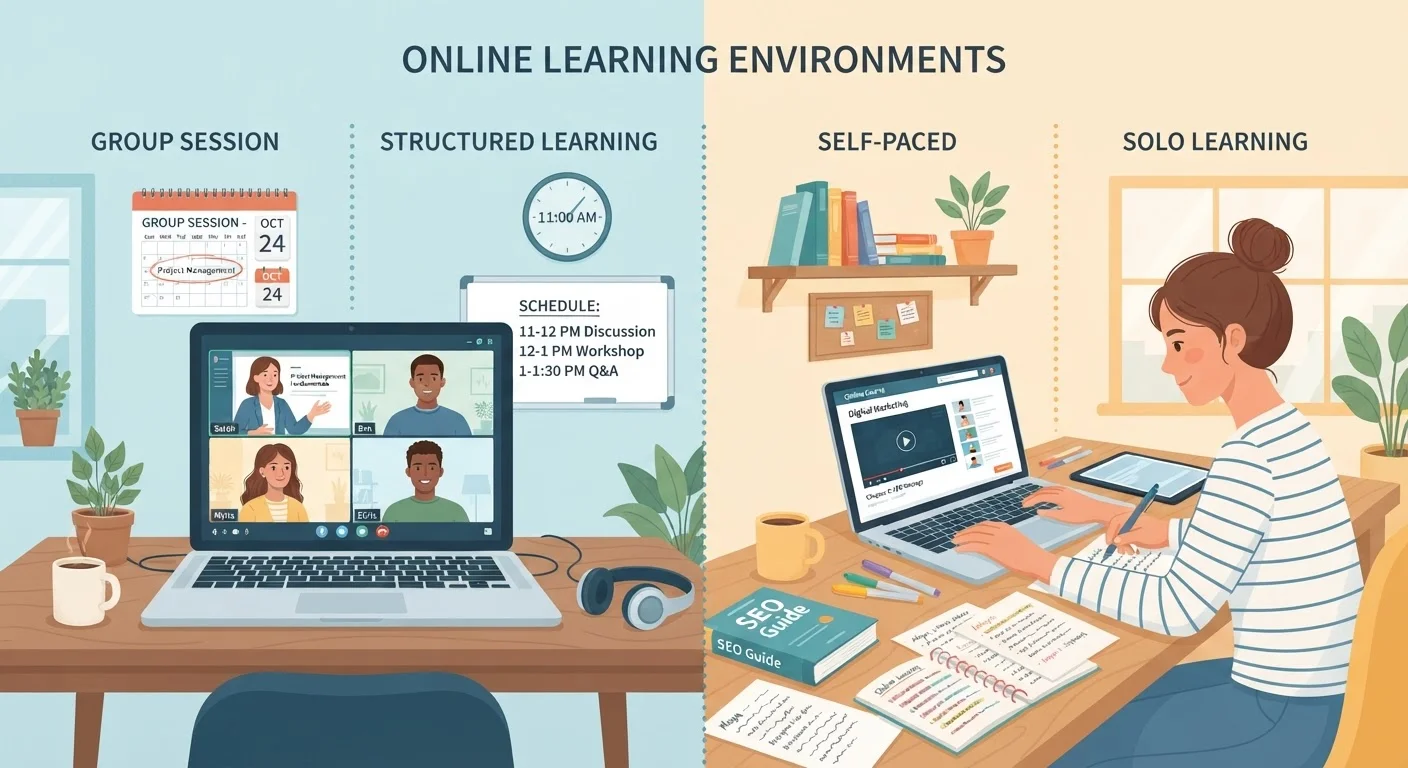
Cohort-based courses enroll a fixed group of learners who move through the curriculum together on a shared timeline. Classes typically include live video sessions, group discussions, peer review assignments, and instructor office hours. Start dates are set in advance, and missing a week generally means missing content and falling behind peers. The experience deliberately mirrors aspects of a traditional classroom - community, rhythm, and real-time feedback.
Self-paced courses give learners full control over when and how fast they work through the material. Lessons are pre-recorded or text-based, accessible any time, and there are no live sessions to attend. Some platforms include discussion forums where learners can interact asynchronously, but the core experience is solitary. You set the timeline - which is both the format's greatest strength and its biggest risk. For a deeper look at why independent study works well for adults, see our piece on self-directed learning.
| Criterion | Cohort-Based Courses | Self-Paced Courses |
|---|---|---|
| Schedule | Fixed start/end dates, live sessions | Study anytime, no set schedule |
| Accountability | Peers, instructors, deadlines | Self-motivated only |
| Interaction | Live discussion, peer review | Asynchronous forums, if any |
| Typical cost | Higher - reflects live facilitation | Free to low-cost options common |
| Completion likelihood | Generally higher | Historically lower without motivation |
| Flexibility | Low - missing sessions has consequences | High - pause and resume freely |
| Networking potential | Strong - shared experience with peers | Limited - mostly solo experience |
| Best skill depth | Deep, applied, iterative learning | Foundational to intermediate knowledge |
Completion Rates, Accountability, and Motivation
One of the most practical differences between these formats is how each handles the very human tendency to procrastinate.
Research on massive open online courses (MOOCs) - the dominant self-paced format - has consistently found completion rates in the single digits to low double digits. The flexibility that makes self-paced courses accessible is the same flexibility that allows learners to indefinitely defer finishing them. Without external pressure, motivation must come entirely from within.
<13%
Average MOOC completion rate
Multiple academic analyses of large-scale MOOC platforms have found average course completion rates consistently below 13%, highlighting the dropout challenge in self-paced formats.
~70%
Cohort learners reporting higher motivation
Surveys of cohort-based program participants frequently find that peer accountability and live sessions are cited as primary drivers of sustained engagement and course completion.
Cohort courses address this structurally. Knowing that peers and instructors expect your participation by a specific date creates social accountability. Many cohort programs also build in milestone check-ins, peer critique sessions, and cohort-wide communication channels, all of which reinforce a sense of shared purpose.
That said, cohort accountability cuts both ways. If life intervenes - illness, a work deadline, a family obligation - a cohort schedule can become a source of stress rather than support. Self-paced learners face no such friction.
Cost, Access, and What You Actually Get
Price differences between these formats are real and worth factoring into your decision.
Self-paced courses span a wide range - from fully free audit options on major learning platforms to paid certificates costing anywhere from a few dollars to a few hundred. The material is often identical regardless of whether you pay; the fee typically covers assessment access or a credential. This makes self-paced learning one of the most cost-accessible routes to new skills.
Cohort programs tend to cost more, reflecting the live instruction, facilitation, and community management involved. Some charge several hundred to several thousand dollars depending on the subject and duration. However, what you're paying for - structured feedback, live expert access, and peer collaboration - can represent meaningful added value for learners whose goals require deeper skill development rather than surface familiarity.
For guidance on structuring your approach regardless of which format you choose, our article on building a personal learning plan is a practical next step. You might also find it useful to explore the major online learning models to see how these two formats fit within the broader landscape of digital education.
Choosing the Right Fit for Your Situation
Neither format has a universal edge. The decision comes down to an honest assessment of your schedule, working style, and specific learning goal.
Ask yourself three questions before enrolling in anything:
- How consistent is my schedule? Irregular hours or unpredictable commitments make cohort deadlines a liability rather than an asset.
- Do I finish things I start independently? If the answer is mostly no, the external structure of a cohort is likely worth the additional cost.
- Do I need peer feedback or networking as part of this goal? If the skill you're building involves collaboration, critique, or professional relationships, a cohort context provides practice that self-paced formats rarely replicate.
It's also worth noting these formats aren't mutually exclusive over time. Many learners start with self-paced content to test interest in a topic, then invest in a cohort program once they're committed to going deeper. For practical habits that improve outcomes in either format, see getting the most out of any online course.