

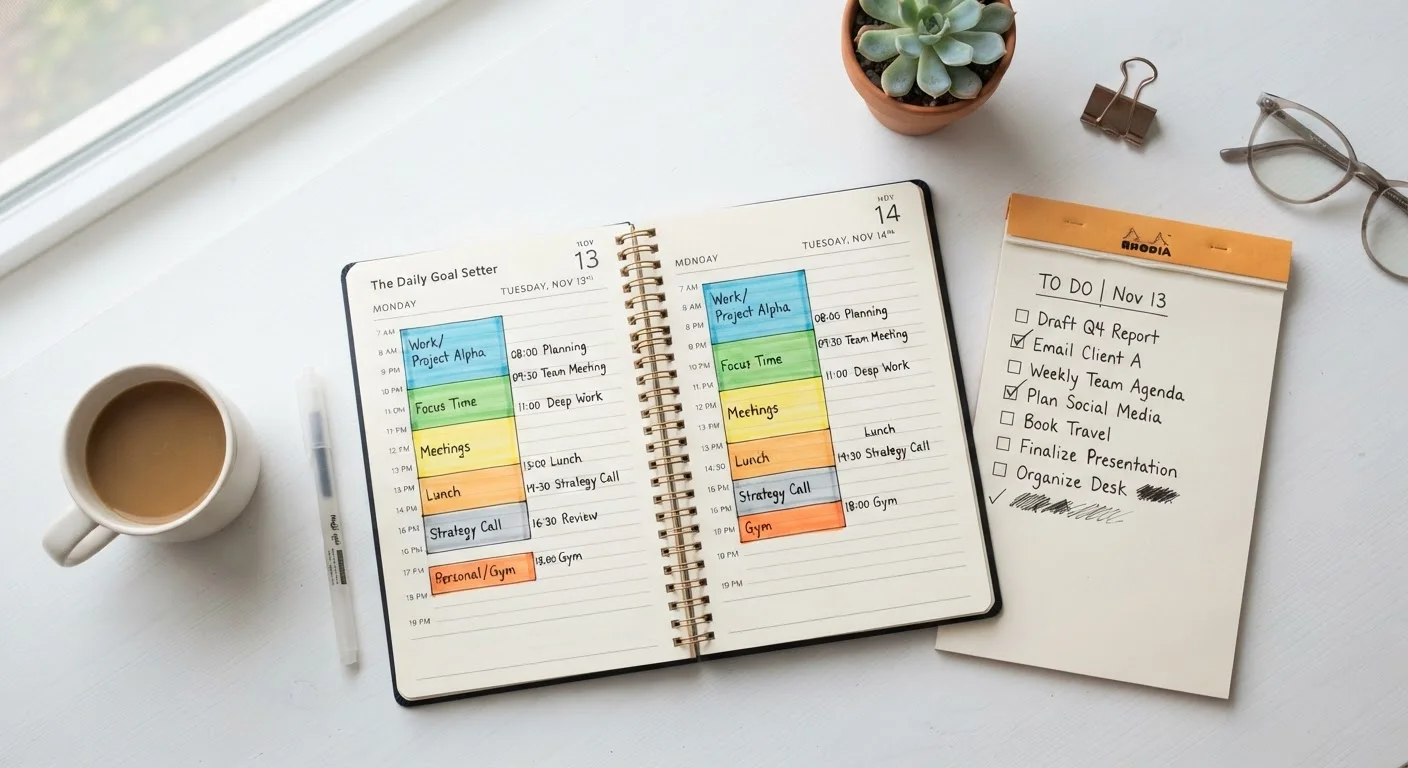
Key Takeaways
Option A
Time Blocking
The structured, calendar-driven approach to protecting your attention.
Best for: People who struggle with focus, have predictable schedules, and need to make progress on complex or creative work.
Option B
To-Do Lists
The flexible, task-capture system most people already use.
Best for: People managing high volumes of varied tasks, unpredictable days, or work that requires quick context-switching.
If your work involves long, focused sessions - writing, coding, studying, designing
Time Blocking
Blocking dedicated time guards against interruption and makes deep work a standing appointment rather than an afterthought.
If your day is unpredictable with frequent requests, meetings, or shifting priorities
To-Do Lists
A well-maintained task list lets you respond to what actually happens without a rigid schedule falling apart around you.
If you often end the day unsure what you actually accomplished
Time Blocking
Assigning work to named time slots creates visible accountability and makes it easier to review how your time was really spent.
If you're balancing many small tasks across multiple life domains
To-Do Lists
A categorized to-do list captures every obligation in one place, preventing things from falling through the cracks on busy days.
If you want the structure of time blocking but need flexibility for the unexpected
Time Blocking
Build in buffer blocks and keep a short task list as overflow - this hybrid approach captures the strengths of both systems.
How Each System Actually Works
Understanding what separates these two methods is the first step toward choosing one - or combining both intelligently.
Time blocking means dividing your day into dedicated segments, each assigned to a specific task or category of work. You open your calendar and literally block time - for example, 9-11 a.m. for a project report, 11-11:30 a.m. for email, 2-3 p.m. for a learning session. The block acts as a commitment: that time belongs to that work. Proponents of the method, including productivity researchers who study knowledge workers, argue it reduces the constant mental overhead of deciding what to do next.
To-do lists work differently. Instead of assigning time, they capture tasks - a running inventory of things that need to happen. The list might be organized by project, priority, or context. You work through it in whatever order fits the day, crossing off items as you go. The strength here is flexibility: you can add, reorder, and reprioritize without restructuring a calendar.
Both methods are trying to solve the same problem - making sure important work happens - but they approach it from opposite angles. Time blocking controls when; to-do lists control what.
| Criterion | Time Blocking | To-Do Lists |
|---|---|---|
| Core mechanism | Assigns tasks to calendar slots | Captures tasks in a prioritized list |
| Flexibility | Low - disruptions break the schedule | High - easy to reorder on the fly |
| Setup time | Higher - requires daily calendar planning | Lower - quick to add and tick off |
| Protects deep work | Yes - time is reserved in advance | No - depends on when you get to it |
| Handles many small tasks | Awkward - blocks become fragmented | Well - lists scale with task volume |
| Accountability | Built-in - blocks show whether work happened | Requires self-discipline to prioritize |
| Best schedule type | Predictable, controlled days | Variable, interrupt-driven days |
Where Each Method Breaks Down
No planning system is failure-proof, and knowing each method's weak points helps you set realistic expectations.
Time blocking's main vulnerability is schedule disruption. A blocked calendar assumes your day will go roughly as planned. One urgent meeting, a slow-loading tool, or an unexpected conversation can cascade into a completely derailed afternoon. People who adopt time blocking without building in buffer time often find themselves chronically behind, which can feel worse than having no system at all.
Time blocking also requires upfront mental energy. Deciding how long tasks take - and being honest about it - is harder than it sounds. Research on planning behavior consistently finds that people underestimate task duration, a phenomenon sometimes called the planning fallacy. This means time block estimates frequently need adjustment, especially early in the practice.
To-do lists have a different failure mode: they grow without limit. Without a clear rule about what gets on the list and when it gets done, a to-do list becomes a source of low-grade anxiety rather than clarity. Tasks sit uncompleted for days. High-value work competes with minor errands. There's no built-in protection for the work that matters most - it only gets done if you happen to get to it.
For students building learning habits, this is especially relevant. A to-do list that includes "study for exam" alongside "reply to texts" gives both tasks equal visual weight. Time blocking forces you to ask: when, specifically, will this happen? That question is often what separates intention from action. If you're working on structured self-improvement, see how building a personal learning plan can provide the goal-setting backbone that either method needs.
~20%
Time workers spend on their most important tasks
Research by productivity consultant and author Gary Keller suggests most people spend only around 20% of their workday on high-priority work, with the rest absorbed by reactive tasks.
40%
Productivity loss from task-switching
Studies from the American Psychological Association on multitasking found that switching between tasks can reduce productivity by as much as 40%, underscoring the value of focused work blocks.
Choosing the Right Method - or Mixing Both
The most useful question isn't which method is objectively better - it's which fits how you actually work and what your schedule allows.
Consider time blocking if you have recurring blocks of uninterrupted time, if deep or creative work is central to your goals, or if you've noticed that tasks linger on lists indefinitely without getting done. It pairs especially well with morning routines - dedicating the first hour of the day to a single priority is a common and effective application. For practical guidance on structuring those early hours, building a morning routine that holds up walks through how to anchor productive habits to the start of your day.
Consider to-do lists if your responsibilities shift frequently, if you're managing tasks across multiple domains (work, study, home, social), or if you're early in your career and still figuring out how your time actually gets spent. A well-organized list - ideally prioritized each morning - gives you a responsive, low-overhead system that adapts to reality.
Many people find the most traction with a hybrid approach: maintain a master task list, then each morning select two or three priority items and block specific time for them. The list provides completeness; the calendar provides commitment. This layered method mirrors how structured planning frameworks like the Getting Things Done (GTD) methodology suggest bridging capture and execution - though any hybrid approach should be kept simple enough that the system itself doesn't become the task.
Whatever method you choose, the goal is the same: fewer decisions made reactively, and more of your limited time directed toward work that actually matters to you.