

Key Takeaways
Dollar-Cost Averaging
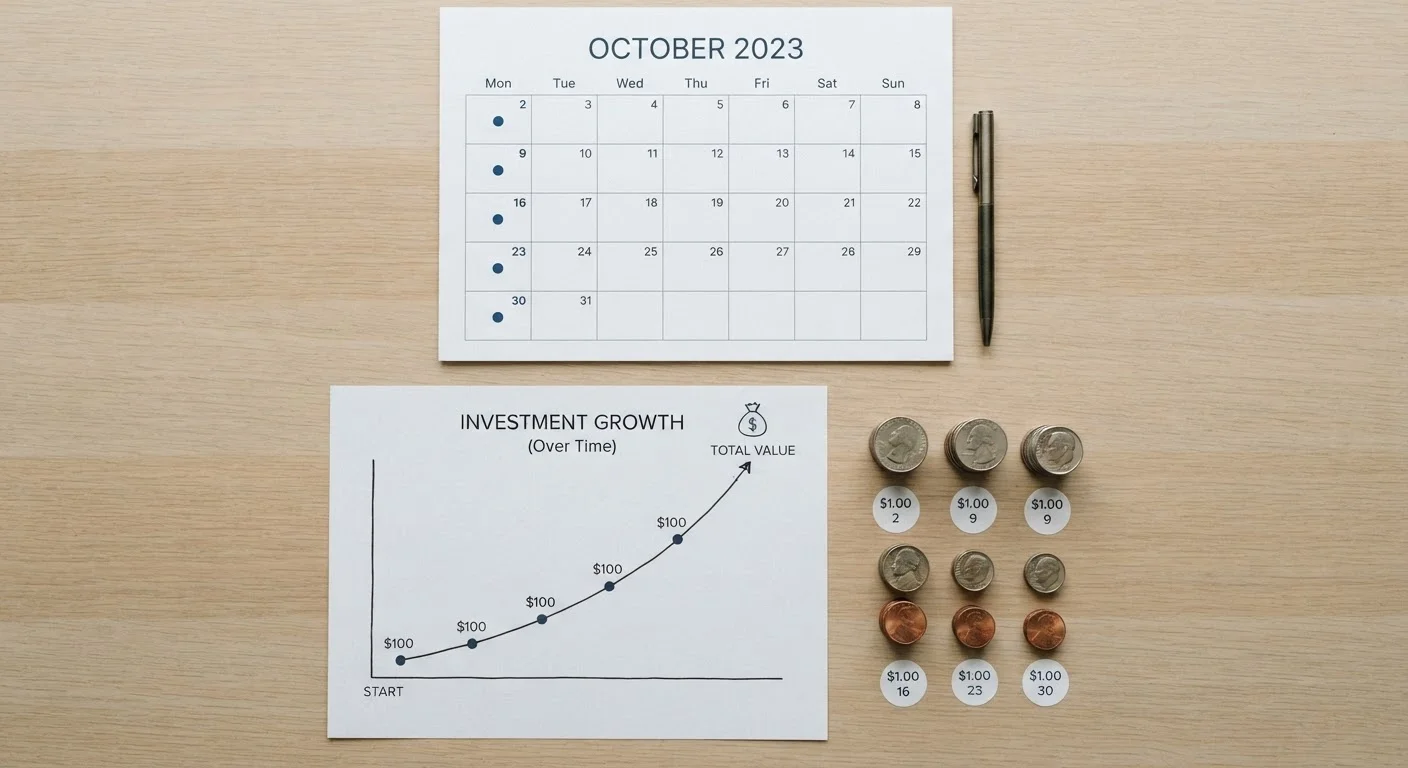
Dollar-cost averaging (DCA) is an investment strategy where you invest a fixed dollar amount at regular intervals - say, $100 every month - regardless of what the market is doing. Because you buy more shares when prices are low and fewer when prices are high, your average cost per share can be lower over time than if you tried to pick the perfect moment to invest. It is a disciplined, systematic approach that sidesteps the anxiety of market timing.
DCA does not guarantee a profit or protect against loss in declining markets; it reduces the risk of investing a large sum at a market peak by spreading purchases across multiple price points.
The Core Idea: Invest Consistently, Not Perfectly
Most people assume successful investing requires knowing exactly when to buy - catching the market at its lowest point before a big run-up. In practice, even professional fund managers rarely get this right consistently. Dollar-cost averaging offers a different path: forget timing, focus on regularity.
The mechanics are straightforward. You decide on a fixed amount - say, $150 - and invest it on the same day every month, no matter what the headlines say. Some months your $150 buys 5 shares; other months, when prices are lower, it buys 7. Over time, this rhythm naturally lowers your average cost per share compared to a single large purchase made at a random moment.
This strategy pairs exceptionally well with automation. If you already set up recurring transfers to a savings account, you can apply the same principle to investing. See our guide to automating your savings for the principles that make recurring financial habits stick.
Start Small - Consistency Beats Amount
You don't need to invest hundreds of dollars to benefit from dollar-cost averaging. Starting with a small, manageable amount on a fixed schedule builds the habit and keeps you invested through market swings. Increasing the contribution later - as income grows - is far easier than starting from zero.
Why Emotion Is the Enemy of Returns
Markets fluctuate constantly. When prices drop sharply, the instinct is to pause contributions or sell existing holdings to stop further losses. When prices surge, it's tempting to invest a large amount all at once, hoping to ride the wave. Both reactions tend to hurt long-term outcomes.
Behavioral finance research consistently shows that individual investors tend to buy high - after prices have already risen and excitement is peaking - and sell low, after fear sets in. Dollar-cost averaging counteracts this by making your investment decision in advance: the amount, the asset, and the schedule are all decided before any market move occurs.
“The stock market is a device for transferring money from the impatient to the patient.”
— Warren Buffett, Chairman and CEO of Berkshire Hathaway, widely cited investor
For new investors building their first portfolio, this emotional buffer is particularly valuable. You're not watching charts and second-guessing yourself each time - you're following a plan you set when you were thinking clearly.
A Simple Example in Practice
Imagine you invest $200 per month into a broad market index fund over four months:
| Month | Share Price | Shares Purchased |
|---|---|---|
| January | $40 | 5.0 |
| February | $32 | 6.25 |
| March | $25 | 8.0 |
| April | $50 | 4.0 |
You invested $800 total and acquired 23.25 shares. Your average purchase price is roughly $34.41 per share - lower than the $40 you'd have paid investing everything in January. Had you attempted to time the market and bought all $800 in January, you'd own only 20 shares at a higher average cost.
This example is simplified and doesn't account for transaction fees or taxes, but it illustrates the core mechanic. For a direct comparison of this approach against lump-sum investing, see lump sum vs. regular contributions.
~80%
Active fund managers underperforming their index benchmark
S&P Dow Jones Indices' SPIVA reports have consistently found that the majority of actively managed U.S. equity funds underperform their benchmark index over 15-year periods, underscoring why systematic strategies like DCA are favored by many long-term investors.
26 years
Average age Americans wish they had started investing
A TIAA survey found that Americans, on average, wish they had started saving and investing in their mid-twenties, highlighting the perceived value of beginning a regular contribution habit early.
Getting Started: What You Actually Need
Dollar-cost averaging doesn't require a large upfront balance or advanced financial knowledge. What it does require is a consistent income to draw from, a clear contribution amount, and an account set up to receive recurring investments.
- Determine a sustainable amount. Review your monthly budget and identify a figure you can invest without disrupting essential expenses. Even a modest amount compounds meaningfully over years.
- Choose an account type. Employer-sponsored plans like a 401(k) already implement DCA automatically with each paycheck. IRAs and taxable brokerage accounts can be configured with scheduled contributions.
- Stick to the schedule. The value of DCA comes from not deviating when markets feel uncomfortable. Skipping contributions during a downturn is precisely when the strategy would have bought shares at lower prices.
Before you invest, make sure you have a foundational savings habit in place. Our guide to building a savings habit covers where to start if you're newer to setting money aside consistently. Dollar-cost averaging is also one of the early investing habits that tend to pay off over time.
This article is for general informational and educational purposes only. It is not personalized financial, investment, tax, or legal advice. Investment returns are not guaranteed, and all investing involves risk, including possible loss of principal. Consult a licensed financial adviser before making investment decisions suited to your individual circumstances.