

Key Takeaways
Investment Portfolio Building Blocks
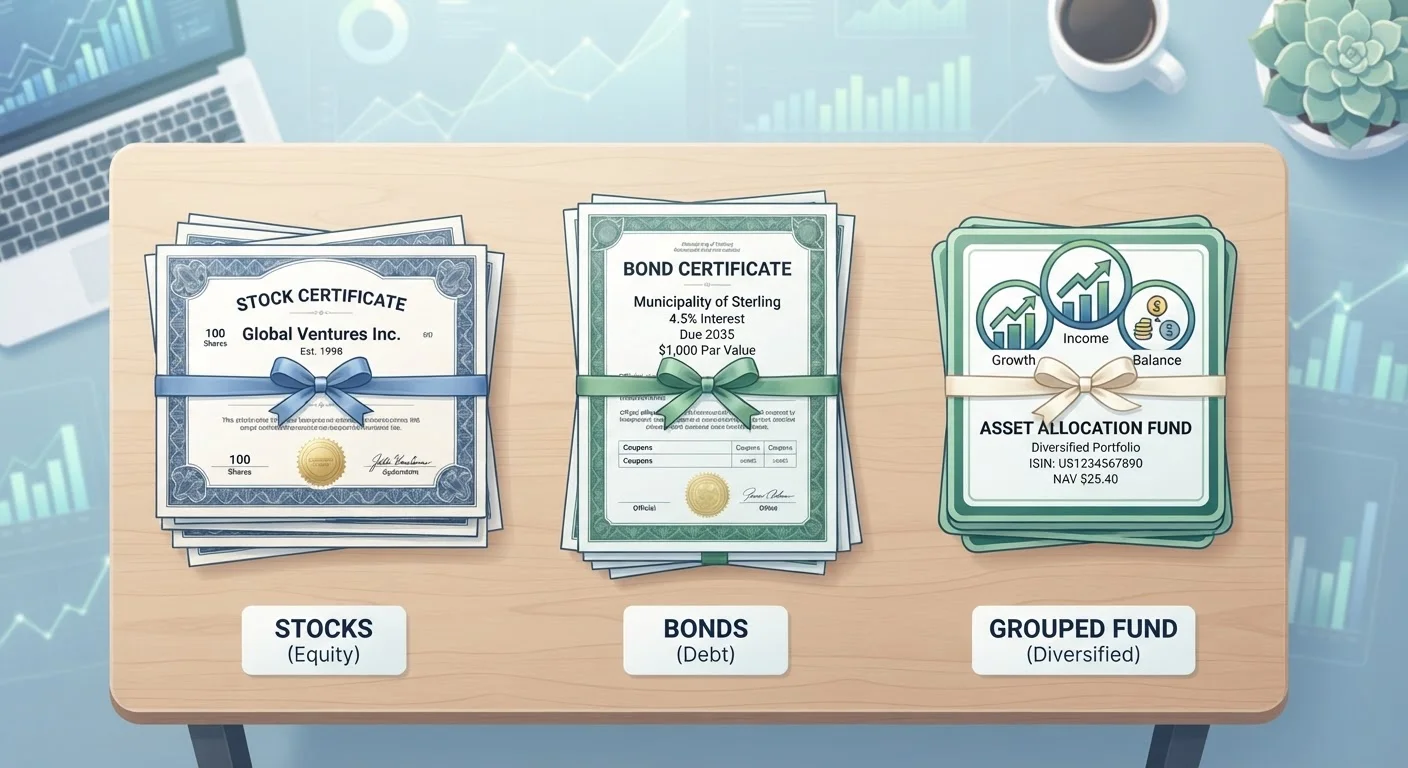
A portfolio is simply a collection of investments you own. The three most common types are stocks (ownership shares in a company), bonds (loans you make to governments or companies), and funds (pooled collections of stocks and/or bonds). Each behaves differently in terms of risk, potential return, and how it generates income.
In financial theory, these asset classes have historically had low or negative correlation with each other, meaning they don't always move in the same direction - a key reason diversification across all three is a widely used risk-management strategy.
Stocks: Buying a Piece of a Company
When a company wants to raise money, it can sell shares of itself to the public - those shares are stocks (also called equities). When you buy a stock, you become a part-owner of that business, however small. If the company grows and becomes more valuable, your shares tend to rise in price. If it struggles, they can fall.
Stocks have historically delivered higher long-term returns than bonds, but they come with more volatility - meaning their value can swing significantly in short periods. Some stocks also pay dividends: regular cash distributions to shareholders from the company's profits. Not all stocks do, and dividends are never guaranteed.
The key risk with individual stocks is concentration: if you put most of your money into one company and it performs poorly, your portfolio takes a heavy hit. This is why diversification - owning many different stocks - matters so much.
Don't Confuse Volatility With Loss
When a stock's price drops, you haven't necessarily lost money - a loss is only realized when you sell. Long-term investors often ride out short-term price swings. Understanding this distinction can help prevent panic-driven decisions during market downturns.
Bonds: Lending Money and Earning Interest
A bond is a loan. When you buy one, you're lending money to a government or corporation for a set period of time. In return, the issuer pays you regular interest (called the coupon rate) and repays your original amount - the principal - when the bond matures.
Because the income is predictable and the principal is scheduled to be returned, bonds are generally considered less volatile than stocks. However, they're not risk-free. A bond issuer can default (fail to repay), and rising interest rates tend to push existing bond prices down. Government bonds from stable economies are typically considered lower risk than corporate bonds.
Bonds often serve as a stabilizing force in a portfolio. When stock markets fall sharply, bonds sometimes hold their value or even rise - though this isn't always the case.
~4,000+
Companies in a broad US stock index
A total market index fund can provide exposure to thousands of individual stocks, illustrating the diversification funds can offer versus single-stock ownership.
$53T+
US bond market size (approximate)
The US bond market is one of the largest capital markets in the world, reflecting how widely governments and corporations use bonds to raise long-term financing.
0.03%-1%+
Typical fund expense ratio range
Passive index funds often charge expense ratios as low as 0.03%, while actively managed funds can charge 1% or more annually - a difference that compounds significantly over time.
Funds: Instant Diversification in a Single Purchase
A fund pools money from many investors and uses it to buy a collection of stocks, bonds, or both. Instead of researching and purchasing dozens of individual assets yourself, you buy into the fund and get exposure to all of them at once.
The two most common fund types for individual investors are mutual funds and exchange-traded funds (ETFs). Both offer diversification, but they differ in how they're traded and priced. For a detailed breakdown, see our guide on ETFs vs. mutual funds.
Funds also charge fees, typically expressed as an expense ratio - a small annual percentage of your investment. Lower fees mean more of your returns stay with you, so expense ratios are worth comparing when evaluating funds.
How These Three Work Together in a Portfolio
No single asset type is right for every investor or every goal. The balance you strike between stocks, bonds, and funds depends on your timeline, your comfort with risk, and what you're saving toward.
A common general principle - not a personal recommendation - is that younger investors with longer time horizons often hold more stocks, while those closer to needing their money may shift toward bonds for stability. Funds make it easier to maintain that balance without managing dozens of individual positions.
Before deciding on any allocation, it's worth working through your financial foundations first. Our pre-investment checklist can help you assess whether you're in a solid position to start. If you're brand new to all of this, our beginner's introduction to investing walks through the foundational concepts first.
And when you encounter unfamiliar terms along the way, our plain-English investing glossary is a useful quick reference.
Asset Allocation Is Personal
There's no universally 'correct' mix of stocks, bonds, and funds. The right balance depends on your individual goals, time horizon, and risk tolerance. General principles and rules of thumb can be useful starting points, but they're not substitutes for advice tailored to your specific situation. A licensed financial adviser can help you think through your own allocation.
This article is for general informational and educational purposes only and does not constitute personalized financial or investment advice. Consult a qualified financial adviser before making decisions about your own investments.