

Key Takeaways
Option A
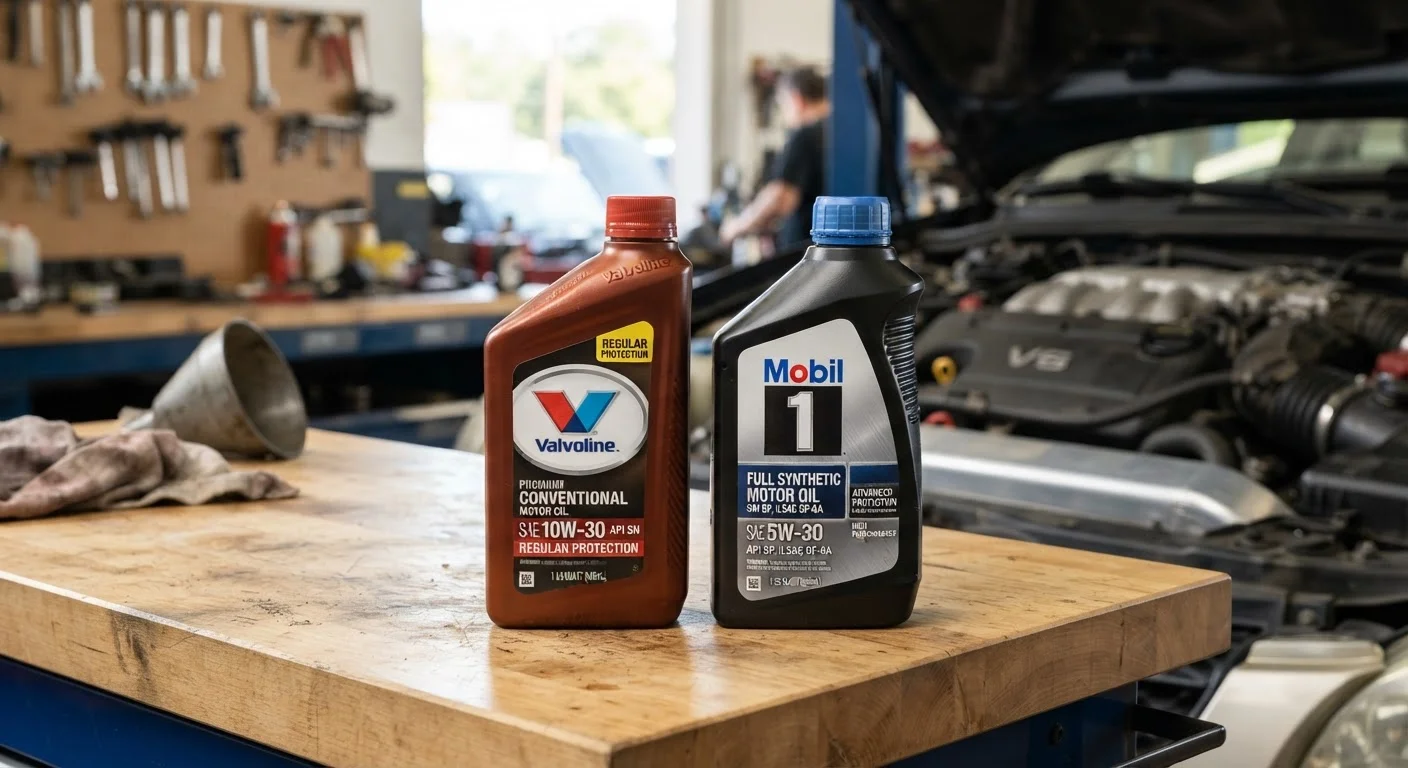
Conventional Motor Oil
The time-tested, budget-friendly baseline.
Best for: Older vehicles with simple engines and drivers following frequent oil-change schedules.
Option B
Synthetic Motor Oil
The engineered option built for modern demands.
Best for: Newer vehicles with turbocharged or high-performance engines and drivers who want longer change intervals.
If you drive an older vehicle with a high-mileage, naturally aspirated engine
Conventional Motor Oil
Older engines designed before synthetic was standard often run fine on conventional oil, and the lower cost per quart may make more sense given the vehicle's age and value.
If your car has a turbocharged engine or your manufacturer specifies full synthetic
Synthetic Motor Oil
Turbochargers run extremely hot and require oil that resists breakdown under high heat. Using conventional oil in these engines risks accelerated wear and potential failure.
If you want fewer oil changes and more consistent engine protection year-round
Synthetic Motor Oil
Synthetic oil degrades more slowly and maintains its protective properties in both extreme cold and heat, making it a practical choice for drivers in variable climates.
If you're on a tight budget and change your oil on schedule without fail
Conventional Motor Oil
Conventional oil performs adequately when changed at the manufacturer's recommended intervals - typically every 3,000-5,000 miles - in vehicles that don't require synthetic.
What Each Oil Actually Is
Motor oil does two critical jobs: it lubricates moving metal parts to reduce friction, and it carries heat away from the engine. The difference between conventional and synthetic comes down to how the base oil is made.
Conventional motor oil is refined from crude petroleum. The refining process removes many impurities, but the resulting molecules are still uneven in size and shape - which means the oil's protective properties can vary more under extreme conditions.
Synthetic motor oil is chemically engineered. Its molecules are more uniform, which allows it to flow more predictably across a wider temperature range, resist breakdown under high heat, and maintain viscosity (thickness) more consistently over time. Full synthetics start from chemically modified base stocks; synthetic blends mix conventional and synthetic base oils at a lower price point.
The practical upshot: synthetic oil doesn't necessarily make your engine run better in normal conditions, but it holds up more reliably when things get demanding - cold starts, stop-and-go traffic, towing, or high-performance engines.
| Criterion | Conventional Oil | Synthetic Oil |
|---|---|---|
| Base material | Refined crude petroleum | Chemically engineered molecules |
| Typical change interval | 3,000-5,000 miles | 7,500-10,000+ miles |
| Cost per quart (approximate) | Lower upfront cost | 2-4x higher upfront cost |
| Cold-weather performance | Thickens more in extreme cold | Flows better at low temperatures |
| Heat resistance | Breaks down faster under high heat | Resists breakdown at high temps |
| Best engine match | Older, naturally aspirated engines | Modern, turbocharged, or high-perf engines |
| Manufacturer specification | Older vehicle specs | Most vehicles made after ~2010 |
Cost vs. Long-Term Value
Synthetic oil typically costs two to four times more per quart than conventional at the point of purchase. For a full oil change, that gap can add up. But per-change cost isn't the whole picture.
Because synthetic oil degrades more slowly, manufacturers of vehicles that require it often specify change intervals of 7,500-10,000 miles or more - compared to the 3,000-5,000 miles commonly associated with conventional oil. Fewer changes per year can meaningfully reduce your total annual oil spend, even with the higher per-change cost.
7,500-10,000 mi
Typical synthetic oil change interval
Many automakers specify extended intervals for full synthetic - roughly double the old conventional oil standard - per vehicle owner's manuals.
2-4×
Higher cost of synthetic per quart vs. conventional
The per-quart price premium of synthetic can be partially offset by fewer changes per year, depending on your driving habits and vehicle requirements.
There's also the repair-cost angle. Engine wear caused by inadequate lubrication - often from degraded oil or missed changes - is one of the more expensive failures a car can suffer. Protecting the engine with the right oil is one of the most cost-effective forms of preventive maintenance. For a fuller picture of how maintenance fits into overall ownership expenses, see our guide to the true cost of car ownership.
It's also worth noting that common ownership myths - like assuming you must always change oil every 3,000 miles regardless of oil type - can lead drivers to overspend unnecessarily. Your owner's manual is the authoritative source for your car's actual interval.
How to Know Which One Your Car Needs
The single most reliable source is your vehicle's owner's manual. Manufacturers specify oil type and viscosity grade (e.g., 5W-30 or 0W-20) based on engine design tolerances. Using a grade or type the engine isn't designed for - in either direction - can affect performance and, in some cases, warranty coverage.
A few practical rules of thumb:
- Turbocharged engines nearly always require full synthetic. The turbocharger spins at very high speeds and temperatures, and conventional oil breaks down faster under those conditions.
- Vehicles built after roughly 2010 increasingly come from the factory with synthetic oil and are designed around its properties.
- High-mileage vehicles (typically over 75,000 miles) can sometimes benefit from high-mileage conventional or synthetic-blend formulations that include seal conditioners - though again, check the manual first.
- Hybrid vehicles have different engine cycling patterns that can affect oil degradation rates; consult your manual and consider how your vehicle type affects running costs overall.
If you've bought a used car and don't have the manual, the manufacturer's website typically lets you look up specifications by VIN or model year. A qualified mechanic can also advise based on your engine type.
This article is for general informational purposes. Always consult your vehicle's owner's manual or a qualified mechanic for maintenance decisions specific to your car.