

Key Takeaways
Start here
Why Car Insurance Is Mandatory - and What Happens Without It
Core knowledge
The Main Coverage Types Explained
Know the numbers
Deductibles, Premiums, and No-Claims Discounts
Avoid the gaps
What Policies Typically Exclude
Final step
How to Read a Policy Without Getting Lost
Why Car Insurance Is Mandatory - and What Happens Without It
In the US, car insurance isn't optional - it's a legal requirement in 49 out of 50 states (New Hampshire is the exception, though drivers there must still prove financial responsibility). The minimum required is liability insurance, which protects other people if you cause an accident. It doesn't cover your own vehicle or injuries.
Driving without the state minimum can result in fines, license or registration suspension, and being held personally liable for damages in a lawsuit. If you cause a serious accident while uninsured, the financial consequences can follow you for years. Insurance is also part of the broader picture of what it truly costs to own a car - see the full breakdown of ongoing ownership costs for context on how premiums fit into your budget.
Liability coverage
Insurance that pays for injuries or property damage you cause to other people in an accident. It does not cover your own vehicle or injuries.
Deductible
The fixed dollar amount you pay out of your own pocket when you make a claim, before your insurer pays the rest.
Premium
The regular payment (monthly or annual) you make to keep your insurance policy active, regardless of whether you make any claims.
Comprehensive coverage
An optional add-on that covers damage to your own vehicle from non-collision events such as theft, fire, flooding, or weather.
No-claims discount
A reduction in your premium earned by completing one or more consecutive years without filing a claim.
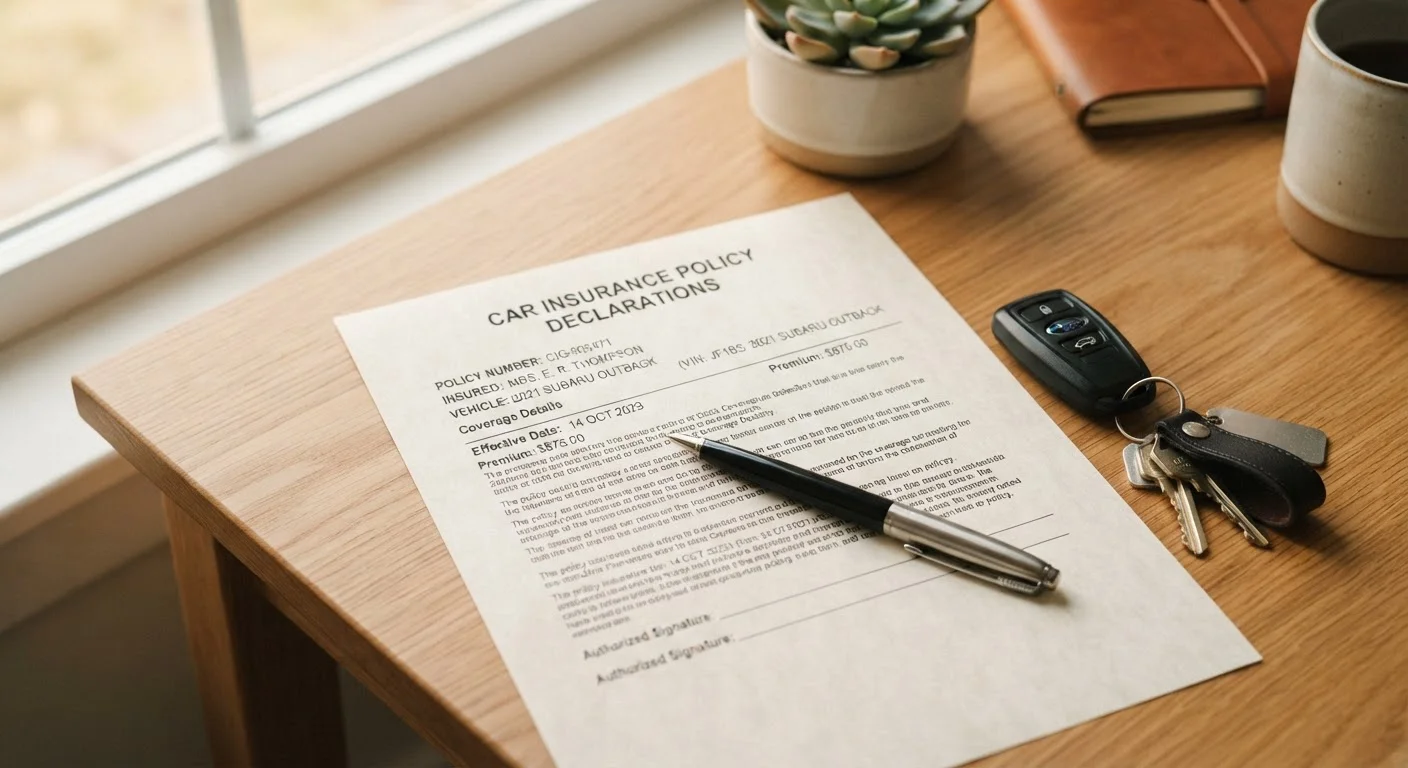
Declarations page
A one-page summary at the front of your policy listing your name, vehicle details, coverage types, limits, and premium - the most important document to read first.
The Main Coverage Types Explained
A standard policy can include several distinct coverage types, often bundled together or purchased separately:
- Liability (Bodily Injury & Property Damage): Pays for injuries and property damage you cause to others. State-mandated minimums are often written as three numbers, e.g., 25/50/25, meaning $25,000 per person injured, $50,000 per accident, and $25,000 for property damage.
- Collision: Covers damage to your own vehicle after a crash with another vehicle or object, regardless of fault. Requires a deductible.
- Comprehensive: Covers non-collision damage to your vehicle - theft, weather, fire, vandalism, or hitting an animal. Also requires a deductible.
- Uninsured/Underinsured Motorist (UM/UIM): Protects you if you're hit by a driver who has no insurance or insufficient coverage. Required in some states.
- Medical Payments (MedPay) / Personal Injury Protection (PIP): Covers medical expenses for you and passengers after an accident, regardless of fault. PIP is broader and mandatory in no-fault states.
Collision and comprehensive are sometimes called full coverage when combined with liability, though that term has no legal definition - always read what's actually listed on your declarations page.
Match your coverage to your vehicle's value
If your car is older and lower in value, paying for comprehensive and collision may cost more annually than the car is worth. A rough guide: if your vehicle's market value is less than ten times your annual deductible plus collision/comprehensive premium combined, dropping those coverages may make financial sense. Always run the numbers for your specific situation.
Deductibles, Premiums, and No-Claims Discounts
Two numbers define how insurance affects your wallet day to day: the premium (what you pay regularly to maintain coverage) and the deductible (what you pay out of pocket before the insurer covers the rest of a claim). These move in opposite directions - raise your deductible and your premium usually falls, and vice versa.
A no-claims discount rewards you for staying claim-free. Each year without a claim typically earns a percentage reduction on renewal. Making a small claim - say, for minor bodywork - can eliminate several years of accumulated discounts, so it's often worth calculating whether paying out of pocket is cheaper. Some policies offer no-claims protection as a paid add-on.
Young and new drivers statistically pay higher premiums. Completing a recognized defensive driving course, keeping your driving record clean, and understanding how vehicle choice affects insurance costs are all documented ways to manage long-term costs. For a broader look at expenses new owners often overlook, see what first-time owners wish they'd known.
What Policies Typically Exclude
Coverage gaps trip up more policyholders than any other issue. Common exclusions include:
- Intentional damage - insurance does not cover deliberate acts.
- Using your car for commercial purposes (rideshare driving, deliveries) without a commercial or rideshare endorsement.
- Mechanical breakdown - standard policies don't cover wear-and-tear or engine failure. That's what a warranty or mechanical breakdown insurance is for.
- Unlisted drivers - if a friend not on your policy drives your car and causes an accident, coverage may be limited or denied depending on your policy language.
- Driving outside permitted territory - coverage may not extend to driving in Mexico or Canada without a separate endorsement.
Rideshare and delivery work voids standard coverage
If you drive for a rideshare or delivery platform using a personal auto policy without a rideshare endorsement, your insurer may deny claims that occur while you're working. Many insurers treat any paid driving as commercial use. Check your policy language before accepting any paid driving gig.
Reading the exclusions section of your policy is just as important as reading the coverage section. Insurers are required to provide a declarations page (the summary sheet) and a full policy document - request both and compare them.
How to Read a Policy Without Getting Lost
Every policy has the same basic anatomy once you know what to look for:
- Declarations page: Your name, vehicle, coverage types, limits, deductibles, and premium. This is the one-page summary - start here.
- Insuring agreement: What the insurer promises to cover.
- Exclusions: What is specifically not covered.
- Conditions: Your obligations - reporting accidents promptly, cooperating with investigations, keeping the vehicle roadworthy.
- Endorsements: Add-ons or modifications to the standard policy (e.g., rental reimbursement, roadside assistance).
If anything is unclear, ask your insurer's customer service team for a plain-language explanation before you sign. Staying on top of your vehicle's general legal obligations goes hand in hand with insurance - understanding roadworthiness requirements is another responsibility new owners often underestimate.
Once your insurance is sorted, our first-year ownership checklist walks you through every other task and deadline in the months ahead.
This article is for general informational purposes only and does not constitute legal or financial advice. Insurance requirements and policy terms vary by state and provider. Consult your insurer and review your state's DMV requirements for guidance specific to your situation.