

Key Takeaways
Vehicle Skid / Loss of Control
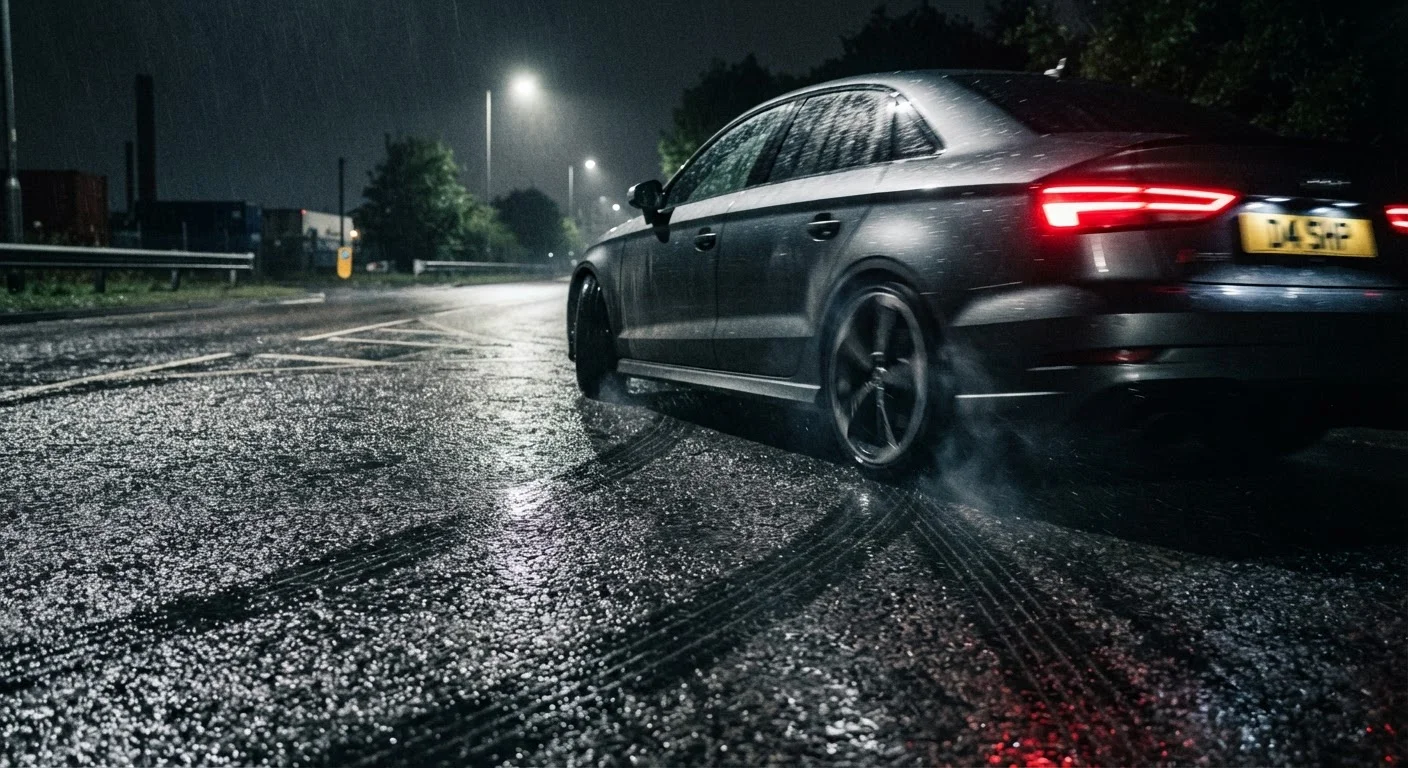
A skid occurs when one or more of your tires lose their grip on the road surface, causing the car to move in a direction different from where you're steering. Grip depends on friction between tire rubber and pavement - when that friction drops below what the forces acting on the car demand, the vehicle slides. Most skids happen in fractions of a second, well before a driver consciously reacts.
Engineers describe tire grip using a 'friction circle' - a model showing that lateral (cornering) and longitudinal (braking/accelerating) forces compete for the same limited traction budget. Exceeding that budget in any direction triggers a slide.
Why Tires Lose Grip in the First Place
Every car maneuver - steering, braking, accelerating - depends entirely on friction at the four small contact patches where tires meet the road. Each patch is roughly the size of a hand. When the forces you're asking those patches to manage exceed the friction available, the tire slides instead of rolling.
Three factors govern available friction: tire condition, road surface, and vehicle speed. Worn tread channels less water away and reduces contact quality. Wet or contaminated surfaces lower the coefficient of friction - sometimes dramatically. And speed amplifies every force: doubling your speed quadruples the energy that braking or cornering must absorb.
This is why tyre condition matters so much beyond just avoiding a flat. A tire at the legal minimum tread depth behaves measurably differently from a new one in emergency braking situations.
~30%
Reduction in wet-road friction
Road safety research broadly estimates that wet pavement reduces available tire friction by approximately 30-50% compared to dry conditions.
2012
ESC mandated on all new US passenger cars
The National Highway Traffic Safety Administration (NHTSA) required Electronic Stability Control as standard equipment on all new light vehicles from model year 2012.
4x
Kinetic energy increase when speed doubles
Basic physics (KE = ½mv²): doubling a vehicle's speed quadruples the kinetic energy that braking systems and tires must manage.
Understeer vs. Oversteer: Two Very Different Problems
Understeer is what most drivers encounter first. You enter a corner, the front of the car fails to follow your steering input, and the vehicle pushes straight or wide. You're pointing the wheel where you want to go but the car isn't responding. This is common in front-wheel-drive (FWD) vehicles and tends to feel like the car is being stubborn rather than dramatic.
Oversteer is the opposite - the rear tires break loose, causing the back of the car to swing outward. The vehicle rotates more than intended. Left uncorrected, this rotation continues until the car spins. Oversteer feels more alarming and is more common in rear-wheel-drive (RWD) vehicles, especially when too much throttle is applied mid-corner.
The corrections are different. For understeer: ease off the accelerator, reduce steering angle slightly to let the tires regain grip, and don't brake hard. For oversteer: steer smoothly in the direction the rear is sliding (countersteering), ease off the throttle, and avoid sudden braking. In both cases, the instinct to brake hard is usually counterproductive - it shifts weight forward abruptly and can deepen the slide.
Slow In, Fast Out - The Golden Rule
The single most effective way to avoid a loss-of-control situation is to reduce speed before entering a corner, not during it. Mid-corner braking shifts weight forward, unloads the rear tires, and can trigger oversteer. Entering at a manageable speed leaves you a margin of grip to steer with if conditions change.
What Electronic Stability Control Actually Does
Since 2012, Electronic Stability Control (ESC) has been federally mandated on all new passenger vehicles sold in the United States. ESC monitors individual wheel speeds and vehicle rotation dozens of times per second. When it detects that the car is sliding - rotating differently from where the driver is steering - it intervenes automatically: cutting engine torque and selectively applying brake pressure to individual wheels to counteract the skid.
ESC's reaction time is measured in milliseconds, far faster than any human reflex. Studies by NHTSA have associated ESC with meaningful reductions in single-vehicle crashes, particularly rollovers. But ESC is not a substitute for speed management. It works within the limits of available tire friction - on black ice or at very high speeds, physics sets a ceiling that no system can raise.
If your dashboard shows the ESC warning light flashing while driving, that's the system working. A permanently illuminated ESC light means the system may be disabled or has a fault - worth having checked by a mechanic.
The Conditions That Make Skids Far More Likely
Understanding when your skid risk is elevated is more useful than trying to react faster in the moment. Several conditions consistently increase the likelihood of losing control:
- Wet roads - Water acts as a lubricant between rubber and pavement. Hydroplaning (where tires skim across a film of water) can cause complete, sudden loss of steering.
- Ice and snow - Friction drops to a fraction of dry-road levels. Even gentle braking or cornering can exceed available grip.
- Loose surfaces - Gravel, leaves, and sand all reduce friction unpredictably.
- Cold tires - Rubber that hasn't reached operating temperature provides less grip. The first few miles of a cold drive carry elevated risk.
- Speed entering a curve - The physics are unforgiving: entering a bend too fast means asking for more grip than the tires have.
For a detailed breakdown of adjusting technique in adverse weather, see how to adapt your driving in rain, fog, and ice.
It's also worth noting that skids rarely happen in isolation from behavioral patterns. Speeding and distraction are the upstream causes that put drivers in the situation where physics takes over.