

Key Takeaways
Why Adverse Weather Demands a Different Mindset
Most driving instruction happens in daylight under decent conditions. That creates a gap: when rain hits hard, fog rolls in, or overnight temperatures drop below freezing, many newer drivers find their usual habits stop working. The car behaves differently, visibility shrinks, and the margin for error gets much smaller.
Adverse weather doesn't require completely different skills - it requires the same skills applied more deliberately, with wider margins and earlier decisions. The core principle across rain, fog, and ice is the same: give yourself more time and more space than you think you need. Situational awareness becomes especially critical in these conditions - see our guide to thinking further ahead for the foundational habits that make bad-weather driving less reactive.
Driving in Rain: Traction, Visibility, and Hydroplaning
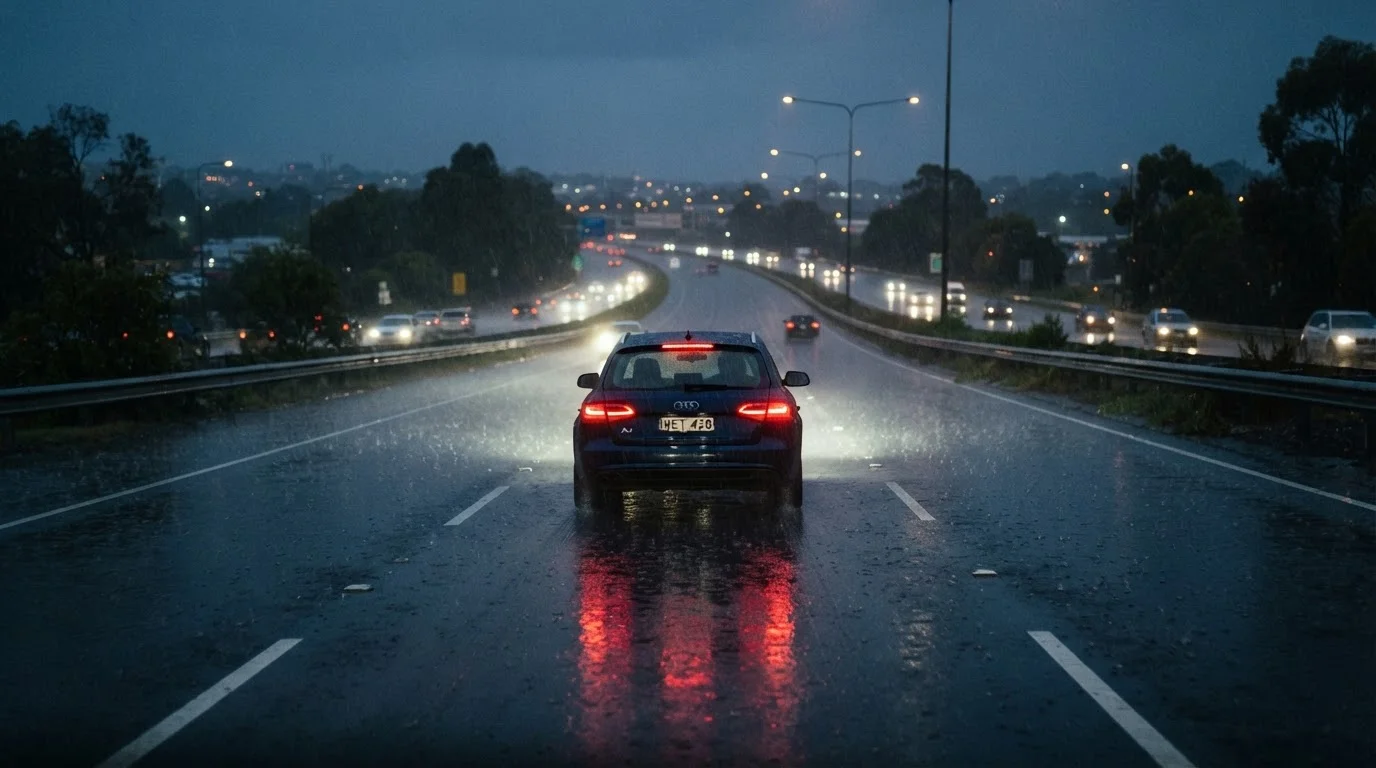
Rain affects your vehicle in two primary ways: it reduces road traction and cuts visibility. Both require active adjustment, not just passive caution.
Drop your speed by at least 5-10 mph below the posted limit in moderate to heavy rain.
Speed limits are set for dry, clear conditions. Wet roads reduce tire grip significantly, and your braking distance increases. Slowing down gives you more time to react to hazards you may see later than usual.
Turn on your headlights whenever your wipers are running, regardless of ambient light.
Headlights in rain aren't just for seeing - they help other drivers and pedestrians see you. Many states legally require headlights when wipers are in use; it's also a practical safety habit that costs nothing.
Double your following distance from the standard 3-second rule to at least 6 seconds in wet conditions.
Wet roads can increase your stopping distance by 50% or more compared to dry pavement. A larger gap to the vehicle ahead gives you room to brake gradually rather than abruptly, reducing skid risk.
Brake early and gently on ice - apply steady, even pressure rather than jabbing the pedal.
Sudden, hard braking on ice causes wheels to lock or - in ABS-equipped vehicles - rapid pulsing that still extends stopping distance. Gradual pressure keeps tires rolling and in better contact with the surface.
Steer smoothly and avoid overcorrecting if you begin to slide.
Jerky or panicked steering inputs on slippery surfaces can cause a skid to worsen or transition from one type to another. Smooth, controlled movements give tires the best chance to regain grip.
One specific hazard worth knowing: hydroplaning occurs when a thin film of water builds up between your tires and the road surface faster than the tread can channel it away. The result is a sudden loss of steering control. If it happens, ease off the accelerator gently and avoid abrupt steering or braking inputs - let the tires regain contact with the road. Worn tires dramatically increase hydroplaning risk, which is one reason tire condition matters year-round. For a full picture of how skids and slides work mechanically, see what's actually happening when your car loses control.
Rain Intensity Changes the Equation
Light drizzle and heavy downpour aren't the same driving challenge. In a light drizzle, the initial mixing of rain with road oils can actually make surfaces more slippery than in sustained heavy rain, which eventually washes oil away. Be especially alert in the first 10-15 minutes of rainfall. If rain is heavy enough to reduce visibility significantly, treat it more like a fog scenario and consider pulling over safely until conditions improve.
Fog: When Visibility Drops Below a Quarter Mile
Fog is one of the most disorienting driving conditions because it distorts depth perception and hides hazards until they're close. Standard high-beam headlights make fog worse - the light scatters back at you. Use low beams (or dedicated fog lights if your vehicle has them) and slow down significantly.
In dense fog, your speed should match your actual stopping distance within visible range - not what feels normal. If visibility drops severely, pulling off the road entirely at a rest stop or parking lot - with hazard lights on - is a legitimate and sometimes correct choice. Visibility conditions that impair other weather types are addressed in our article on how darkness changes your risk profile, which shares some overlap with fog in terms of sight-line management.
Ice and Snow: The Conditions That Punish Overconfidence Most
Ice is the harshest of the three conditions because grip reduction can be dramatic and nearly invisible. Black ice - a thin, transparent glaze on pavement - gives no visual warning. Bridge decks and overpasses freeze first because cold air circulates beneath them as well as above.
On icy roads, braking distances can increase by five to ten times compared to dry pavement. This isn't a small adjustment - it's a fundamentally different road environment. Accelerate slowly, brake early and gently, and steer with smooth, deliberate inputs. ABS (anti-lock braking system) helps prevent wheel lockup but doesn't shorten your stopping distance on ice; it helps you maintain steering control while slowing down.
17%
Of all US vehicle crashes occur in adverse weather
According to the Federal Highway Administration, over 5,000 people are killed annually in weather-related crashes in the United States.
5-10×
Braking distance increase on ice vs. dry road
Transport safety research consistently shows that ice can multiply stopping distances dramatically compared to dry pavement at the same speed.
75%
Of weather-related crashes happen on wet pavement
The Federal Highway Administration attributes the majority of weather-related crash fatalities to wet roads rather than snow or ice alone.
Before winter driving conditions arrive, a seasonal vehicle check is worth doing - tires, battery, wipers, and lights are all weather-sensitive. Our seasonal car checks guide covers what to inspect before conditions change.
“The road doesn't care how experienced you think you are. Ice, in particular, is a great equalizer - the physics work the same on everyone's tires.”
— Cars & Driving Editorial Team, Automotive safety writers covering driving skills for new US drivers
When to Delay or Abandon the Drive
One habit that separates experienced drivers from newer ones isn't a braking technique or a steering trick - it's knowing when to not go. If conditions are severe and the trip isn't essential, delaying or canceling is a valid, responsible choice. Ice storms, near-zero visibility fog, and heavy overnight snow accumulations are conditions that shut down even experienced drivers.
If you're already on the road and conditions deteriorate, find a safe place to stop - a gas station, a parking lot, or a rest area - and wait it out. Leaving your hazard lights on while parked on the shoulder of a highway is dangerous; move off the road entirely where possible.
Fatigue compounds all of these risks. Driving tired in bad weather is especially dangerous because your reaction time degrades precisely when you need it most. See our piece on when tiredness becomes a safety issue for more on recognizing the warning signs.