

Key Takeaways
Night Driving Risk Profile
A driver's night driving risk profile describes how their exposure to collision hazards changes after dark. Reduced visibility, slower hazard detection, and increased fatigue combine to make nighttime driving statistically more dangerous than daytime driving - even on familiar roads at legal speeds.
The NHTSA estimates that roughly half of all traffic fatalities occur at night, despite nighttime accounting for far less than half of total vehicle miles traveled.
Why Darkness Fundamentally Changes the Driving Environment
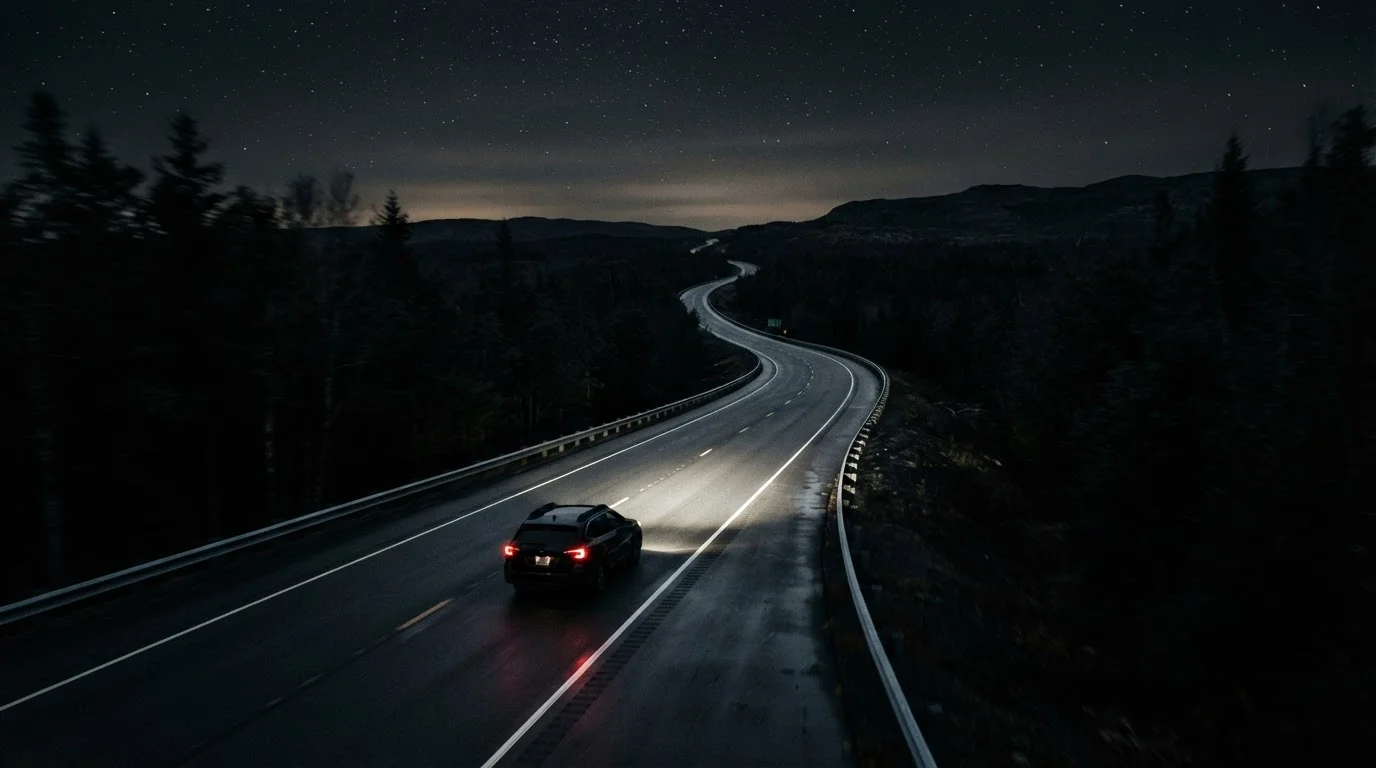
Daylight gives drivers a broad, continuously updated picture of the road ahead - lane markings, pedestrians, intersections, and hazards register automatically. After dark, that information pipeline narrows sharply. Your headlights provide a limited cone of light, and everything outside it is effectively invisible until you're dangerously close.
According to data from the National Highway Traffic Safety Administration (NHTSA), roughly 50% of traffic fatalities occur at night, even though nighttime accounts for a much smaller share of total miles driven. That gap reveals something important: darkness doesn't just inconvenience drivers, it structurally changes the risk equation.
Three core factors drive this shift: visibility reduction, fatigue and circadian biology, and the changed composition of traffic after dark - including a higher proportion of impaired drivers on the road during late-night hours.
~50%
Of fatal crashes occur at night
Despite nighttime accounting for a fraction of total miles driven, roughly half of all U.S. traffic fatalities happen after dark, according to NHTSA data.
160-200 ft
Typical low-beam headlight range
Standard low beams illuminate approximately 160-200 feet ahead - potentially less than the stopping distance needed at highway speeds.
3-4 sec
Recommended following distance at night
Safety guidelines suggest extending the standard two-second following distance to at least three to four seconds after dark to compensate for reduced visibility.
The Headlight Problem: Seeing Less Than You Think
Most drivers assume their headlights give them adequate warning time. In practice, standard low-beam headlights illuminate roughly 160-200 feet ahead. At 60 mph, the total stopping distance - reaction time plus braking - can easily exceed that range. This is known as overdriving your headlights: traveling fast enough that you couldn't stop in time for a hazard appearing at the edge of your visibility.
This problem is compounded by a dirty or foggy windshield, which scatters oncoming light and creates glare that further reduces your effective field of view. A quick pre-drive check that includes your windshield and headlight condition takes under two minutes and directly addresses this risk.
High beams help significantly on unlit roads - they can illuminate 350-500 feet ahead - but must be switched off for oncoming traffic. Properly aimed headlights matter too: headlights that have drifted downward or are misaligned reduce your effective range without any obvious warning sign inside the cabin.
Fatigue, Biology, and the Late-Night Danger Zone
The human body runs on a circadian rhythm that promotes drowsiness in two windows: roughly 2-6 a.m. and, to a lesser degree, early-to-mid afternoon. Driving during those hours - even after a full night's sleep - increases cognitive impairment and slows reaction time. For drivers who are also sleep-deprived, the effect compounds sharply.
What makes fatigue particularly dangerous is that drivers frequently underestimate it. Microsleeps - involuntary sleep episodes lasting 1-4 seconds - can occur without the driver noticing. At 65 mph, a two-second microsleep means approximately 190 feet of travel with no driver input whatsoever.
Understanding the warning signs of driving fatigue - lane drift, difficulty focusing, missing exits - is a core night driving skill. The clearest safety rule: if you're struggling to stay alert, pulling over is the correct decision, not pushing through.
The 'Pull Over' Rule for Fatigue
If you notice yourself drifting between lanes, missing road signs, or struggling to remember the last few miles, treat it as a hard stop signal. Find a safe, well-lit location to pull over. Even a 20-minute rest can reduce acute drowsiness meaningfully - and arriving late is always preferable to not arriving safely.
Adapting Your Approach After Dark
Adjusting to nighttime conditions doesn't require special skills - it requires deliberate habit changes that compensate for what darkness takes away.
- Reduce speed on unlit roads so your stopping distance stays within your headlight range.
- Increase following distance - the two-second rule used in daylight should extend to three or four seconds at night.
- Scan more actively for pedestrians and cyclists, particularly at road edges where streetlighting is weakest. Developing stronger situational awareness is especially valuable after dark.
- Keep your windshield clean inside and out - interior film causes significant glare from oncoming headlights.
- Avoid driving during peak fatigue windows when possible, particularly 2-4 a.m.
Night driving also intersects with poor weather conditions - wet roads at night reflect headlight glare and reduce contrast, making lane markings harder to read. That combination is among the most demanding environments a driver will encounter.
New drivers face additional challenges at night because hazard recognition relies partly on pattern recognition built through experience. Understanding why crash risk is elevated for new drivers helps put these night-specific factors in context and reinforces why building deliberate habits early matters.