

Key Takeaways
What Situational Awareness Actually Means While Driving
Situational awareness is the ability to perceive what's happening around you, understand what it means, and anticipate what's likely to happen next. In driving terms, it's the difference between a driver who reacts to the car braking ahead and one who already had their foot hovering because they read the situation two seconds earlier.
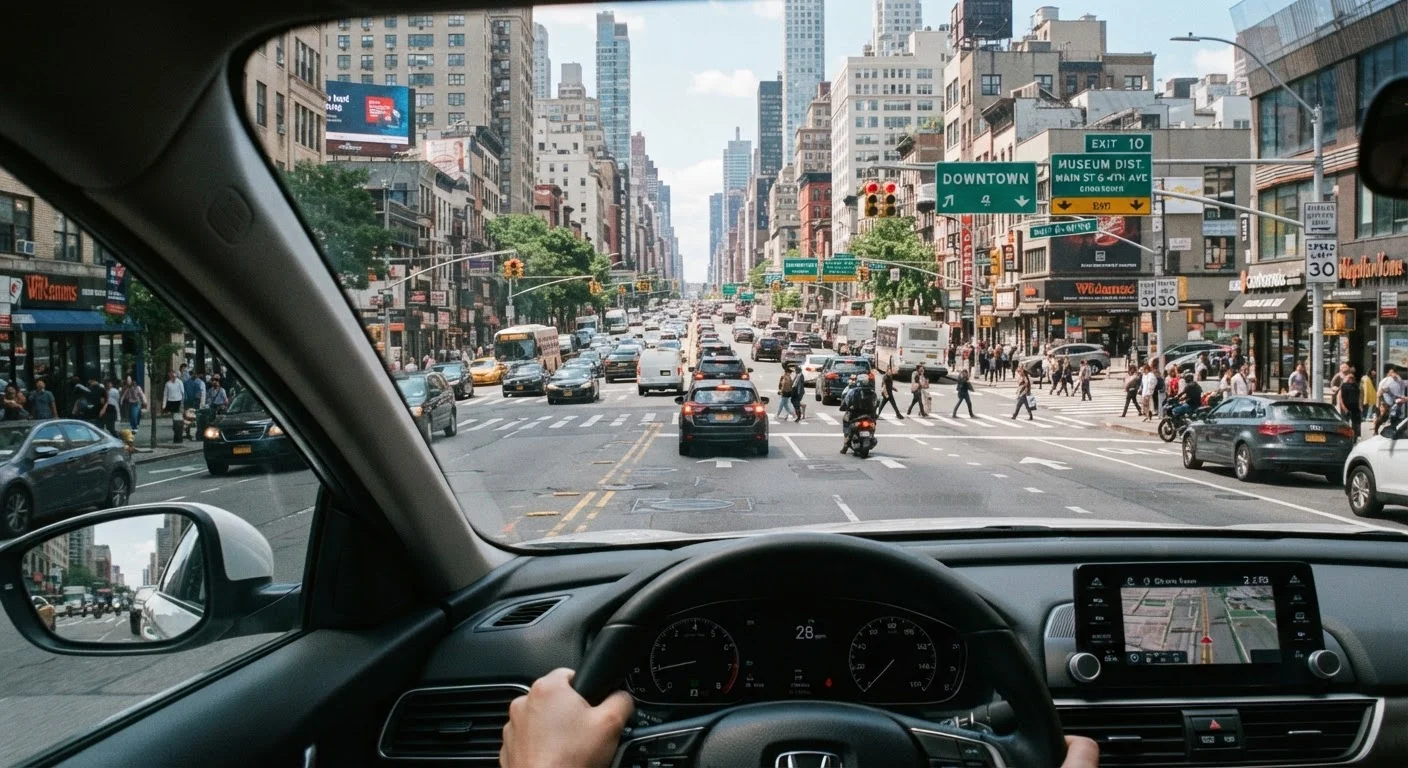
New drivers tend to focus almost entirely on the vehicle immediately in front of them. This is natural - it feels like the most immediate threat. But fixating on one reference point is exactly what limits reaction time and increases stress. The goal isn't to process more information frantically; it's to look further ahead so that nothing ahead of you is a surprise.
This kind of structured attention is what experienced drivers have built over thousands of hours. It can also be developed intentionally, even early in your driving life.
The Science of the Scan: Where Experienced Drivers Look
Research into driver eye movement consistently shows that skilled drivers distribute their gaze much more broadly than novices. Rather than locking onto one vehicle, they continuously scan: the road far ahead, mirrors, blind spots, and peripheral zones - cycling through all of them at regular intervals.
A practical framework used in driver training is the IPDE process: Identify, Predict, Decide, Execute. You first identify potential hazards, then predict how they might develop, then decide on a response, then act. The further ahead you identify something, the more time you have for the other three steps - and the calmer each one feels.
During your first few months driving, try to always keep at least a three-second gap in normal traffic - not just two. The extra second buys you the forward sight lines that make anticipation possible.
New drivers are still allocating significant mental resources to vehicle control itself, leaving less cognitive capacity for hazard scanning. Extra space compensates for this until scanning becomes more automatic.
When stopped at a red light, look down the road in the direction you're traveling and note what traffic is doing at least two blocks ahead - before the light turns green.
Stops are an underused opportunity to gather information. Knowing what the road looks like 400 yards ahead means you start moving with a plan rather than reacting from scratch.
Mirror checks are part of this scan. Knowing what's behind and beside you isn't just about lane changes - it informs every braking decision. If you know a car is close behind you, a gradual, early brake is safer than a sudden stop. That knowledge only comes from checking mirrors regularly, not just when you're about to manoeuvre.
For more on how road markings and signs feed into this wider picture, see Reading the Road: Signs, Markings, and What They're Really Telling You.
The 12-Second Rule and Following Distance
A widely taught guideline is to scan at least 12 seconds ahead - roughly the distance your car will travel in 12 seconds at your current speed. At 60 mph, that's about 1,050 feet, or nearly a fifth of a mile. This sounds like a lot, but on a clear road it's simply the next visible junction, bend, or cluster of vehicles.
Following distance and forward vision are inseparable. If you're tailgating, your visual horizon collapses to the back of the car in front. You lose the ability to see traffic slowing ahead of them, debris in the road, or a pedestrian stepping off the curb. The standard two-second gap (or four seconds in wet conditions) isn't just about stopping distance - it's about giving yourself the sight lines you need to think ahead.
Tailgating Destroys Your Visual Field
Following too closely doesn't just reduce stopping distance - it collapses your view of the road ahead entirely. When the car in front fills your windshield, you lose the ability to see brake light patterns, hazards, or slowing traffic further down the road. In wet conditions, NHTSA data indicates stopping distances roughly double. Maintain at minimum a four-second gap in rain, and more in lower-visibility conditions.
On faster roads like highways and interstates, the 12-second scan becomes even more critical. See Motorway Driving for the First Time for how these principles apply at higher speeds.
Reading Traffic Flow, Not Just Individual Cars
Individual vehicles are the pixels; traffic flow is the picture. Experienced drivers read flow - they notice when a line of brake lights starts three vehicles ahead, when a lane is moving faster than the ones beside it, or when a merge zone is causing a ripple effect half a mile back.
Practical signals to watch for include:
- Brake light chains: If vehicles four or five cars ahead are stopping, you have more time than the driver behind you who's watching only you.
- Pedestrian behavior: Someone standing at a crosswalk glancing at their phone may step out without looking. React to intent, not just action.
- Trucks and buses: Large vehicles block your sight lines significantly. Increase following distance to restore your view down the road.
- Merging lanes: Anticipate where traffic will compress and adjust your position early rather than reacting at the merge point.
Roundabouts concentrate many of these flow-reading demands in one spot. Roundabouts, Priority Rules, and the Situations That Trip Drivers Up covers those scenarios in detail.
Common Awareness Gaps New Drivers Have
Understanding where novice attention typically breaks down helps you address those gaps directly:
- Tunnel vision at junctions
- Focusing so hard on traffic from one direction that you fail to check the other, or miss a cyclist approaching from the sidewalk.
- Over-reliance on the car in front
- Using the vehicle ahead as your sole navigation and braking cue, rather than forming independent judgments about the road.
- Under-use of mirrors between manoeuvres
- Checking mirrors only before lane changes rather than as an ongoing, rhythmic habit.
- Ignoring peripheral movement
- Not registering that something is happening to the side until it enters your lane - at which point reaction time is already compressed.
Many of these gaps close with deliberate practice. Night Driving: How Darkness Changes Your Risk Profile illustrates how these weaknesses are amplified after dark, when visual input is already reduced.
How to Deliberately Build Better Awareness
Situational awareness improves with structured practice, not just more hours behind the wheel. A few approaches that actually work:
- Narrate the road out loud - describe what you see as you drive: "Car merging left, gap closing, bus stop ahead, cyclist on the shoulder." This forces deliberate attention rather than passive watching.
- Pick a target ahead - identify a landmark or vehicle 12+ seconds away and track your approach to it, noticing everything in between.
- Set a mirror routine - check each mirror every 5-8 seconds as a habit, not only when prompted by a situation.
- Eliminate in-car distractions first - awareness is a cognitive resource. Music at high volume, phone notifications, or heated conversations consume bandwidth that should go to the road.
- Review near-misses mentally - when something surprises you, ask: where in the scan did I miss the early signal? This turns incidents into learning rather than just relief.
Start each journey right with a quick pre-drive safety routine - being physically prepared to drive supports the mental focus situational awareness demands.
This article provides general driving education only. Always follow the rules and regulations applicable in your state or jurisdiction, and consider working with a qualified driving instructor to develop specific skills.