

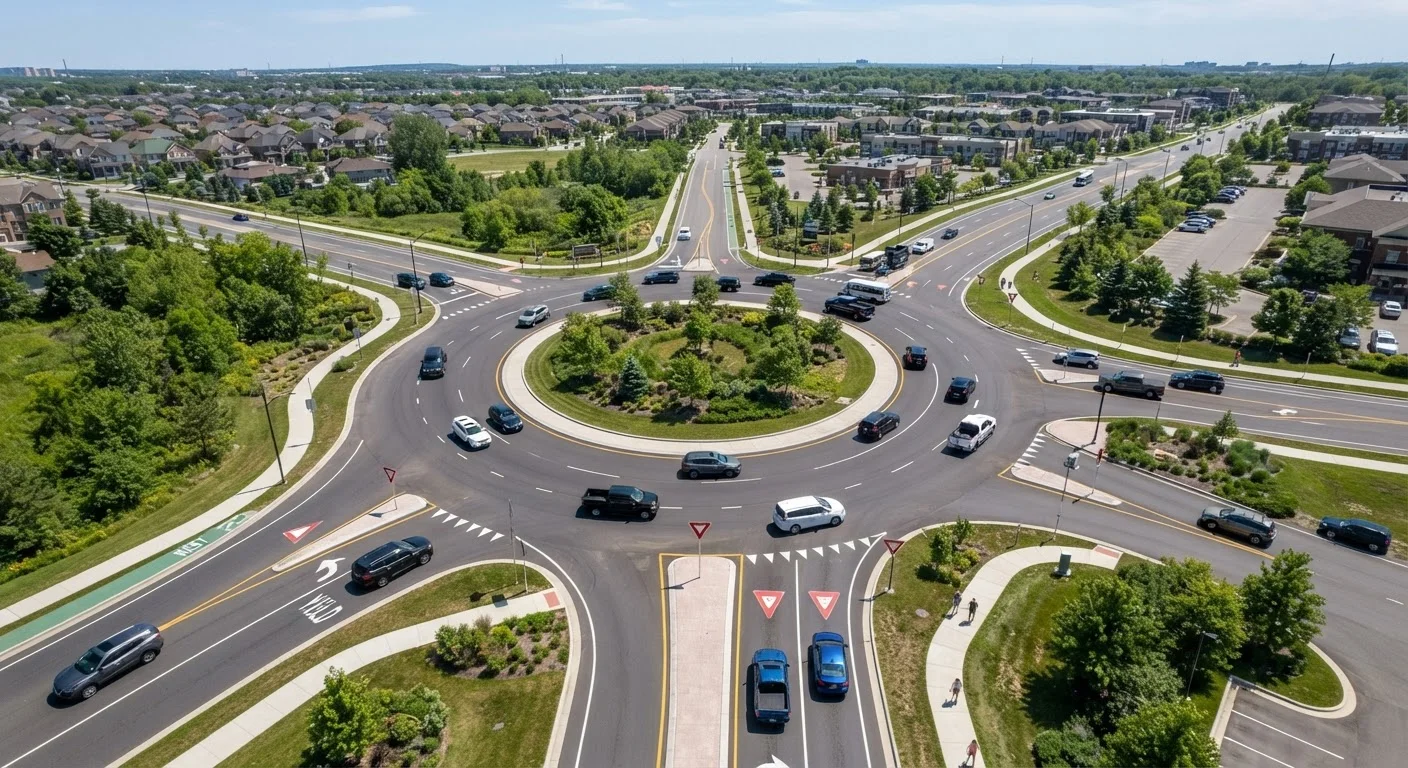
The One Rule That Governs Every Roundabout
In the United States, roundabout priority is straightforward: vehicles already inside the roundabout have the right of way. Entering drivers must yield at the dashed white yield line, wait for a safe gap, then merge into the circulating lane. This single rule replaces the four-way stop logic that many new drivers default to - and confusing the two is the root cause of most roundabout hesitation and collisions.
Roundabouts circulate counterclockwise in the US. Entering from the right-hand approach, you travel counterclockwise around the central island until you reach your exit. Unlike a traffic signal, there is no protected turn - you read the traffic and move when it is safe.
Speed matters enormously here. Most single-lane roundabouts are designed for entry speeds between 15 and 25 mph. Approaching too fast compresses your reaction time and makes it harder to judge gaps accurately. Slowing early - not slamming the brakes at the yield line - gives you time to assess the circulating flow. For more on reading road markings that guide your approach, see our guide to road signs and markings.
Lane Choice, Signalling, and Multi-Lane Roundabouts
Single-lane roundabouts are relatively forgiving. Multi-lane roundabouts are where drivers - including experienced ones - consistently make errors.
Choosing Your Lane Before You Enter
Lane selection must happen before you reach the yield line, not inside the roundabout. A common rule of thumb used in US driving education:
- Right lane: Use for turning right or going straight (first or second exit).
- Left lane: Use for going straight on a four-exit roundabout or turning left (exits beyond the halfway point).
Always check posted directional signs - layouts vary, and some roundabouts use dedicated exit-only lanes that override general guidance.
Signalling Correctly
Signalling tells other drivers and pedestrians what you intend to do. Standard US practice:
- Signal right when taking the first exit.
- No signal (or signal right as you pass the exit before yours) when going straight.
- Signal left on entry when taking a left-turn exit; signal right as you pass the exit before your intended one.
If you're unsure of the local convention, at minimum signal right before your exit - it alerts pedestrians on the crosswalk ahead that you are leaving the roundabout.
Yield line
The dashed white line at the roundabout entry where drivers must pause and give way to circulating traffic before entering. It is not a stop line - you only stop if traffic makes entry unsafe.
Circulating lane
The road space inside the roundabout where vehicles travel counterclockwise around the central island. Vehicles in this lane have priority over those entering.
Central island
The raised or marked area in the middle of a roundabout that vehicles travel around. It physically guides traffic in the correct direction.
Splitter island
A raised or painted triangular area on the approach to a roundabout that separates entering and exiting traffic and helps channelise vehicles toward the yield line.
Approach leg
One of the roads feeding into a roundabout. Each approach leg has its own yield line and may have one or more entry lanes depending on the roundabout's size.
Exit leg
The road leaving the roundabout toward a particular destination. Pedestrian crosswalks are typically located a short distance along each exit leg.
Staying in Your Lane While Circulating
In a multi-lane roundabout, lane discipline inside the circle is as important as entry lane choice. Drifting outward from an inside lane is one of the most frequent causes of side-impact collisions at roundabouts. Keep your steering smooth and consistent, and resist the urge to rush into a gap in the outer lane. Better situational awareness inside roundabouts comes with practice - thinking further ahead than the car in front explains how to develop that skill more broadly.
The Scenarios That Catch Drivers Out
Even drivers who understand the basics get tripped up in specific situations. Here are the most common:
Stopping Inside the Roundabout
Once you have entered and are circulating, you generally should not stop unless an emergency requires it. Stopping mid-circle confuses drivers behind you and disrupts the flow the roundabout is designed to maintain. If you miss your exit, continue around and take it on the next pass - do not reverse.
Yielding to Pedestrians and Cyclists
Pedestrian crosswalks are typically located on the approach and exit legs, not within the circulating roadway. You must yield to pedestrians on the crosswalk of the exit leg you are leaving by. Cyclists may legally circulate with traffic in many states; treat them as you would another vehicle. Check your state's specific rules, as bicycle handling varies.
Trucks and Oversize Vehicles
Large vehicles - trucks, buses, emergency vehicles - may need to use both lanes or cross lane lines to navigate a roundabout safely. When you see an oversize vehicle approaching or inside, give it extra space, even if that means waiting longer at the yield line than you otherwise would.
Emergency Vehicles
If an emergency vehicle with lights and sirens approaches while you are in the roundabout, exit the roundabout first, then pull to the right and stop. Do not stop inside the circle - this blocks other drivers from clearing the path.
Understanding these edge cases connects directly to broader safe driving habits. Abrupt braking and erratic lane changes inside roundabouts mirror the same risky behaviours covered in common crash-causing habits.