

| Sign shape for stop | Octagon (8 sides) (MUTCD (Manual on Uniform Traffic Control Devices)) |
| Sign shape for yield | Downward-pointing triangle (MUTCD) |
| Warning sign color | Yellow (permanent), Orange (temporary/construction) (MUTCD) |
| Double solid yellow line | No passing permitted by either direction (MUTCD) |
| Flashing red signal | Treat as a stop sign - full stop required (MUTCD) |
| Flashing yellow signal | Slow down and proceed with caution (MUTCD) |
The Three Sign Categories Every Driver Should Know Cold
US road signs are organized into three functional categories, each with a distinct color-and-shape logic. Once you recognize the system, signs become far easier to read at speed.
| Sign shape for stop | Octagon (8 sides) (MUTCD (Manual on Uniform Traffic Control Devices)) |
| Sign shape for yield | Downward-pointing triangle (MUTCD) |
| Warning sign color | Yellow (permanent), Orange (temporary/construction) (MUTCD) |
| Double solid yellow line | No passing permitted by either direction (MUTCD) |
| Flashing red signal | Treat as a stop sign - full stop required (MUTCD) |
| Flashing yellow signal | Slow down and proceed with caution (MUTCD) |
Regulatory Signs (Red, White, and Black)
These signs state the law. A stop sign (red octagon) requires a complete stop - wheels fully stopped - before the line or edge of the intersection, every time, even if the road appears clear. A yield sign (red and white triangle) means slow down and give right-of-way to traffic already in the intersection or lane; stop only if necessary. Speed limit signs are also regulatory - the number shown is a legal maximum under ideal conditions, not a target.
Warning Signs (Yellow or Orange Diamond)
Warning signs alert you to upcoming hazards: sharp curves, merging lanes, pedestrian crossings, or school zones. The key habit: treat every warning sign as a reason to reduce speed before you reach the hazard, not after. Orange versions of the same shape indicate temporary conditions - construction zones typically carry doubled fines for moving violations.
Guide Signs (Green, Blue, and Brown)
Green signs direct highway and street navigation. Blue signs point to traveler services (gas, food, lodging). Brown signs mark recreational areas or points of interest. These signs rarely carry a legal obligation, but misreading a freeway exit sign is one of the most common causes of abrupt, dangerous lane changes - so scan ahead and plan your position early.
Lane Markings: What the Lines Are Actually Saying
Pavement markings operate on a simple logic that many new drivers never formally learn. Knowing it removes a lot of guesswork.
Regulatory sign
A sign that legally dictates driver behavior - such as speed limits, stop requirements, or turn restrictions. Violating a regulatory sign is a traffic offense.
Right-of-way
The legal or conventional priority one driver, cyclist, or pedestrian has to proceed before another. Misunderstanding right-of-way is a leading cause of intersection collisions.
Two-way left-turn lane
A center lane marked with yellow lines and bidirectional arrows that allows vehicles from either direction to make a left turn. It is not intended as a travel or passing lane.
HOV lane
A high-occupancy vehicle lane restricted to vehicles carrying a minimum number of occupants (typically two or three). Eligibility rules and enforcement hours vary by state.
Stop line
A solid white line painted across the lane at an intersection indicating exactly where a vehicle must stop. Drivers should stop before the line, not on it or past it.
Pavement markings
Lines, symbols, and words painted on the road surface to guide, warn, or regulate traffic. Yellow markings separate opposing traffic; white markings separate same-direction traffic.
Yellow Lines
Yellow markings divide opposing traffic. A solid double yellow line means neither side may cross. A single broken yellow line means passing is permitted when safe. A solid line on your side paired with a broken line on the other means only the side with the broken line may pass - check which side you're on before making any move.
White Lines
White markings divide same-direction traffic. Broken white lines separate lanes you may change between. Solid white lines - like the edge line at the road's shoulder or a lane adjacent to a turn-only lane - signal that changing is strongly discouraged or prohibited. A double solid white line (common near highway exits and HOV lanes) means do not cross.
Stop Lines, Crosswalks, and Arrows
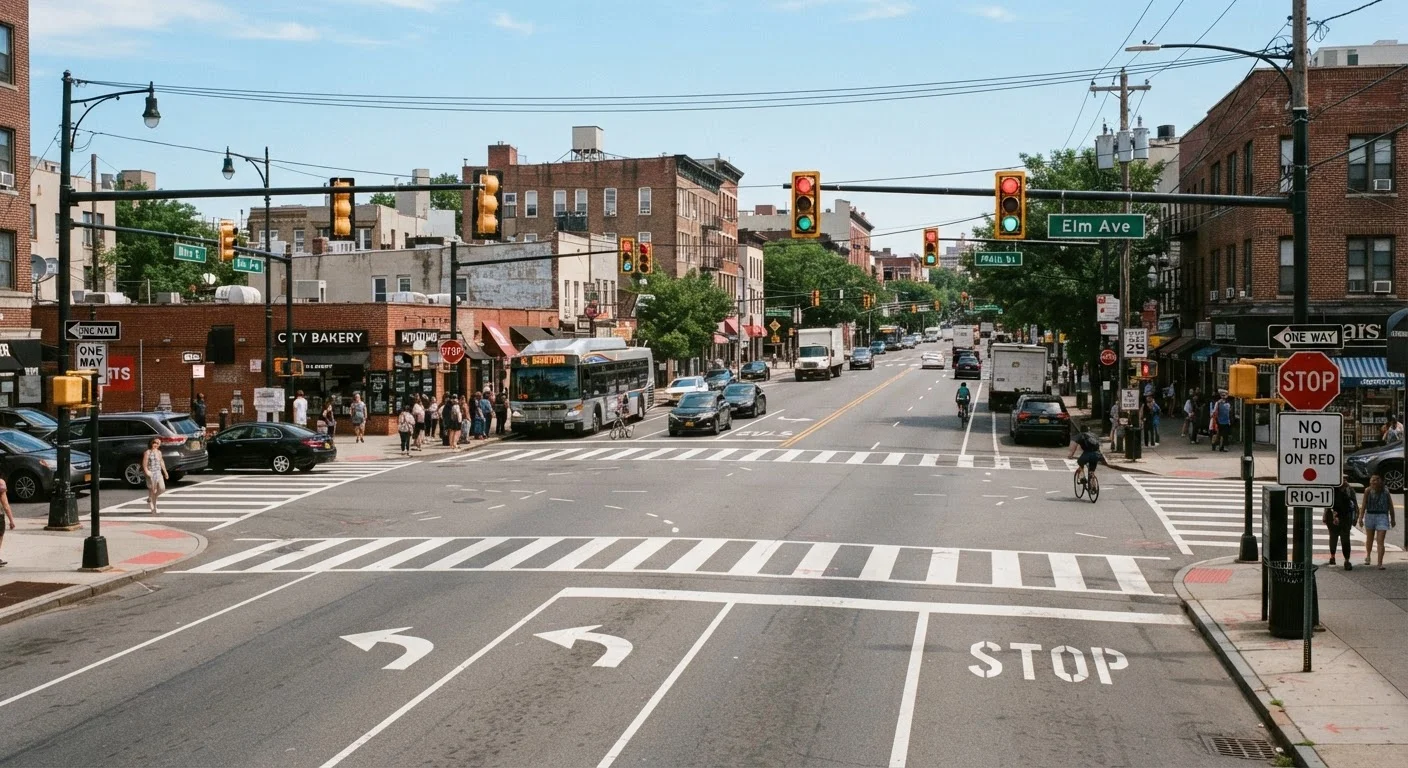
A wide white stop line marks exactly where your front bumper should stop. If a crosswalk exists, stop before the first line - pedestrians have the right-of-way once they step into a marked crossing in most US states. Painted lane arrows (straight, turn, or combined) are binding at intersections: if your lane shows only a left-turn arrow, you must turn left. Merge early rather than last-second.
For a broader view of staying alert while navigating complex road environments, see our guide to situational awareness.
Signals and Signs New Drivers Most Often Misread
Driver education covers the basics, but a handful of situations consistently trip up newer drivers in real-world conditions.
When the Traffic Signal Is Completely Dark
A signal that is entirely blacked out - whether from a power outage or equipment failure - should be treated as a four-way stop. All drivers must stop and take turns proceeding. This rule applies in all 50 states, but driver awareness of it is inconsistent. Slow down well before the intersection and be prepared for other drivers who may not stop.
Flashing Signals
A flashing red light functions exactly like a stop sign - full stop required. A flashing yellow means slow down and proceed with caution; no stop is required unless crossing traffic has the right-of-way. Flashing signals often appear at lower-traffic intersections or when the main signal system is malfunctioning - treat a dark or blacked-out signal as a four-way stop.
Shared Turn Lanes (Two-Way Left-Turn Lanes)
The center lane marked with double yellow lines and a left-turn arrow in both directions is a two-way left-turn lane - it lets vehicles from either direction turn left or complete a U-turn, but it is not a travel lane. Enter it only when you're close to your turn, not as a merge acceleration lane.
Pedestrian Signal Countdowns
The flashing orange hand with a countdown number tells pedestrians how many seconds remain to cross - it does not signal to drivers that the light is about to change. Don't accelerate based on the pedestrian countdown; wait for the green.
HOV and Managed Lane Signs
High-occupancy vehicle (HOV) lanes display the minimum passenger requirement and hours of enforcement. Entering an HOV lane outside your vehicle's eligibility can result in fines. Some states allow solo electric vehicle drivers in HOV lanes with a special permit - check your state's DMV for current rules rather than assuming.
Conditions change how signs and markings behave, too. Review our bad-weather driving guide to understand how rain, fog, and ice affect road visibility and stopping distance.
This article is for general educational purposes only. Always consult your state's official driver handbook and applicable traffic laws, which vary by jurisdiction.