

Key Takeaways
Our Verdict
No single fat type tells the whole story of a healthy diet. Unsaturated fats - especially the monounsaturated and omega-3 varieties - have the strongest evidence for heart and overall health support. Saturated fat warrants mindful moderation rather than complete elimination, and artificial trans fats are best avoided altogether. Understanding what's in your food is the first step toward making more informed choices.
| Best for | Recommended |
|---|---|
| Those prioritizing heart health and everyday cooking | Unsaturated fats (olive oil, avocado, nuts, fish) |
| Those navigating moderate intake of animal products | Saturated fat in limited, whole-food forms (dairy, lean meats) |
| Those wanting the clearest dietary risk reduction | Minimize or eliminate artificial trans fats entirely |
Why Fat Got a Bad Reputation - and Why That's Complicated
For decades, dietary fat was treated as the enemy of good health. Low-fat products flooded grocery shelves, and the advice to cut fat intake became almost universal. The problem? That guidance blurred an important distinction: fat is not one thing. It's a category that includes several structurally different molecules, each with its own behavior in the body.
Fat is a macronutrient your body genuinely needs. It supports cell membrane integrity, helps absorb fat-soluble vitamins (A, D, E, and K), cushions organs, and provides a concentrated source of energy. To understand how to eat fat well, you first need to understand the three main types. For a broader view of how fat fits alongside carbohydrates and protein, see our guide to macronutrients.
Saturated Fat: The Moderation Middle Ground
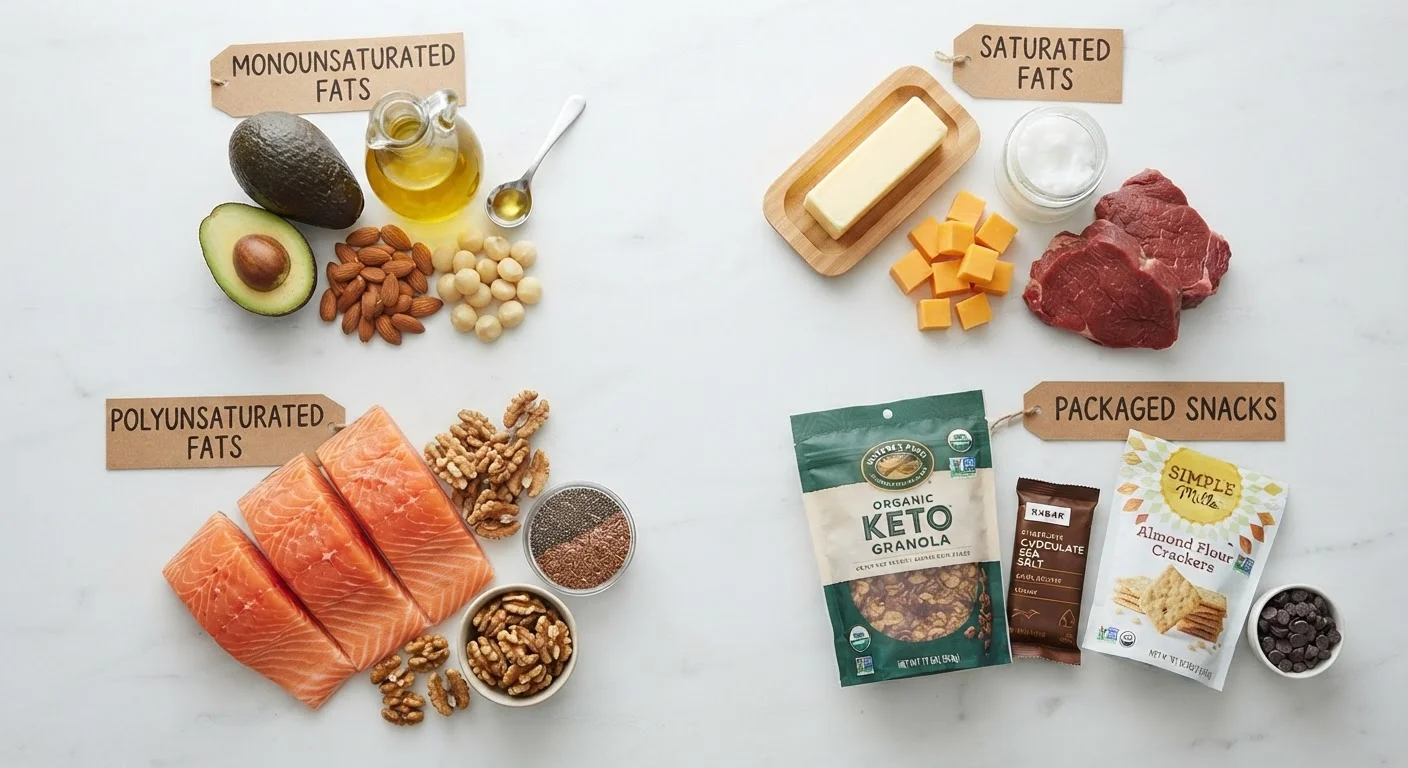
Saturated fats are named for their chemical structure: every carbon atom in the fatty acid chain is fully "saturated" with hydrogen atoms. This makes them solid at room temperature - think butter, coconut oil, or the white fat on a piece of meat.
Common food sources include red meat, full-fat dairy (cheese, butter, cream), and tropical oils like coconut and palm oil. Saturated fats are stable under heat, which is why they've long been used in cooking and food manufacturing.
Health-wise, the picture is nuanced. Long-standing dietary guidelines from organizations like the American Heart Association have linked high saturated fat intake to elevated LDL (low-density lipoprotein) cholesterol, a known risk factor for cardiovascular disease. More recent research has raised questions about whether all saturated fats behave identically or whether the food they come from changes the equation - but scientific consensus still supports limiting saturated fat intake rather than treating it as freely consumed.
A Simple Swap Worth Knowing
When cooking at lower to medium temperatures, swapping butter for olive oil is a straightforward way to shift from saturated to monounsaturated fat without dramatically changing the flavor of most dishes. For high-heat cooking, avocado oil - also high in MUFAs - is a stable option. Small, consistent swaps like these tend to be more sustainable than overhauling an entire diet at once.
Unsaturated Fat: The Broadly Supported Type
Unsaturated fats have one or more double bonds in their carbon chain, which creates a "kink" in the molecule and keeps them liquid at room temperature. They divide into two subcategories:
- Monounsaturated fats (MUFAs) have one double bond. Olive oil, avocados, and most nuts are rich sources. Research consistently associates MUFA-rich diets with improved cholesterol profiles and reduced cardiovascular risk.
- Polyunsaturated fats (PUFAs) have multiple double bonds and include two essential fatty acids your body cannot make on its own: omega-3s and omega-6s. Omega-3s - found in fatty fish (salmon, sardines, mackerel), walnuts, and flaxseed - are particularly well-studied for their role in reducing inflammation and supporting heart and brain health. Omega-6s are widespread in vegetable oils and processed foods; while necessary, the typical US diet already contains them in abundance.
Replacing saturated fats with unsaturated fats is one of the most consistently supported dietary shifts in nutrition research. Understanding where your food comes from matters too - see our piece on whole foods vs. processed foods for context.
Trans Fat: The One to Actively Avoid
Trans fats occur in two forms. Small amounts are found naturally in some dairy and meat products (conjugated linoleic acid, or CLA). The more concerning form - artificial trans fat - is created through a process called partial hydrogenation, where hydrogen is added to liquid vegetable oil to make it solid, shelf-stable, and resistant to spoilage.
Artificial trans fats were widely used in margarine, commercially fried foods, and packaged baked goods. Research strongly and consistently linked them to raised LDL cholesterol, lowered HDL ("good") cholesterol, and increased cardiovascular risk - a doubly damaging combination.
The U.S. Food and Drug Administration (FDA) determined that partially hydrogenated oils were no longer "generally recognized as safe" and effectively phased them out of the domestic food supply. However, trace amounts can legally appear in products containing less than 0.5 grams per serving, and some imported or shelf-stable products may still contain them. Checking ingredient lists for the phrase "partially hydrogenated oil" remains the most reliable way to identify them.
| Saturated Fat | Monounsaturated Fat | Polyunsaturated Fat | Trans Fat (Artificial) | |
|---|---|---|---|---|
| Physical state at room temperature | Solid | Liquid | Liquid | Solid or semi-solid |
| Common food sources | Butter, red meat, coconut oil | Olive oil, avocado, almonds | Salmon, walnuts, flaxseed | Partially hydrogenated oils, some fried foods |
| Effect on LDL cholesterol | May raise LDL | Neutral or lowers LDL | Generally lowers LDL | Raises LDL significantly |
| Effect on HDL cholesterol | Neutral or slight raise | May raise HDL | May raise HDL | Lowers HDL |
| Current dietary guidance | Limit intake | Include regularly | Include regularly | Avoid entirely |
| Essential to the body? | No (but present naturally in diet) | No (body can produce) | Yes (omega-3 and omega-6) | No |
This article is for general informational and educational purposes only and is not a substitute for professional medical or dietary advice. Consult a registered dietitian or qualified healthcare provider for guidance tailored to your individual health needs.