

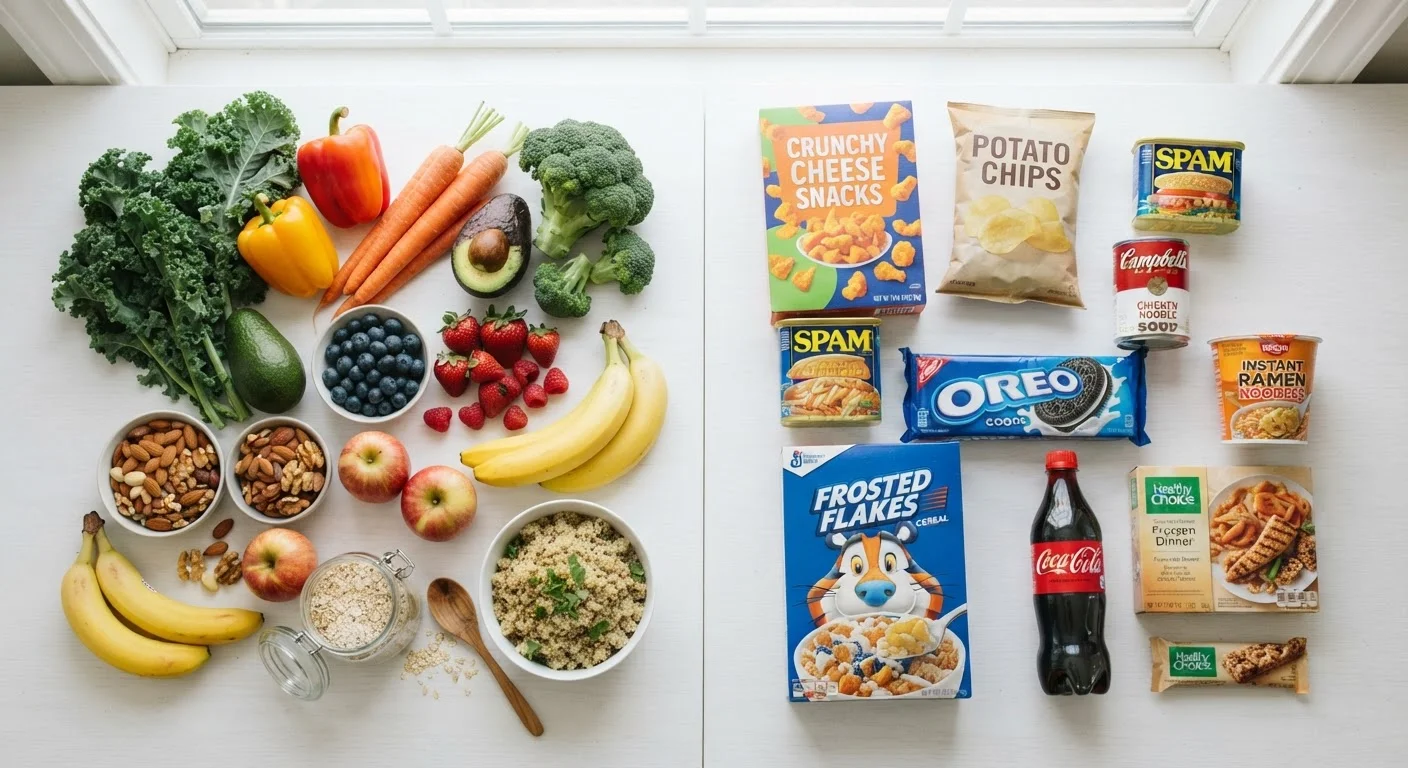
Key Takeaways
Option A
Whole Foods
The minimally altered, nutrient-dense foundation of a balanced diet.
Best for: Anyone looking to maximize nutrient density and reduce reliance on additives and refined ingredients.
Option B
Processed Foods
A wide-ranging category from minimally altered staples to heavily engineered products.
Best for: Understanding the spectrum of processing helps you identify which processed items fit into a generally healthy eating pattern.
If you want to build a nutrient-dense eating pattern from the ground up
Whole Foods
Whole foods provide fiber, micronutrients, and phytochemicals in their most intact form, making them a reliable foundation for any eating approach.
If convenience is a real constraint in your daily life
Processed Foods
Minimally processed options - like canned legumes, frozen vegetables, or plain yogurt - can fit well within a nutritious diet without sacrificing practicality.
If you're trying to reduce added sugar and sodium intake
Whole Foods
Whole and minimally processed foods typically contain little or no added salt, sugar, or artificial flavoring agents.
If you're new to nutrition and want a simple starting framework
Whole Foods
Prioritizing recognizable, single-ingredient foods is one of the easiest entry points for improving overall diet quality without needing to count nutrients.
Defining the Terms: What Does 'Processed' Actually Mean?
The word processed gets used as a blanket warning label, but it technically applies to almost everything people eat. Cooking a carrot processes it. Pasteurizing milk processes it. Freezing peas processes them. So the real question isn't whether a food has been processed - it's how much and to what end.
A useful research framework is the NOVA classification, developed by nutrition researchers at the University of São Paulo. NOVA groups foods into four categories based on the extent and purpose of processing:
- Group 1 - Unprocessed or minimally processed foods: Whole fruits, vegetables, plain meat, eggs, legumes, and unsalted nuts. These are as close to their natural state as practical.
- Group 2 - Processed culinary ingredients: Oils, flours, sugar, and salt - substances extracted from whole foods and used in cooking.
- Group 3 - Processed foods: Products made by combining Group 1 and Group 2 items, like canned tomatoes, cheese, or cured fish. The processing extends shelf life or enhances flavor but doesn't fundamentally change the food's identity.
- Group 4 - Ultra-processed foods: Industrial formulations containing substances rarely found in a home kitchen - emulsifiers, flavor enhancers, hydrogenated oils, artificial colorings, and sweeteners. Examples include packaged chips, sugary breakfast cereals, reconstituted meat products, and many soft drinks.
Understanding this spectrum is the first step toward reading your own diet more clearly. For a broader vocabulary around nutrition concepts, see our plain-language nutrition glossary.
How Whole and Ultra-Processed Foods Differ Nutritionally
The nutritional gap between a whole food and an ultra-processed product isn't just about one ingredient - it's structural. Whole foods arrive with their nutrients intact and in context: fiber that slows digestion, water that contributes to satiety, and micronutrients that work together in ways researchers are still studying.
| Criterion | Whole / Minimally Processed | Ultra-Processed |
|---|---|---|
| Fiber content | Naturally high; intact | Typically low; may be added back |
| Added sugar | Absent or negligible | Often significant |
| Sodium | Low; naturally occurring | Frequently high due to preservatives |
| Micronutrient density | High; vitamins and minerals intact | Often lower; lost in refining |
| Additives and emulsifiers | None or minimal | Common; extend shelf life or palatability |
| Satiety per calorie | Generally higher | Generally lower |
| Convenience | Variable; often requires prep | High; ready to eat or quick to prepare |
Ultra-processed foods are often engineered to be highly palatable - meaning they're calibrated for taste, texture, and smell in ways that can override normal fullness signals. Research published in peer-reviewed journals has linked high ultra-processed food intake to higher energy consumption and, in observational studies, elevated risks of certain chronic conditions. These are associations, not proven cause-and-effect - but the pattern is consistent enough that major nutrition bodies take it seriously.
Fiber is one of the clearest differentiators. Whole grains, legumes, fruits, and vegetables are naturally fiber-rich. Ultra-processed products are typically fiber-poor, even when fiber is added back in after processing. The type and structure of naturally occurring fiber appears to behave differently in the gut than isolated fiber additives, though research on this is ongoing.
Calorie counts alone won't tell you this story. Two foods with identical calorie totals can differ dramatically in how they affect satiety, blood sugar response, and nutrient intake. For a deeper look at this concept, see our article on why calories and nutrients aren't the same thing.
57%
Share of US calories from ultra-processed foods
A nationally representative dietary survey published in the BMJ estimated that ultra-processed foods account for roughly 57% of total energy intake among US adults.
~500
Extra calories consumed daily in ultra-processed diet
A controlled NIH clinical trial found participants eating an ultra-processed diet consumed approximately 500 more calories per day than when eating an unprocessed diet, despite similar food availability.
4x
Processing categories in the NOVA classification
The NOVA framework, widely used in nutrition research, groups all foods into four distinct levels of processing to help researchers study diet patterns more precisely.
Practical Ways to Shift the Balance
Eating more whole foods doesn't require an overnight overhaul. Small, consistent shifts tend to be more sustainable than rigid rules - and they don't require labeling every food as "good" or "bad." Here are some approaches grounded in general dietary guidance:
- Use the ingredient list as a quick scan: A shorter list with recognizable ingredients usually signals less processing. This isn't foolproof, but it's a practical starting point.
- Lean on minimally processed staples: Plain frozen vegetables, canned beans in water (with no added salt), plain oats, and unsalted nuts are convenient, affordable, and nutritionally solid.
- Swap rather than eliminate: Replace sweetened flavored yogurt with plain yogurt and add fruit yourself. Choose plain sparkling water over a flavored soft drink. These swaps reduce additives without major sacrifice.
- Cook more at home - even simply: Home-cooked meals using whole or minimally processed ingredients give you direct control over sodium, oil, and sugar content.
- Think about protein sources thoughtfully: Eggs, legumes, plain fish, and unseasoned poultry are whole-food protein sources. Highly processed meat products often come with significant added sodium and preservatives. Our guide to plant-based vs. animal protein covers this in more detail.
The goal isn't perfection - it's awareness. Understanding where your food sits on the processing spectrum gives you information to make choices that reflect your actual priorities and circumstances.
This article is for general informational and educational purposes only and is not a substitute for personalized medical or dietary advice. Consult a registered dietitian or qualified healthcare professional before making significant changes to your diet.