

Key Takeaways
Start here
What Are Micronutrients?
Next
Vitamins: Fat-Soluble vs. Water-Soluble
Then
Essential Minerals and What They Do
Understand the stakes
Why Deficiencies Matter
Apply it
Getting Micronutrients From Food
What Are Micronutrients?
When people talk about eating well, they usually mention calories, protein, or carbohydrates - the macronutrients that fuel your body in large amounts. But running quietly underneath all of that is a second category of essential nutrients: micronutrients. These are the vitamins and minerals your body needs in much smaller quantities, yet cannot produce on its own in sufficient amounts to stay healthy.
The "micro" in the name refers to quantity, not importance. Without adequate micronutrients, the biochemical machinery that converts food into energy, repairs cells, and coordinates immune responses simply cannot function properly. Think of macronutrients as the fuel and micronutrients as the engine components - both are non-negotiable.
For a plain-language foundation before diving deeper, see our nutrition glossary for definitions of key terms you'll encounter throughout this guide.
Micronutrients
Vitamins and minerals your body needs in small quantities to function - but cannot produce on its own in adequate amounts, so they must come from food.
Fat-soluble vitamins
Vitamins (A, D, E, K) that dissolve in fat, are stored in body tissue, and don't need to be consumed every day - but can build up to harmful levels if over-supplemented.
Water-soluble vitamins
Vitamins (C and all B vitamins) that dissolve in water, are not stored long-term, and need regular replenishment through daily food intake.
Trace minerals
Minerals the body needs only in very tiny amounts - such as iodine, zinc, and selenium - but that are still essential for normal biological function.
Dietary variety
Eating a wide range of different foods across categories like vegetables, fruits, grains, legumes, and proteins - the most practical way to cover all your micronutrient needs.
Bioavailability
How well your body can actually absorb and use a nutrient from a particular food or supplement - affected by cooking method, food combinations, and individual health factors.
Vitamins: Fat-Soluble vs. Water-Soluble
There are 13 vitamins considered essential for human health, and the most important structural distinction is how they behave in your body.
Fat-soluble vitamins - A, D, E, and K - dissolve in fat and are stored in your liver and fatty tissues. Because they accumulate, you don't need them every single day, but overconsumption through high-dose supplements can lead to toxicity over time.
- Vitamin A - supports vision, immune defense, and skin cell renewal. Found in liver, eggs, dairy, and as beta-carotene in orange and dark-green vegetables.
- Vitamin D - critical for calcium absorption and bone health; also plays a role in immune regulation. Synthesized by skin in sunlight; found in oily fish and fortified foods.
- Vitamin E - an antioxidant that protects cells from oxidative damage. Found in nuts, seeds, and vegetable oils.
- Vitamin K - essential for blood clotting and bone metabolism. Found in leafy greens and fermented foods.
Water-soluble vitamins - vitamin C and the eight B vitamins - dissolve in water and are not stored for long. Excesses are excreted in urine, which means they need regular replenishment through food.
- Vitamin C - supports immune function, collagen synthesis, and iron absorption. Found in citrus fruits, bell peppers, and strawberries.
- B vitamins (including B12, folate, B6, thiamin, and riboflavin) - collectively involved in energy metabolism, red blood cell production, and nervous system function. Whole grains, legumes, eggs, meat, and leafy greens are key sources.
Essential Minerals and What They Do
Minerals are inorganic elements drawn from soil and water and absorbed through the plants and animals we eat. They are typically grouped as macrominerals (needed in larger amounts) and trace minerals (needed in tiny amounts, but still essential).
| Mineral | Key Function | Food Sources |
|---|---|---|
| Calcium | Bone and tooth structure, muscle contraction, nerve signaling | Dairy, fortified plant milks, leafy greens, tofu |
| Iron | Oxygen transport in red blood cells | Red meat, lentils, spinach, fortified cereals |
| Magnesium | Muscle and nerve function, blood sugar regulation, protein synthesis | Nuts, seeds, whole grains, dark chocolate |
| Zinc | Immune response, wound healing, DNA synthesis | Shellfish, meat, legumes, pumpkin seeds |
| Potassium | Fluid balance, blood pressure regulation, muscle function | Bananas, potatoes, beans, avocado |
| Iodine | Thyroid hormone production, metabolic regulation | Iodized salt, seafood, dairy |
Pair Iron-Rich Plants With Vitamin C
Plant-based iron (called non-heme iron) is less readily absorbed than iron from meat. Adding a vitamin C source to the same meal - such as lemon juice over lentil soup or bell peppers in a bean stir-fry - significantly boosts absorption. This is one of the most practical food-pairing strategies in everyday nutrition.
Why Deficiencies Matter
Because micronutrients are needed in small amounts, deficiencies can develop slowly and without obvious early symptoms - which is part of what makes them easy to overlook. By the time signs appear, the shortfall may have been present for months.
Common consequences of specific deficiencies include:
- Iron deficiency: fatigue, poor concentration, and impaired immune response - the most prevalent nutritional deficiency worldwide.
- Vitamin D deficiency: weakened bones over time, and research suggests links to reduced immune function.
- Iodine deficiency: disrupted thyroid function, which affects metabolism and, in pregnancy, fetal brain development.
- Folate deficiency: particularly important during early pregnancy, where low levels are associated with neural tube defects.
Supplements Are Not a Safety Net
High-dose micronutrient supplements are not a reliable substitute for a varied diet and can cause harm if taken inappropriately. Fat-soluble vitamins in particular accumulate in tissue and can reach toxic levels with excessive supplementation. Never begin a supplement regimen without first discussing it with a healthcare professional.
Certain populations face higher risk: people who follow vegetarian or vegan diets may need to pay closer attention to B12, iron, calcium, and zinc. Those with limited sun exposure are frequently low in vitamin D. Understanding these patterns helps you know where to focus - though a healthcare provider is the right person to assess and address any actual deficiency.
To understand how micronutrient intake fits within the bigger picture of a healthy diet, see building a nutritionally balanced meal.
Getting Micronutrients From Food
The single most effective strategy for covering your micronutrient needs is dietary variety. No single food provides everything - but combining a wide range of whole foods across multiple categories gets you remarkably close.
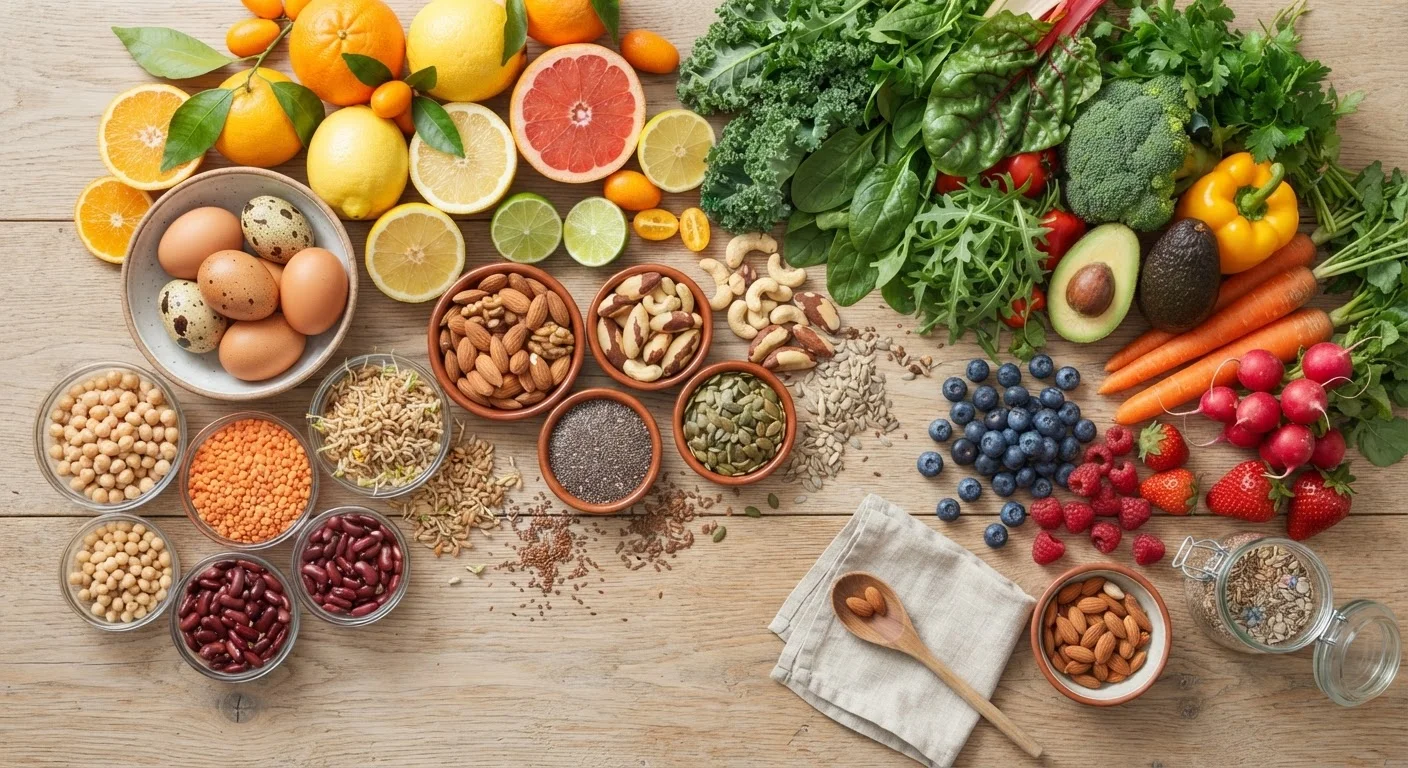
A practical way to think about it: aim for color variety on your plate. Different pigments in fruits and vegetables correspond to different phytonutrients and micronutrients. Dark leafy greens deliver folate, vitamin K, and iron. Orange and red produce is rich in beta-carotene. Legumes and whole grains supply B vitamins, magnesium, and zinc. Nuts and seeds add vitamin E and selenium.
Food preparation also matters. Some vitamins - particularly vitamin C and many B vitamins - degrade with prolonged heat. Light steaming or eating foods raw preserves more of these nutrients than boiling. Fat-soluble vitamins, on the other hand, are better absorbed when eaten alongside a small amount of dietary fat - a practical reason to dress your salad or pair vegetables with olive oil.
Micronutrients also interact with each other. Vitamin C, for example, significantly enhances absorption of non-heme iron (the type found in plant foods), which is why pairing iron-rich legumes with a squeeze of lemon is genuinely useful. This kind of synergy is one reason whole-food sources are generally more effective than isolated supplements.
To understand how micronutrients compare to macronutrients in the broader nutrition picture, see our macronutrients guide.
This article is for general informational and educational purposes only. It is not a substitute for professional medical advice, diagnosis, or treatment. If you have questions about your nutritional health or specific deficiencies, consult a qualified healthcare provider.