

Key Takeaways
Annuals vs. Perennials
Annual plants complete their entire life cycle - germinating, flowering, setting seed, and dying - within a single growing season. Perennial plants, by contrast, survive winter (at least in part) and return to grow and bloom again the following year. This single biological difference shapes how much you spend, how much you plant, and when your garden looks its best.
Technically, some plants marketed as annuals are tender perennials - they can survive multiple years in frost-free climates but are killed by freezing temperatures in colder regions (USDA hardiness zones 6 and below).
The Core Difference, Simply Explained
Every plant you bring into your garden falls somewhere on a lifespan spectrum, and the most important dividing line is between annuals and perennials.
An annual germinates, grows, flowers, produces seed, and dies - all within one growing season. It does everything it will ever do in roughly three to six months. A perennial invests energy into roots and structure that persist through winter, allowing the plant to re-emerge and flower again the following spring.
A third category - biennials - completes its life cycle over two years, flowering in year two before dying. They're less common, but worth knowing exist; foxglove and hollyhock are familiar examples.
Tender Perennials: A Common Source of Confusion
Some plants sold as annuals - such as impatiens, salvias, and certain begonias - are actually tender perennials that live for several years in frost-free climates. In cold-winter regions they cannot survive outdoors year-round and are treated as annuals. If you're unsure about a plant's classification in your area, check its USDA hardiness zone rating or ask at your local extension office.
Understanding this distinction helps you read plant tags at the nursery, plan what to buy each season, and build a garden that delivers color without constant replanting effort. Our gardening calendar for beginners maps out exactly when to sow, plant, and divide based on plant type.
Annuals: Maximum Color, Maximum Commitment
The trade-off with annuals is straightforward: they bloom prolifically from planting until the first hard frost, but they need to be replaced every single year. That means recurring seed or transplant costs, and spring planting labor each season.
Their upside is significant, though. Annuals are often the fastest path to a full, colorful garden because they pour all of their energy into flowers rather than root development. They're also forgiving of imperfect soil and are an excellent way to experiment - if you plant the wrong color combination, you start fresh next year.
Common annuals include:
- Marigolds - tough, pest-deterring, and long-blooming
- Zinnias - drought-tolerant and available in dozens of colors
- Petunias - reliable container and border plants
- Basil - a culinary annual that doubles as ornamental
Deadhead Annuals to Extend Blooming
Removing spent flowers - a technique called deadheading - prevents annuals from directing energy into seed production. Pinch or snip faded blooms regularly throughout the season to keep plants flowering as long as possible before frost arrives.
Most vegetables are technically annuals too. If you're growing food alongside flowers, see our guide on growing vegetables in a small garden for realistic first-year expectations.
Perennials: Build Once, Benefit for Years
Perennials cost more upfront - both in plant price and patience. Most need their first full growing season just to establish roots, and many gardeners cite the saying "sleep, creep, leap" to describe the three-year arc: slow in year one, modest in year two, fully flowering by year three.
The payoff is a garden that largely takes care of itself structurally. Once established, perennials require mainly seasonal pruning, occasional dividing (splitting clumps to maintain vigor and create new plants), and mulching to protect roots through winter.
Reliable beginner perennials include:
- Black-eyed Susans - drought-tolerant, native to much of North America
- Hostas - ideal for shaded spots with minimal fuss
- Coneflowers (Echinacea) - pollinator magnets with a long bloom season
- Daylilies - adaptable and nearly indestructible once established
One important note: always verify the USDA hardiness zone rating on a perennial's label. A plant described as perennial must be cold-hardy to your zone's minimum winter temperatures to actually come back each year.
Mixing Both for a Smarter Garden
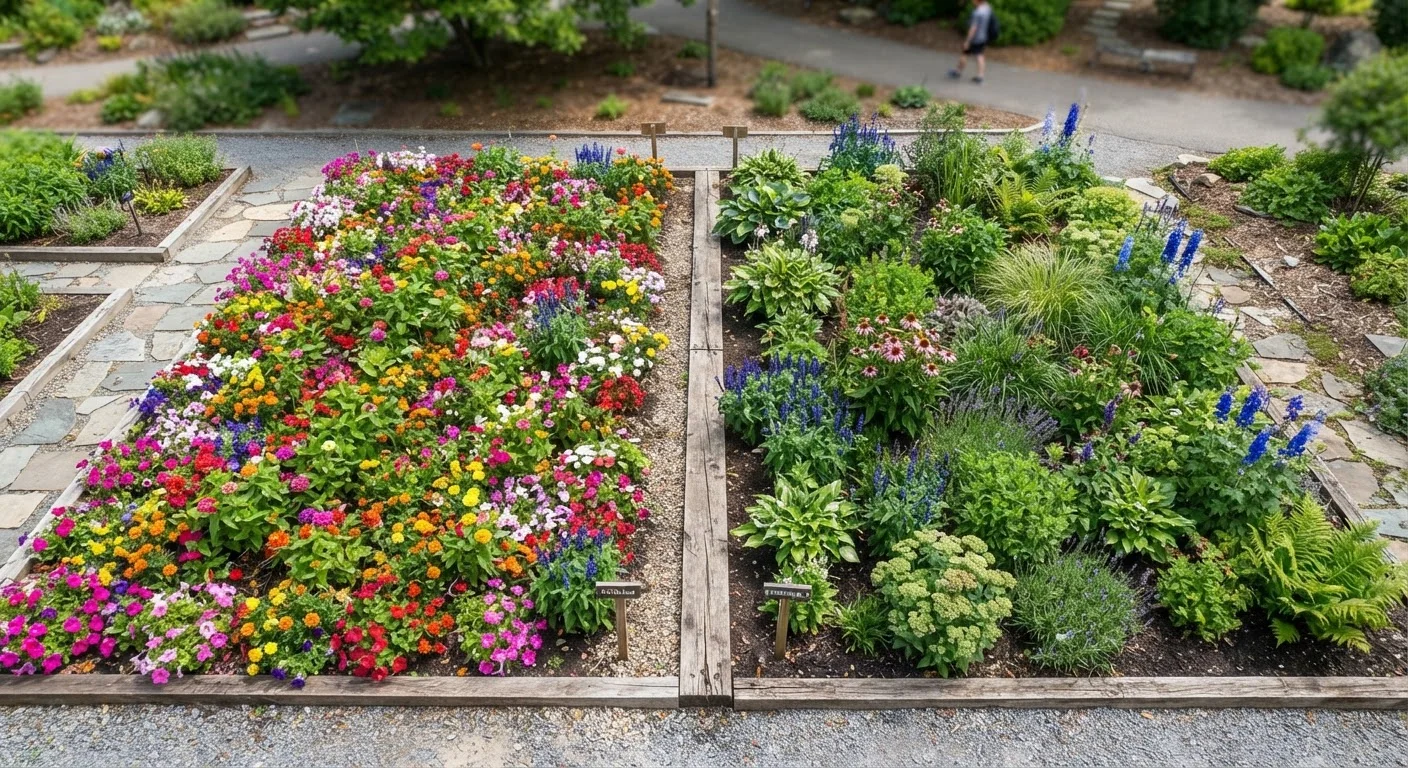
Seasoned gardeners rarely choose between annuals and perennials - they use both intentionally. Perennials provide the garden's reliable backbone: consistent structure, native habitat, and lower ongoing cost. Annuals fill in the gaps - covering bare soil while perennials establish, extending seasonal color, and allowing creative experimentation each year.
3 years
Typical perennial establishment timeline
Horticulturists commonly cite a three-year "sleep, creep, leap" cycle before most perennials reach their full flowering potential.
~3-6 months
Average annual bloom period
Most summer annuals flower continuously from transplant time through the first killing frost, giving them one of the longest bloom windows of any garden plant.
Every 3-5 years
Recommended perennial dividing frequency
Most perennial clumps benefit from being divided every three to five years to maintain vigor, improve flowering, and generate free new plants for the garden.
A practical starting approach: dedicate roughly two-thirds of a new bed to low-maintenance perennials and one-third to annuals. As your perennials mature and spread, the annual portion naturally shrinks - and so does your annual planting budget.
Whether you're working in raised beds or in-ground borders, this mix strategy applies broadly. Our comparison of raised beds vs. ground planting explains how each setup handles plant types differently - worth reading before you lay out your first bed.