

Key Takeaways
Investing
Investing means putting money into assets - such as stocks, bonds, or funds - with the expectation that your money will grow in value over time. Unlike saving, investing accepts some level of risk in exchange for the potential of higher returns. It is a deliberate strategy for building wealth over the long term, not a substitute for an emergency fund.
In financial terms, investing involves deploying capital into assets whose returns are not guaranteed and whose value can fluctuate - sometimes significantly - based on market conditions, economic factors, and the performance of the underlying asset.
The Core Difference: Safety vs. Growth Potential
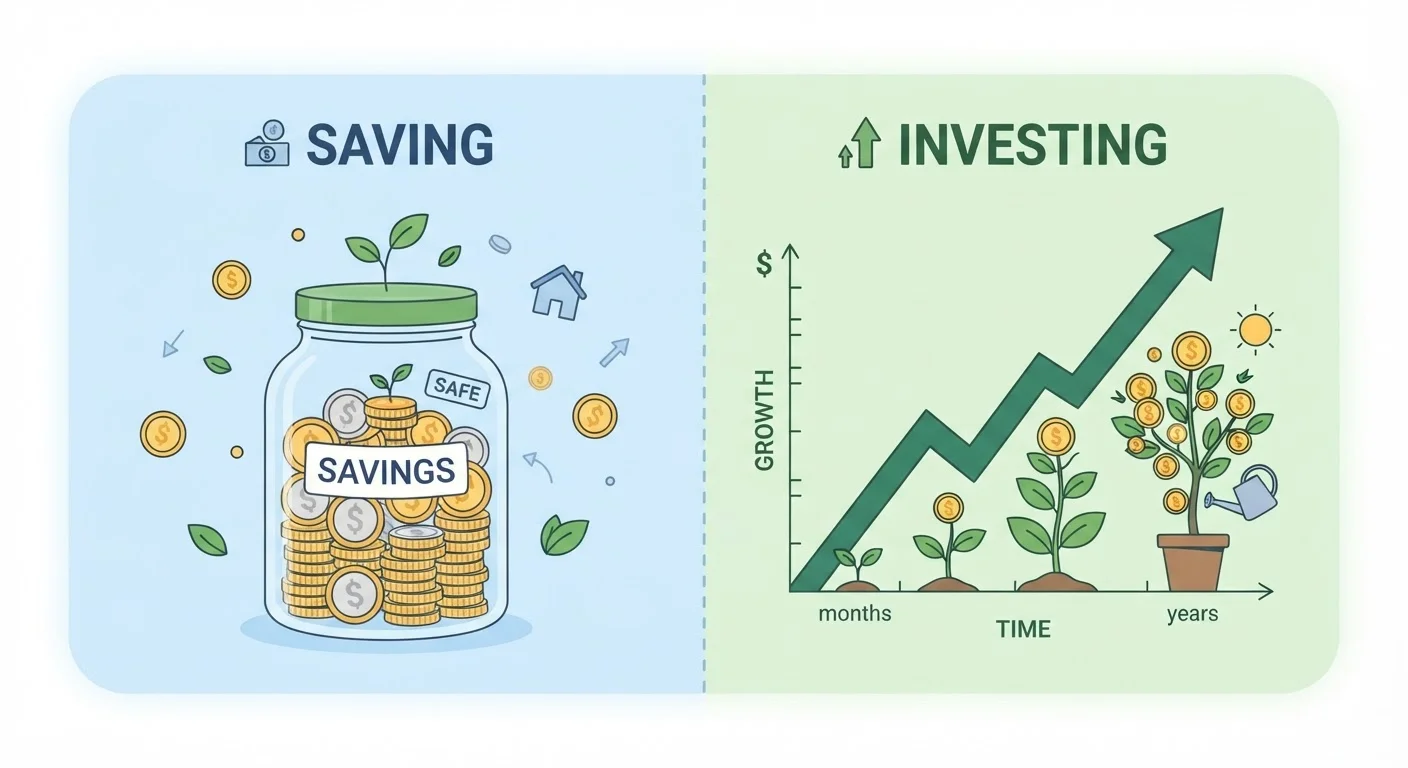
When people say they're "saving up" for something, they mean storing money somewhere safe and accessible - typically a bank account - so it's ready when needed. Investing is something different: it's the act of directing money into assets that have the potential to grow in value over time, accepting that their value can also decline.
This distinction matters more than it might seem. A savings account at a federally insured bank protects your principal - the amount you put in. If you deposit $1,000, you'll still have $1,000 (plus interest) when you come back for it. With investing, that same $1,000 might be worth $1,400 in a decade - or $800 after a market downturn. The upside is greater; so is the uncertainty.
For a deeper look at building a savings foundation before you invest, the Saving & Debt hub covers practical strategies for managing both.
3-4%
Average annual US inflation rate (historical)
The Federal Reserve targets 2% long-term inflation; actual rates have averaged higher over multi-decade periods, eroding the purchasing power of cash savings.
72%
Americans with access to workplace retirement plans who participate
According to the U.S. Bureau of Labor Statistics, roughly 72% of workers with access to a workplace retirement plan choose to participate.
~10%
Average annual S&P 500 return (long-term historical)
The S&P 500 has historically delivered roughly 10% average annual returns before inflation; past performance does not guarantee future results.
Why Investing Exists: The Problem With Just Saving
Saving is essential - but it has a structural limitation: inflation. Inflation is the gradual rise in the cost of goods and services over time. If your savings account earns 1% annual interest but inflation runs at 3%, your money is effectively losing purchasing power every year. A dollar today buys more than a dollar will ten years from now.
Investing is the primary tool most people use to outpace inflation over the long run. Historically, broad stock market indexes have delivered average annual returns that exceed inflation over multi-decade periods - though past performance does not guarantee future results, and markets involve real volatility and risk along the way.
This is why financial educators often frame the choice not as saving or investing, but as each serving a distinct purpose: savings for short-term security, investing for long-term growth.
“An investment in knowledge pays the best interest. Understanding the difference between saving and investing is the first step toward making your money work for you.”
— Benjamin Franklin, Founding Father, author, and early American advocate for financial self-reliance
The Role of Risk - And Why It Isn't Something to Avoid Completely
Risk is often treated as a dirty word in personal finance conversations, but understanding it is more useful than fearing it. In investing, risk refers to the possibility that an asset's value will decrease - temporarily or permanently. Higher potential returns generally come with higher risk, and lower-risk assets tend to offer more modest growth.
What makes risk manageable over time is two things: diversification and time horizon. Spreading investments across different asset types - stocks, bonds, funds - means a decline in one area doesn't wipe out everything. And holding investments over a longer period smooths out short-term volatility. Someone who invested in a broad market index fund and held it for 20 years has historically fared better than someone who bought and sold based on short-term market swings - though no outcome is guaranteed.
To understand the core building blocks of an investment portfolio, see Stocks, Bonds, and Funds: Understanding the Building Blocks of a Portfolio.
How Compounding Makes Time Your Most Valuable Asset
One of the most cited principles in personal finance is compound growth - the process by which returns generate their own returns over time. If you invest $5,000 and it grows by 7%, you now have $5,350. Next year, 7% applies to $5,350, not just the original $5,000. The difference seems small early on but becomes significant over decades.
This is why the timing of when you start investing often matters more than how much you start with. Beginning even a small amount earlier gives compounding more time to work. The reverse is also true: delaying investing by even a few years can mean meaningfully less accumulated wealth at retirement, all else being equal.
For a broader foundation on how to get started, the beginner's guide to investing from scratch walks through the key concepts and account types worth understanding before you begin.
This article is for general informational and educational purposes only. It does not constitute personalized financial, investment, or tax advice. Please consult a qualified financial professional before making decisions about your own finances.