

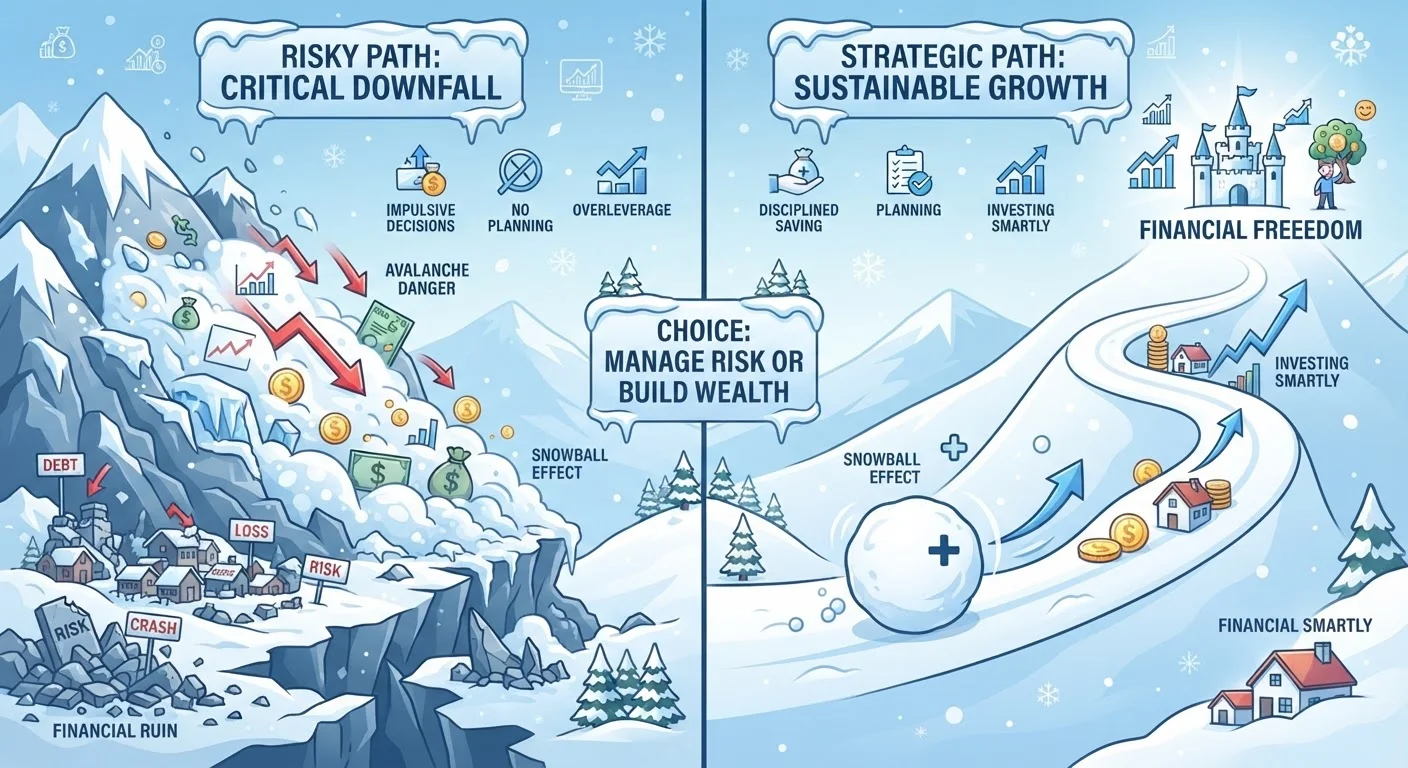
Key Takeaways
Option A
Debt Avalanche
The mathematically optimal, interest-minimizing approach.
Best for: People who are disciplined, motivated by data, and want to pay the least interest over the life of their debt.
Option B
Debt Snowball
The psychologically rewarding, momentum-building method.
Best for: People who need early wins to stay motivated and benefit from visible, frequent progress milestones.
If you want to minimize total interest paid
Debt Avalanche
By targeting the highest interest rate first, you reduce the amount accumulating on your most expensive debt, saving more money over the full repayment period.
If you struggle to stay motivated with debt repayment
Debt Snowball
Paying off smaller balances quickly delivers frequent, concrete wins that reinforce the habit of repayment and help prevent burnout.
If your highest-interest debt also happens to be your smallest balance
Debt Avalanche
In this scenario both methods lead to the same first payoff, so you capture the mathematical savings of the avalanche without sacrificing early momentum.
If you have many small debts scattered across multiple accounts
Debt Snowball
Rapidly closing out individual accounts simplifies your financial picture and reduces the cognitive load of managing multiple creditors simultaneously.
What Each Strategy Actually Means
Both the debt avalanche and the debt snowball are structured repayment frameworks. The core mechanic is the same: you make minimum payments on every debt you carry, then direct any extra money toward one priority account. What differs is how you choose that priority.
Debt Avalanche: You rank your debts from highest to lowest interest rate (also called APR - Annual Percentage Rate). Your extra payment always goes to the account at the top of that list. Once that debt is paid off, you redirect all its payment to the next highest-rate account, and so on. The cascade of funds accelerating down the list is the origin of the name.
Debt Snowball: You rank your debts from smallest to largest balance, ignoring interest rates. Your extra money attacks the smallest balance first. Once it's gone, that payment rolls into the next account - growing in size, like a snowball gathering mass. The focus is on eliminating accounts quickly to build psychological momentum.
Before applying either method, it helps to have a clear picture of every debt you carry. A structured audit - listing creditor, balance, interest rate, and minimum payment - is the foundation of any repayment plan. See our debt situation audit checklist for a practical starting point.
Head-to-Head: How the Methods Compare
The table below contrasts the two strategies across the criteria that matter most to most borrowers.
| Criterion | Debt Avalanche | Debt Snowball |
|---|---|---|
| Repayment priority | Highest interest rate first | Smallest balance first |
| Total interest paid | Generally lower | Potentially higher |
| Time to first payoff | Can be longer | Typically faster |
| Motivational structure | Data-driven, delayed milestones | Frequent wins, visible progress |
| Best with | Large rate differences between debts | Many small accounts to close out |
| Complexity | Requires tracking APRs | Requires tracking balances only |
One important nuance: the interest savings from the avalanche method are real but vary significantly based on your specific interest rates and balances. When rates are clustered closely together, the difference in total interest paid between the two methods can be modest. When one debt carries a dramatically higher rate - such as a high-rate credit card - the avalanche delivers more substantial savings.
Understanding why minimum payments alone extend your debt timeline is also essential context. Our article on why minimum payments keep you in debt longer explains the underlying math in detail.
The Psychology Behind the Snowball's Popularity
From a purely numerical standpoint, the avalanche wins. So why does the snowball remain widely recommended by financial educators? Because behavior matters as much as math.
Research in behavioral economics consistently finds that people are more likely to continue a habit when they receive frequent, visible rewards. Paying off a small debt - even one with a low interest rate - triggers a genuine sense of accomplishment. That feeling can be a powerful motivator to stay the course through months or years of repayment.
33%
Americans who have abandoned a debt repayment plan
A survey by the National Foundation for Credit Counseling found roughly one in three respondents had started and then stopped a formal repayment plan, often citing lack of visible progress.
~18%-29%
Typical APR range on US credit card debt
According to Federal Reserve data, credit card interest rates in the US frequently fall in this range, making the choice of repayment order financially significant over multi-year timelines.
The risk with the avalanche is that your highest-interest debt may also carry a large balance, meaning it could take a long time before you experience a payoff milestone. For some people, that extended wait erodes motivation. If you abandon your repayment strategy partway through, neither method delivers its theoretical benefits.
Choosing the snowball isn't a sign of mathematical naivety - it's an acknowledgment that sustainable financial behavior is the real driver of debt elimination.
Practical Factors to Weigh Before Choosing
Neither method is universally superior. Consider the following as you decide:
- Your interest rate spread: If one debt carries a significantly higher rate than the rest, the avalanche's advantage grows. If rates are similar, the snowball's motivational edge may matter more.
- Number of accounts: Many small accounts often favor the snowball, as closing them out simplifies your financial picture quickly.
- Income stability: If your budget is tight and variable, the snowball's early payoffs free up minimum payments faster, giving you more flexibility sooner.
- Your track record with financial commitments: Honest self-assessment matters. If you've abandoned debt plans before, the snowball's frequent wins may be the structure you need.
It's also worth considering whether debt consolidation might be relevant to your situation - particularly if you're managing several high-rate accounts. Our overview of how debt consolidation works covers when it may or may not be appropriate.
Finally, debt repayment doesn't have to mean putting savings entirely on hold. Explore the trade-offs in our piece on saving while in debt.
What About Not-Quite-Bad Debt?
Not all debt is equally urgent to pay down aggressively. Low-rate student loans or mortgages may warrant a different priority than high-rate credit card balances. Understanding the distinction between productive and costly debt helps you allocate extra payments more effectively. Our article on good debt vs. bad debt explains how financial educators categorize different types of borrowing.
This article is for general informational and educational purposes only and does not constitute personalized financial advice. Consider speaking with a certified financial counselor or advisor about your specific debt situation.