

Key Takeaways
Our Verdict
For most people carrying high-interest debt, prioritizing repayment delivers the strongest financial return. However, building a minimal emergency fund and capturing any employer retirement match are generally worth doing simultaneously. As interest rates on debt drop closer to what savings can earn, the case for splitting effort more evenly grows stronger.
| Best for | Recommended |
|---|---|
| Those carrying high-interest credit card or personal loan debt | Debt-first approach |
| Those with no emergency cushion and unpredictable expenses | Hybrid approach with small emergency fund |
| Those with employer retirement matching available | Hybrid approach capturing the full employer match |
| Those carrying only low-interest debt such as federal student loans | Simultaneous saving and debt repayment |
Why This Question Is Harder Than It Looks
Most personal finance advice makes the debt-vs.-saving debate sound simple: eliminate all debt before saving a dollar. In practice, the decision is more nuanced. Stopping all saving while you pay down debt can leave you financially exposed to the next emergency - which often leads to borrowing again. Saving aggressively while ignoring high-interest debt, on the other hand, means you're almost certainly losing money on the spread between what debt costs and what savings earn.
The right approach sits somewhere between those extremes, and it shifts depending on your interest rates, income stability, and what kind of debt you carry. Understanding how compound interest works for and against you is the essential first step - it explains why the gap between a 22% credit card rate and a 4% savings rate is so consequential.
The Core Trade-Off: Interest Rates Drive the Math
At its heart, this is an arbitrage question. If your debt charges 20% annually and your savings account returns 4%, every dollar saved instead of applied to debt costs you roughly 16 cents per year in net interest. Over time, that gap compounds against you.
But when debt carries a lower rate - say, a federal student loan at 5% - and a savings vehicle can realistically return a comparable or higher amount over the long run, the calculus changes. You may be better served building savings in parallel rather than racing to zero debt first.
| Debt-First Approach | Hybrid Approach | Savings-First Approach | |
|---|---|---|---|
| Best suited for | High-interest debt (above ~8%) | Mix of debt types and no emergency fund | Low-interest debt only |
| Interest cost impact | Minimizes total interest paid | Moderate interest reduction | Higher total interest paid over time |
| Emergency preparedness | Low until debt is cleared | Maintained at a basic level | Strong cushion available |
| Retirement contributions | Paused or minimal | Enough to capture employer match | Maximized or near-maximized |
| Psychological impact | Motivated by visible debt reduction | Balanced progress on both fronts | Security from growing savings |
| Risk if income drops | Higher - no savings buffer | Moderate - small buffer exists | Lower - savings provide runway |
This is why a blanket rule fails many people. The avalanche vs. snowball repayment comparison is worth reading alongside this decision - it covers how to sequence multiple debts once you've decided how much of your budget goes toward repayment.
Three Situations Where Saving While in Debt Makes Sense
1. You have no emergency fund. Without even one month of essential expenses in liquid savings, an unexpected car repair or medical bill can push you straight back onto high-interest credit. Most financial educators suggest a starter emergency fund of at least $500-$1,000 before accelerating debt payoff, specifically to break this cycle.
2. Your employer offers a retirement match. If your employer matches retirement contributions - for example, 50 cents for every dollar up to 6% of salary - declining that match to pay debt faster means leaving guaranteed compensation on the table. The effective return on a dollar that receives a 50% match is immediate and substantial, typically outpacing even high-interest debt when viewed as a one-time incentive.
3. Your debt carries a low interest rate. Federal student loans, certain auto loans, and mortgages often carry rates that are meaningfully lower than the long-run expected return of a diversified investment portfolio. In these cases, making minimum debt payments while directing surplus funds toward savings or investing may be mathematically reasonable - though it comes with more uncertainty and market risk. Consult a licensed financial professional before making this call for your own situation.
Start With a Written Snapshot
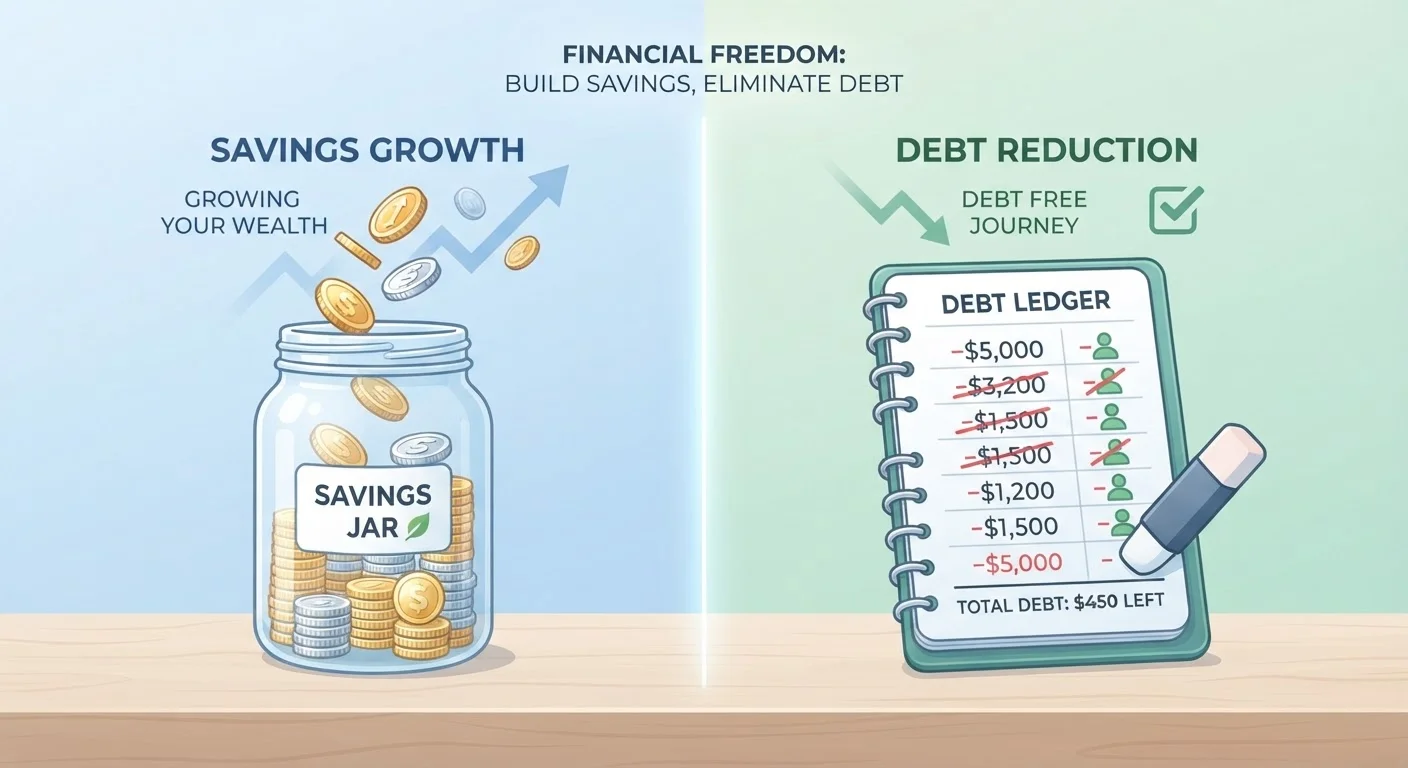
Before deciding how to split your money, list every debt with its balance and interest rate alongside your current savings balance. This one-page picture makes the trade-offs concrete. You may find that one or two high-rate debts are costing far more than you realized, or that your savings rate already justifies parallel contributions to a retirement account.
Building a Practical Hybrid Approach
A hybrid strategy doesn't mean splitting every dollar 50/50. It means being intentional about thresholds. A common starting framework: first, build a small starter emergency fund; second, contribute enough to retirement to capture any employer match; third, direct all remaining surplus toward high-interest debt. Once high-interest debt is cleared, redirect that freed-up cash toward expanding savings and lower-priority debt.
Automation is one of the most reliable tools here. Setting up a recurring transfer - even a modest one - toward a dedicated savings account on payday removes the decision from your monthly routine. See the principles behind automating savings for a breakdown of how to structure those transfers effectively. If you're just developing the habit, building a savings habit from scratch offers a beginner-friendly starting point.
Be honest about behaviors that can quietly derail both goals. Common habits that undermine savings plans - like lifestyle inflation and vague goals - apply equally when you're trying to reduce debt at the same time.
This article is for general informational purposes only and does not constitute personalized financial, investment, or tax advice. Speak with a qualified financial professional about decisions specific to your circumstances.