

Key Takeaways
Compound Interest
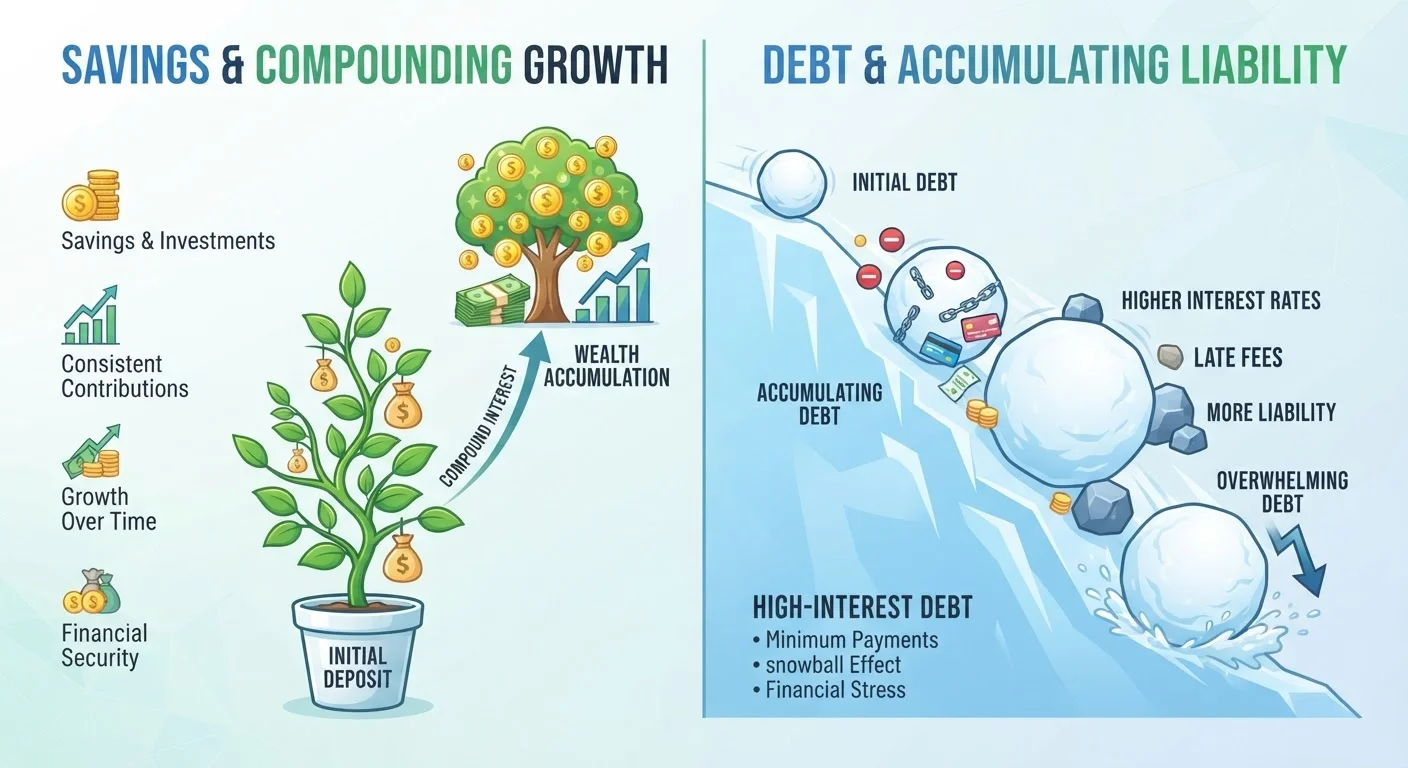
Compound interest is interest calculated on both the original amount of money (the principal) and any interest that has already been earned or charged. Unlike simple interest, which applies only to the principal, compound interest causes balances to grow at an accelerating rate over time. This makes it a powerful tool for building savings - and a costly force when it applies to unpaid debt.
The frequency of compounding (daily, monthly, annually) directly affects the total amount accumulated. More frequent compounding periods result in slightly higher effective interest rates, expressed as the Annual Percentage Yield (APY) on savings or the Annual Percentage Rate (APR) on debt.
The Core Mechanic: Interest on Interest
At its simplest, compound interest means you earn (or owe) interest not just on your original balance, but on every dollar of interest that has already accumulated. Consider a $1,000 savings balance earning 5% annually. After year one, you have $1,050. In year two, you earn 5% on $1,050 - not the original $1,000 - giving you $1,102.50. That extra $2.50 may seem trivial, but the pattern compounds relentlessly.
Over 30 years at the same rate with no additional contributions, that $1,000 grows to roughly $4,320. The same $1,000 under simple interest would grow to just $2,500. The difference - nearly $1,820 - is entirely the product of compounding. For a deeper look at key financial terms connected to this concept, see our personal finance glossary.
~$4,320
Value of $1,000 after 30 years at 5% compound interest
Compared to $2,500 under simple interest - a difference generated entirely by compounding, with no additional contributions.
22%+
Average credit card APR in recent years (US)
According to Federal Reserve consumer credit data, average credit card interest rates have reached historically high levels, making compounding on unpaid balances especially costly.
9 years
Time to double at 8% using the Rule of 72
The Rule of 72 is a widely used estimation tool in personal finance education to illustrate compounding speed across different interest rates.
When Compound Interest Works For You
Compounding rewards patience more than any other financial force. The earlier you start saving or investing, the more compounding periods your money experiences - and the more dramatic the results. A 25-year-old who saves consistently has a significant mathematical advantage over someone who starts at 35, even if the later starter contributes more money overall.
This dynamic is why financial educators consistently emphasize beginning early, even with small amounts. Consistent, automated contributions amplify the effect further by ensuring your principal grows every period. If you want to put this principle into action, automating your savings is one of the most effective ways to stay consistent. You can also explore foundational investing ideas in the Investing Essentials hub.
Start Small, Start Now
You don't need a large lump sum to benefit from compounding. Even modest, consistent contributions - such as automatically transferring a small amount each paycheck - give compounding more time to work. The key variable is time, not the size of your initial deposit.
When Compound Interest Works Against You
The same mechanic that builds wealth can rapidly expand debt. Credit card balances are a common example: issuers typically compound interest daily on any unpaid balance. A $3,000 balance at a 22% APR left unpaid for a year doesn't simply accrue $660 in interest - the daily compounding pushes the effective cost higher, and the growing balance is itself charged interest each cycle.
Student loans, personal loans, and payday loans can carry compounding structures that accelerate balances in similar ways. The critical principle: the longer you carry debt, the more compounding amplifies the total cost. If you're managing high-interest debt alongside savings goals, our article on saving while in debt explores when it makes sense to do both. And if you're carrying multiple debts, debt consolidation may be worth understanding.
APR vs. APY: Know the Difference
APR (Annual Percentage Rate) is the stated interest rate without accounting for compounding within the year. APY (Annual Percentage Yield) reflects the actual annual rate after compounding is factored in. When comparing savings accounts, look at APY. When evaluating debt, check APR - and recognize the real cost may be higher due to compounding frequency.
Putting It to Work: Practical Steps
Understanding compound interest isn't just academic - it changes how you prioritize money decisions.
- On savings: Open accounts with competitive APYs, contribute regularly, and avoid withdrawing early. Each withdrawal resets the principal compounding is working from.
- On debt: Pay more than the minimum whenever possible. Even modest extra payments reduce the principal faster, cutting the base that compounding charges apply to.
- On timing: Use the Rule of 72 as a mental check - divide 72 by your interest rate to estimate how long it takes a balance to double. At 8%, a debt or savings balance doubles in about 9 years.
Compounding is neither inherently good nor bad - it amplifies whatever direction your money is already moving. Directing it intentionally, starting sooner rather than later, is the core insight. For a closer look at how compounding shapes long-term investing specifically, see how compounding shapes investing over time.
This article is for general informational and educational purposes only and does not constitute personalized financial, investment, or tax advice. Consult a qualified financial professional for guidance specific to your situation.