

Key Takeaways
Good Debt vs. Bad Debt
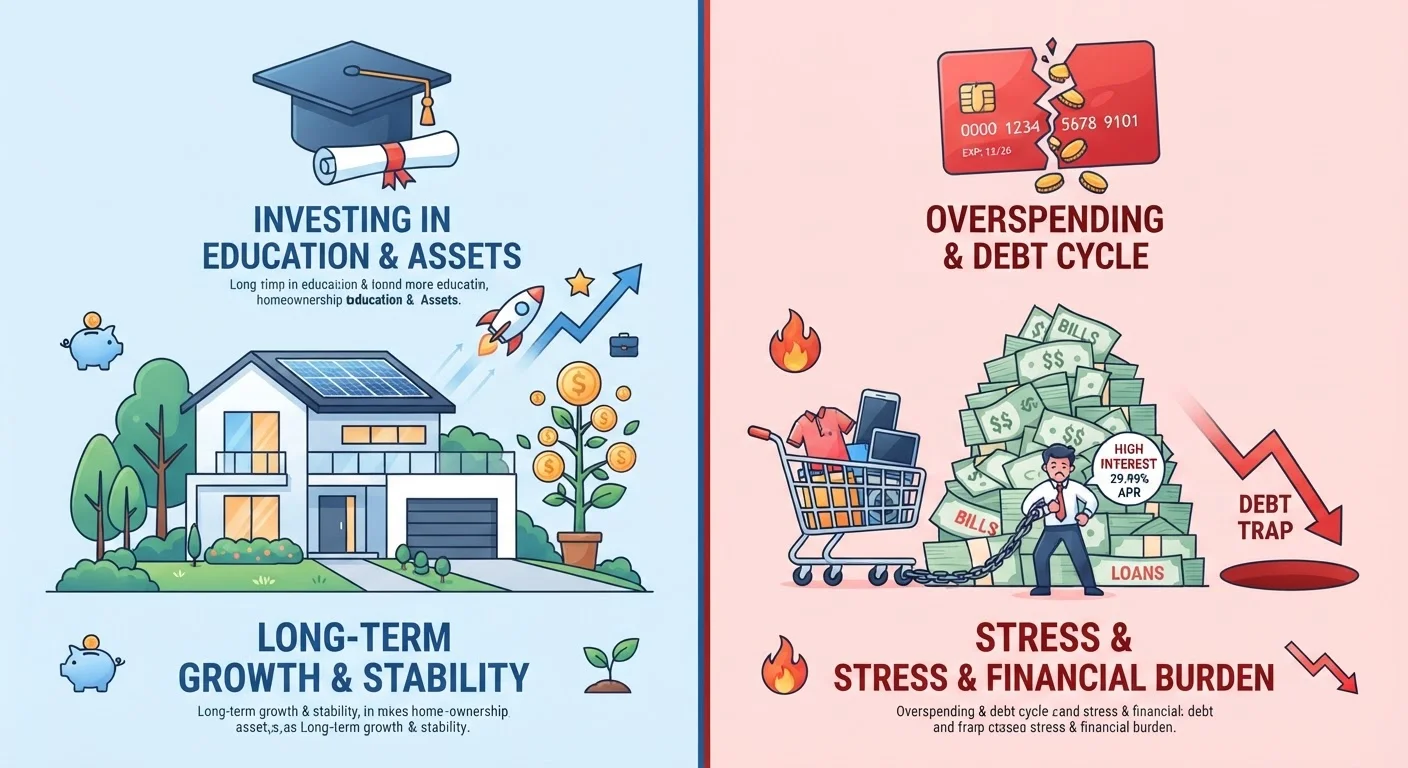
"Good debt" refers to borrowing that finances something likely to increase your financial standing over time - such as education, a home, or a business. "Bad debt" typically describes borrowing used for depreciating or consumable purchases, often at high interest rates. The distinction isn't always black and white, but the framework helps you evaluate whether a debt is working for you or against you.
Economists often frame this as the difference between debt that funds investment with a positive expected return versus debt whose cost exceeds any financial benefit it produces.
Why the Distinction Matters
Most people learn early that debt is something to avoid. But that blanket view can lead to missed opportunities - and it doesn't reflect how lenders, economists, or experienced personal finance educators actually think about borrowing. Debt is a tool. Like any tool, its value depends on what you use it for and how carefully you handle it.
Understanding the difference between productive and harmful debt is foundational to managing money well. It helps you decide when borrowing makes sense, how aggressively to pay something off, and how to prioritize competing financial goals. If you're new to the terminology, our personal finance glossary covers core concepts like APR and compound interest that underpin this topic.
~$1.77T
Total U.S. student loan debt outstanding
According to Federal Reserve data, student loans represent one of the largest categories of consumer debt in the United States.
20%+
Typical credit card APR in recent years
Federal Reserve consumer credit reports have shown average credit card interest rates exceeding 20% annually in recent periods - among the highest of common debt types.
3x
Lifetime earnings premium associated with a bachelor's degree
Research from the Georgetown University Center on Education and the Workforce has estimated that bachelor's degree holders earn substantially more over a lifetime than those with only a high school diploma, though outcomes vary widely by field.
What Makes Debt "Good"
Good debt is generally defined by two qualities: it finances something with lasting value or income potential, and it comes at a cost - the interest rate - that is reasonable relative to the expected return. Common examples include:
- Mortgages: Borrowing to buy a home puts you in an asset that historically tends to appreciate, while also providing a place to live. Interest rates are typically lower than other debt types.
- Student loans: Education can raise lifetime earning potential. When the income boost exceeds the loan cost, the math favors borrowing - though this depends heavily on the program and amount borrowed.
- Business loans: Financing a business that generates more revenue than the loan costs is a textbook case of productive debt.
The key test: does what you're buying generate enough value - financial or otherwise - to justify the interest you'll pay?
A Simple Test Before You Borrow
Ask yourself two questions before taking on any debt: Will what I'm buying be worth more - financially or practically - than what I'll pay in total interest? And can I comfortably manage the monthly payment given my current income? If both answers are clearly yes, the debt is more likely to serve you well. If you're unsure, that uncertainty itself is useful information.
What Makes Debt "Bad"
Bad debt typically shares the opposite characteristics: high interest rates, applied to things that lose value quickly or are consumed entirely. High-rate credit card balances are the most common example. If you carry a $3,000 balance at 22% APR and make only minimum payments, you'll pay hundreds of dollars in interest for purchases that have likely long since been forgotten.
Other examples often categorized as bad debt include payday loans, which can carry extremely high effective interest rates, and financing for discretionary luxuries - electronics, vacations, clothing - on revolving credit. The purchased items decline in value (or have no lasting value) while the debt compounds.
This doesn't mean borrowing for any consumer item is inherently irresponsible. Context matters. But when the interest cost clearly exceeds any benefit derived from the purchase, the debt works against your financial position rather than for it.
The Gray Areas Worth Knowing
The good/bad framework is useful but simplified. Several types of debt sit in more ambiguous territory:
- Auto loans: A car depreciates from the moment you drive it off the lot, which sounds like bad debt territory. But if the car enables you to earn income - getting to work, for instance - the loan may be justified. The interest rate and loan term still matter significantly.
- Medical debt: This debt is often unavoidable and rarely optional, making the good/bad label somewhat beside the point. The priority becomes managing it as efficiently as possible.
- Student loans for lower-return programs: Education debt isn't automatically good debt if the credential doesn't translate into meaningfully higher income.
It's also worth noting that even legitimately "good" debt can become a problem if the payments exceed what your income can handle. Debt level matters as much as debt type. For a deeper look at managing both debt and savings simultaneously, see our piece on saving while in debt.
This article is for general informational and educational purposes only and does not constitute personalized financial, tax, or legal advice. Consult a qualified financial professional before making decisions based on your individual circumstances.