

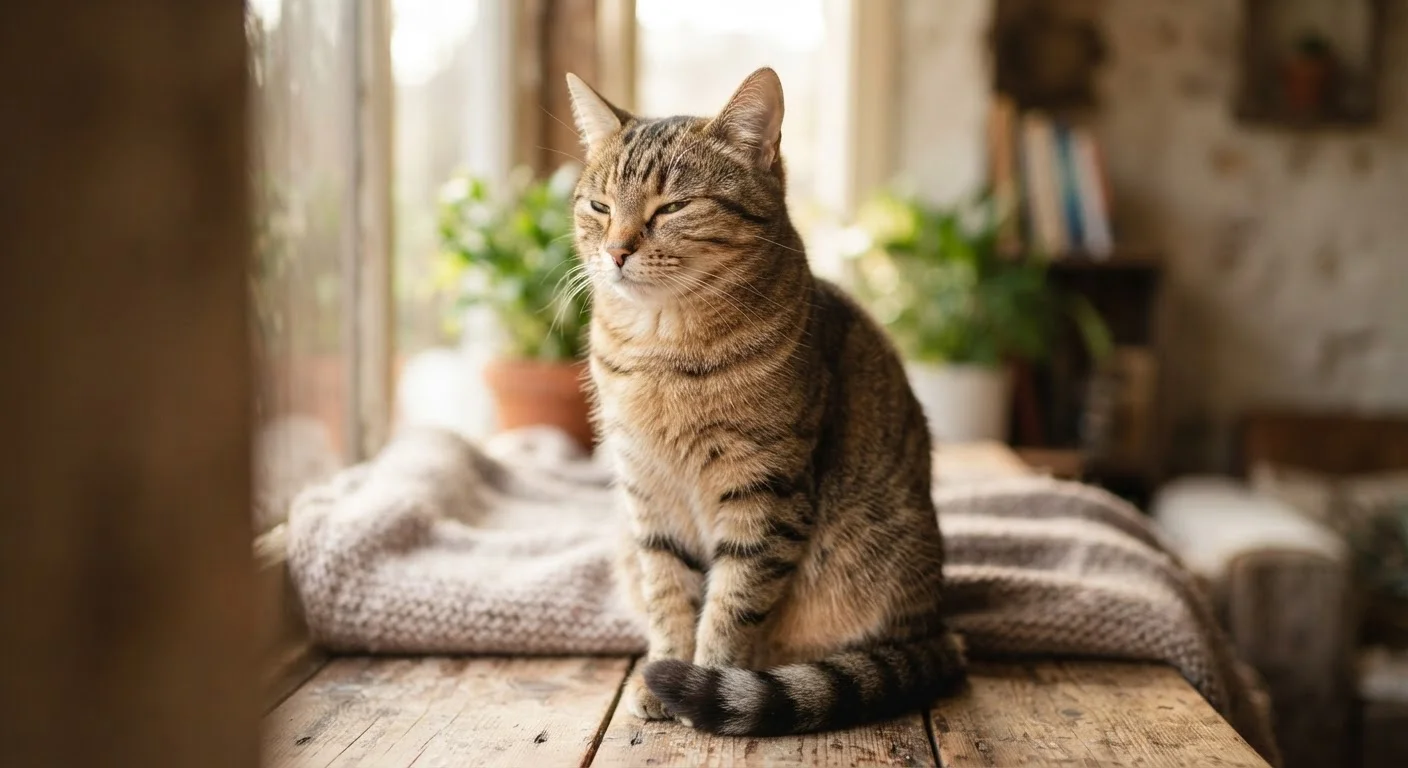
| Tail upright | Friendly greeting, confidence |
| Tail lashing | Irritation or overstimulation |
| Ears flattened back | Fear or defensive aggression |
| Slow blink | Trust and contentment |
| Loaf posture | Relaxed and comfortable |
| Puffed tail/fur | Startled or threatened |
| Exposed belly | Trust - not necessarily a petting invitation |
| Dilated pupils (bright light) | Fear, excitement, or pain |
Why Cat Body Language Is Different
Cats evolved as both predators and prey, which means their communication style prioritizes subtlety over spectacle. Unlike dogs - whose signals tend to be broad and exaggerated - cats express themselves through small, layered cues that are easy to overlook. A slight ear rotation or a tail held at a specific angle can communicate more than a full vocalization. Understanding this nuance is especially important for first-time cat owners, who may misread neutral or stressed behavior as affectionate, or vice versa.
Reading cat signals always requires looking at the whole picture. A single cue in isolation can be misleading; pair tail position with ear angle, eye shape, and body posture to get an accurate read. The glossary below defines the core building blocks - refer back to it as you work through the rest of this guide.
Piloerection
The involuntary raising of fur along the back and tail, often called "puffing up." It is a stress response that makes the cat appear larger to potential threats.
Slow blink
A deliberate, relaxed closing and opening of the eyes that cats use to signal trust and non-threat. It is one of the clearest positive signals a cat can direct at a human.
Overstimulation
A state in which a cat receives more physical or sensory input than it can comfortably process, often triggering a rapid switch from calm to defensive behavior.
Defensive aggression
Aggressive behavior triggered by fear rather than predatory drive. A cat displaying defensive aggression wants to create distance, not pursue conflict.
Bunting
When a cat presses its forehead, cheeks, or chin against a person or object. Scent glands in these areas leave a chemical mark that cats use to claim familiar, safe things.
Displacement behavior
An out-of-context action - like sudden grooming - that signals internal conflict or mild stress. It helps the cat self-regulate without escalating.
For a broader look at how cats bond with people - including some behaviors that are easy to misinterpret - see our guide on how cats show affection.
The Key Signals: A Quick-Reference Breakdown
Use the quick facts card below as a fast lookup while you observe your cat. The sections that follow go deeper on each signal cluster.
| Tail upright | Friendly greeting, confidence |
| Tail lashing | Irritation or overstimulation |
| Ears flattened back | Fear or defensive aggression |
| Slow blink | Trust and contentment |
| Loaf posture | Relaxed and comfortable |
| Puffed tail/fur | Startled or threatened |
| Exposed belly | Trust - not necessarily a petting invitation |
| Dilated pupils (bright light) | Fear, excitement, or pain |
Tail Position
- Upright tail: Confidence and a friendly greeting. When held straight up with a slight curl at the tip, your cat is approaching you with positive intent.
- Puffed tail: Fear or sudden agitation. The fur stands on end to make the cat appear larger - a classic stress response.
- Low or tucked tail: Anxiety, submission, or pain. A tail wrapped tightly around the body signals the cat wants to minimize its presence.
- Lashing or thumping tail: Often misread as a wag - in cats this typically signals irritation or overstimulation, not happiness.
Ear Angle
- Forward-facing ears: Alert, curious, and engaged.
- Flattened or rotated back (airplane ears): Fear, aggression, or defensive arousal. Stop approaching and give the cat space.
- Slightly sideways (neutral): Relaxed and comfortable.
Eye Shape and the Slow Blink
- Slow blink: A deliberate, unhurried closing and opening of the eyes directed at you signals trust and contentment. You can return it as a low-key sign of goodwill.
- Dilated pupils in bright light: Can indicate fear, excitement, or pain - context matters.
- Constricted pupils in dim light: May signal aggression or intense focus.
- Half-closed eyes: Relaxation and comfort.
Body Posture
- Loaf position (paws tucked under): Content and at ease - a cat that feels safe enough to hide its escape tools.
- Exposed belly: Often a sign of comfort, but not always an invitation to pet. Many cats will swipe if their belly is touched; read the full context.
- Arched back, sideways stance: Defensive threat display. Back away calmly.
It's worth noting that some common assumptions about cat behavior are myths. Our article on common cat myths addresses several misunderstandings that can affect how owners interpret their pet's signals.
Putting It All Together
Individual signals layer - a cat with a straight-up tail, forward ears, and slow-blinking eyes is almost certainly in a friendly, relaxed state. A cat with flattened ears, a puffed tail, and constricted pupils is telling you - and any nearby animal - to keep distance. When signals seem contradictory, weight the most defensive signal most heavily and give the cat room to decompress.
If a cat's body language shifts noticeably without an obvious environmental trigger - sudden hiding, persistent crouching, tail-tucking in normally relaxed situations - it may be worth a veterinary check. Behavioral changes can sometimes indicate pain or illness before other symptoms appear. This article provides general educational information only; if you have concerns about your cat's health or behavior, consult a licensed veterinarian.
Curious how cat communication compares to other pets? Our guide to reading dog body language shows how different the two species really are - useful context if your household has both.