

Key Takeaways
Feline Affection Displays
Feline affection displays are the behaviors cats use to communicate trust, bonding, and positive social attachment to people or other animals. Unlike dogs, cats evolved as more solitary hunters, so their affectionate signals tend to be quieter, slower, and context-dependent. Learning to read them correctly strengthens the relationship between cat and owner.
Many cat affection behaviors - including scent marking via bunting and allogrooming - originate from colony-living cat social structures observed in field research on feral populations.
Why Cat Affection Looks So Different From What We Expect
Most people grow up around dogs, whose affection is unmistakable - tail wags, jumping, licking. Cats operate on a fundamentally different social frequency, and first-time owners often misread neutral or even affectionate behaviors as indifference or standoffishness. The result is a widespread myth that cats simply don't bond with people.
Science tells a different story. Studies on cat-human relationships show that cats do form selective attachments, but they express them through quieter, more context-sensitive signals. If you're not watching for those signals, you'll miss them entirely. Understanding them is also the foundation of meeting your cat's emotional needs - something our guide for first-time cat owners covers in detail.
65%
Cats showing secure attachment to owners
A 2019 study published in Current Biology found that approximately 65% of cats studied showed secure attachment behaviors toward their owners, similar to rates seen in human infants and dogs.
~40
Distinct vocalizations cats use with humans
Research suggests cats have developed a range of vocalizations directed specifically at humans - a communication adaptation that appears largely absent in their interactions with other cats.
9,500+
Years of cat-human cohabitation
Archaeological evidence places cat domestication to at least 7,500 BCE in Cyprus, suggesting cats and humans have been navigating social relationships for millennia.
The Core Affection Signals and What They Mean
Once you know what to look for, feline affection becomes surprisingly readable. Here are the most common displays and the instincts behind them:
- Slow blinking: Direct eye contact from a relaxed cat, followed by a slow, deliberate blink, is a non-threatening signal of trust. Closing the eyes - even briefly - in your presence signals that your cat doesn't consider you a threat.
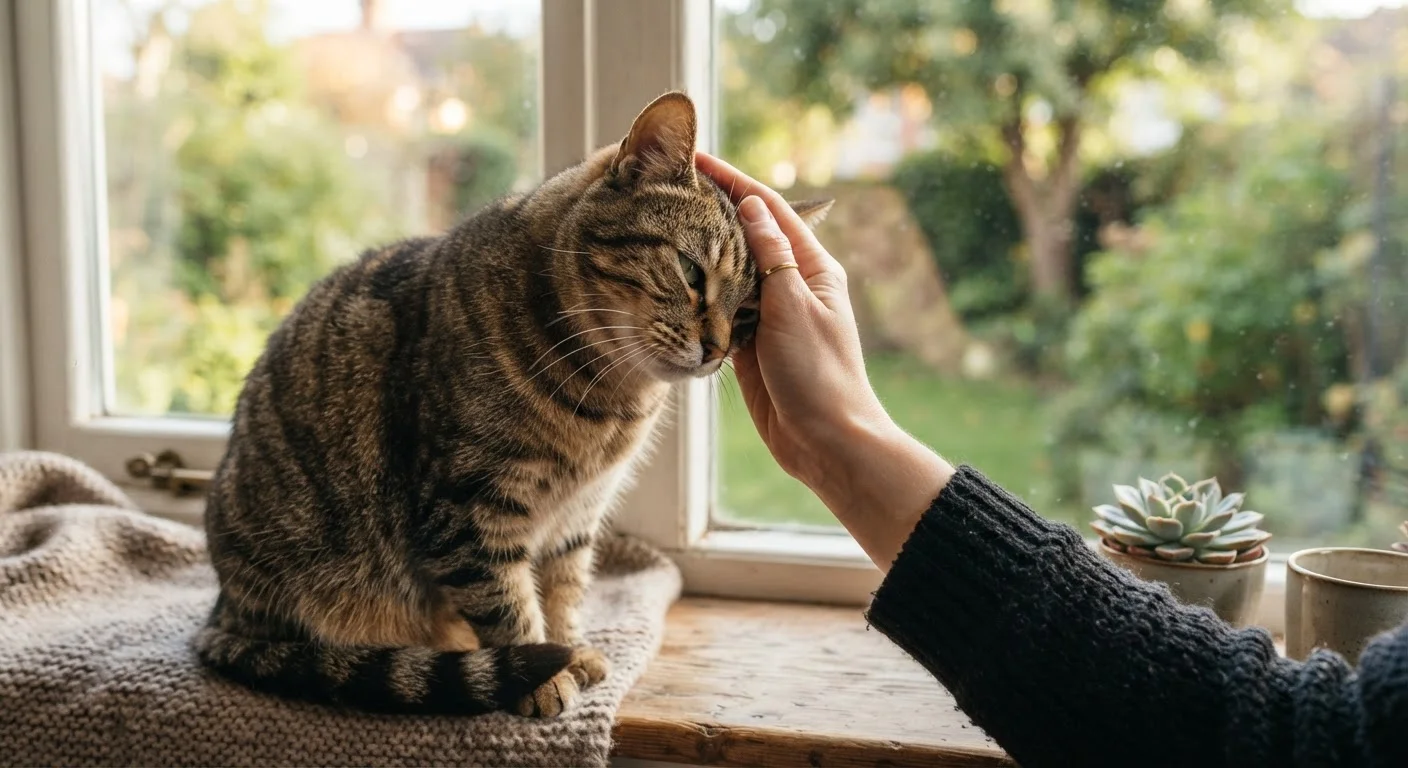
- Head bunting and cheek rubbing: Cats have scent glands along their forehead, cheeks, and chin. When they press these areas against you, they're marking you with familiar scent - a behavior shared between bonded cats. It's one of the most direct affection signals available to a cat.
- Tail position: A tail held high and loosely curved at the tip is a greeting signal cats use with trusted individuals. It's the feline equivalent of a friendly wave.
- Kneading: That rhythmic pressing of paws against soft surfaces (or you) is a holdover from nursing behavior and occurs when a cat feels profoundly safe and content.
- Proximity and following: A cat that chooses to be in the same room as you - without demanding anything - is demonstrating preference for your company. Sitting near you, not necessarily on you, still counts.
For a fuller breakdown of how body language, ear angle, and posture all work together, see our field guide to cat body language.
The Misunderstood Ones: Belly Exposure and Gift-Giving
Two affection behaviors routinely confuse - and sometimes frustrate - new owners.
The belly display is a vulnerability signal. When a cat rolls onto its back and shows you its stomach, it's communicating a high level of trust - the belly is the most exposed, least defended part of the body. What it is not is an automatic invitation for a belly rub. Many cats find belly contact overstimulating and will bite or scratch in response. Read it as a compliment, not a request.
Bringing prey or toy 'gifts' is rooted in maternal behavior. Mother cats bring kittens prey to teach hunting skills; when your cat brings you a dead mouse or a balled-up sock, it may be including you in that social dynamic. The appropriate response is calm acknowledgment - reacting with disgust or alarm can confuse an animal performing what it experiences as a generous social act.
How to Respond to a Gift
When your cat brings you a 'present' - toy, prey, or otherwise - respond with calm acknowledgment rather than dramatic reaction. A quiet 'thank you' and gentle interaction afterward reinforces that this social gesture was received well. Avoid punishing or showing strong disgust, as this can confuse a cat performing an instinctive bonding behavior.
Building a Bond on Your Cat's Terms
Understanding affection signals only gets you so far - you also need to respond in ways that cats find reassuring. A few evidence-backed principles:
- Let the cat initiate contact. Reaching toward a cat that hasn't approached you first often causes it to retreat. Extend a loose finger or the back of your hand and let the cat decide whether to investigate.
- Slow-blink back. If a cat slow-blinks at you, returning the gesture signals that you're paying attention and that you're equally relaxed.
- Keep interactions short and positive. Many cats prefer frequent, brief interactions over long, involuntary cuddle sessions. Watching for signs of overstimulation - tail twitching, skin rippling, ears flattening - helps keep interactions pleasant. Our article on purring explains how even that familiar sound can sometimes signal stress rather than contentment.
- Respect retreats. A cat that walks away isn't rejecting you permanently. Chasing or restraining a cat that wants space erodes the trust that affection is built on.
It's also worth noting that some behaviors people assume are affection - like knocking objects off tables - are actually driven by curiosity and prey instinct rather than a desire for attention or to annoy you. Our piece on why cats knock things off tables explains the real motivations at work.
Cats build trust incrementally and on their own schedule. Consistent, low-pressure presence almost always produces a more affectionate cat than forced interaction will.