

Key Takeaways
Feline Object Manipulation
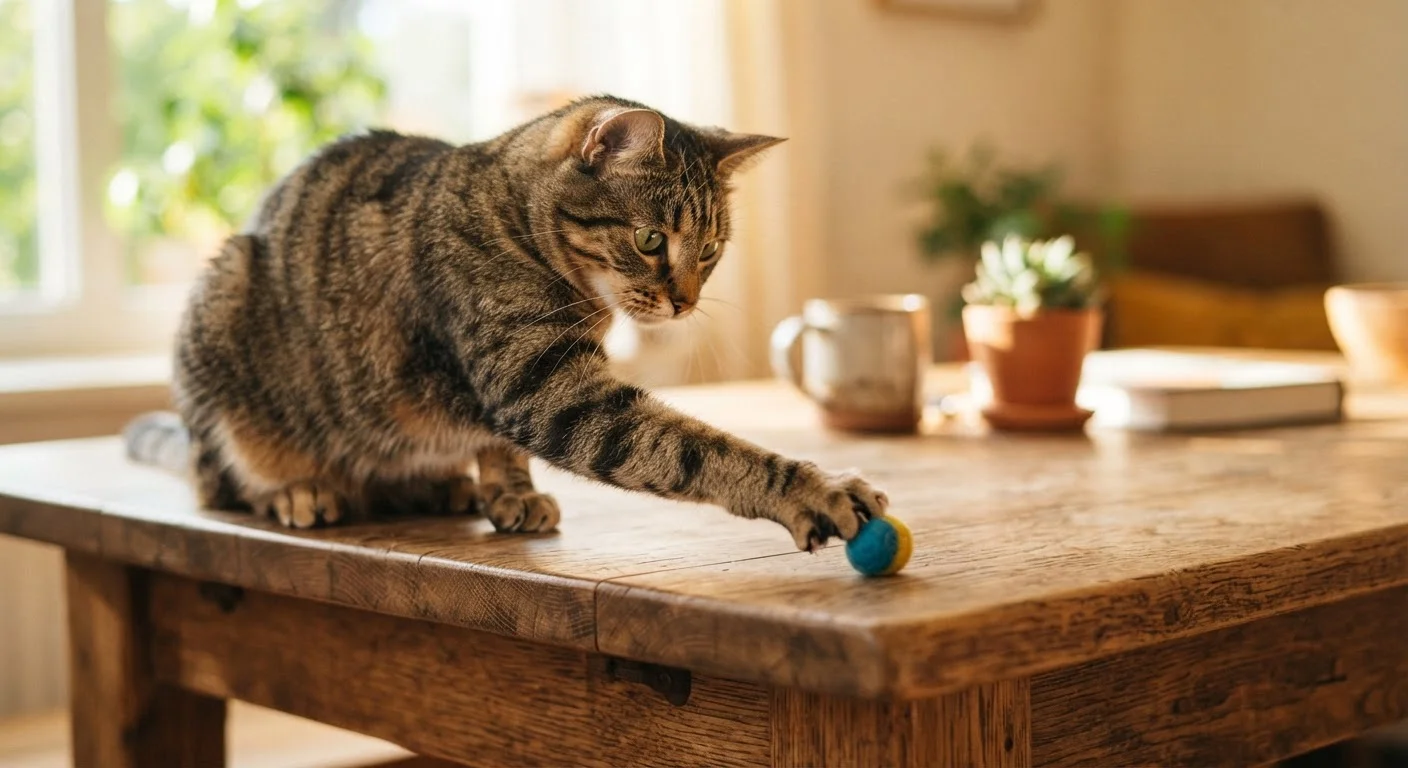
Cats batting or pushing objects off elevated surfaces is a natural behavior rooted in predatory instinct and sensory curiosity. It is not an act of spite or revenge. Cats use their paws to test the properties of objects - movement, texture, and response - the same way they would investigate potential prey in the wild.
Animal behaviorists categorize this under exploratory and predatory motor patterns, which remain active in domesticated cats regardless of whether they have ever hunted.
The Predatory Instinct Behind the Paw
Watch a cat slowly extend one paw toward a pen on the edge of a desk, tap it once, then send it sailing to the floor. It looks deliberate - almost theatrical. To many first-time cat owners, it reads as mischief or even a small act of defiance. In reality, it has nothing to do with your cat's feelings about you.
The behavior traces directly back to predatory instinct. Wild cats use their paws to pat at potential prey before committing to a full pounce. This testing motion helps them assess whether something is alive, how it moves, and whether it poses any danger. Your cat's paw-patting at a lip balm or a TV remote is activating the exact same neural circuitry - the object just happens to be sitting on your coffee table instead of the forest floor.
Cats are also natural edge-walkers and elevated-surface explorers. High vantage points offer safety and a clear view of their environment. Tables, shelves, and counters are prime real estate in a cat's mental map of your home. The objects sitting on those surfaces are, to a curious cat, simply part of the terrain worth investigating.
“Cats are not being spiteful when they knock things over - they are being cats. The behavior is rooted in predation and sensory exploration, not in any desire to frustrate their owners.”
— Dr. Karen Overall, Veterinary behaviorist and author of works on clinical behavioral medicine for small animals
Curiosity, Attention, and Learning by Doing
Beyond predatory behavior, cats are genuinely curious animals. They learn about their world through direct physical interaction. Pushing an object and watching it fall gives a cat immediate sensory feedback: it moves, it makes a sound, it disappears below the surface. That kind of cause-and-effect loop is mentally engaging - and cats notice when the same action reliably produces an interesting result.
There is also a social dimension worth understanding. If your cat knocks something over and you immediately leap up to respond, your cat registers that outcome. Over time, the behavior can become associated with getting your attention - not because your cat is being manipulative in a human sense, but because cats are skilled at identifying which actions produce a reaction from the people they live with. This is operant learning, and it is perfectly normal.
Try Scheduled Play Before Problem Times
If your cat tends to knock things over at predictable times - early morning or when you sit down to work - try a 10-minute interactive play session just beforehand. Burning off predatory energy at a scheduled time can reduce the urge to self-entertain with your belongings.
This is also why scolding rarely helps. Raising your voice or rushing toward your cat is still a reaction - still stimulating, still rewarding in the cat's behavioral framework. Quiet redirection and proactive enrichment are far more effective long-term strategies.
For a fuller picture of how cats communicate and bond with the people in their lives, see how cats show affection - many behaviors that look indifferent or troublesome are actually signs of comfort and trust.
What You Can Actually Do About It
Understanding the "why" makes the solution clearer. Cats that knock things over frequently are often telling you they need more stimulation. Interactive wand toys, puzzle feeders, and window perches that give them something real to watch are practical starting points. Our guide to keeping an indoor cat mentally stimulated covers enrichment strategies grounded in feline instinct.
74%
Indoor cats showing object-manipulation behavior
A commonly cited figure in applied animal behavior literature suggests the majority of indoor cats engage in some form of object patting or pushing, with frequency correlating to enrichment levels.
2-3x
More active in understimulated cats
Animal behaviorists generally observe that cats lacking adequate daily play and environmental enrichment exhibit exploratory and attention-seeking behaviors at notably higher rates.
Practically speaking, secure or relocate any items that are fragile or could cause injury if knocked down - glass objects, medications, or anything sharp. This is the fastest way to reduce immediate risk while you work on longer-term enrichment. It is also worth noting that this behavior tends to be more pronounced in younger cats and often mellows with age and adequate stimulation.
This is one of many feline behaviors that makes more sense once you understand the instincts driving it. Just like furniture scratching, object manipulation is not bad manners - it is your cat doing exactly what cats do. Working with those instincts, rather than against them, makes life easier for both of you.
If you are still in the early stages of getting to know your cat, what to expect when bringing your first cat home covers a lot of the foundational behavior questions new owners tend to have.