

Key Takeaways
Why Mental Enrichment Matters for Indoor Cats
Indoor cats live longer, safer lives on average - but safety without stimulation creates its own set of problems. Without outlets for natural behaviors like hunting, climbing, and investigating, cats can develop boredom-driven issues: destructive scratching, over-grooming, aggression, or excessive vocalization. These aren't personality flaws; they're signs of unmet needs.
Feline behaviorists describe the domestic cat as an "obligate predator" - hardwired to stalk, pounce, and capture prey multiple times a day. When that drive has nowhere to go, frustration builds. The good news is that enrichment doesn't require a large budget or elaborate setups. It requires understanding what your cat's instincts are actually asking for.
If you're still getting settled with a new cat, our guide for first-time cat owners covers the essentials of those early days. Once you've got the basics down, the list below will help you build a stimulating daily environment.
Set Up a Window Perch with a View
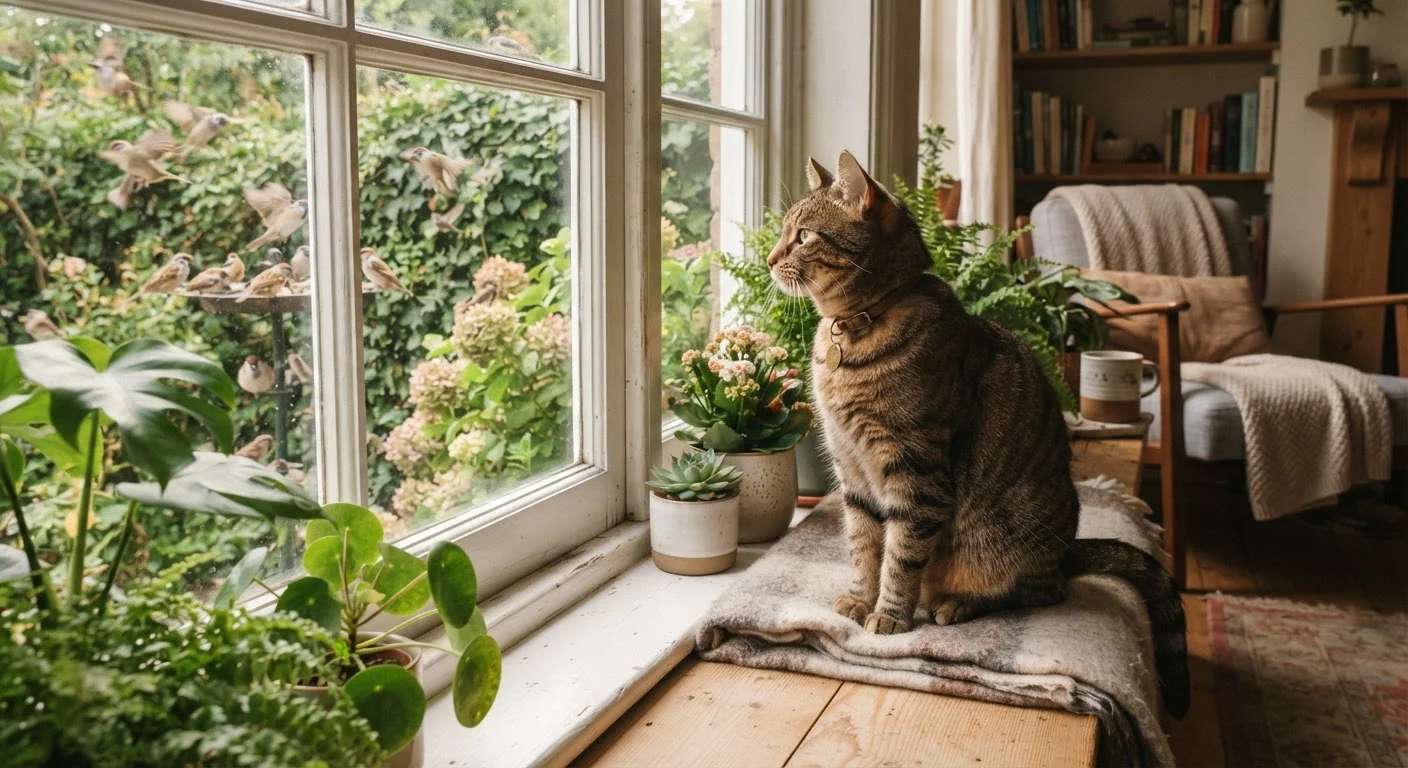
One of the simplest and most effective enrichment tools costs very little: a window perch or sturdy shelf positioned where your cat can watch the outdoors. Cats are highly visual hunters, and observing birds, squirrels, or even passing pedestrians engages their predatory instincts in a low-stress way - sometimes called "cat TV."
For best results, place a bird feeder or bird bath within your cat's sightline. Choose a south- or east-facing window for reliable daylight. Ensure the perch is stable enough that your cat feels secure, since a wobbly platform will deter use.
A window perch with an outdoor view is one of the most cost-effective enrichment tools available to indoor cat owners.
Use Puzzle Feeders Instead of a Standard Bowl
Feeding from a flat bowl takes seconds and bypasses the mental effort cats are built to expend while hunting for food. Puzzle feeders - containers that require a cat to manipulate, paw at, or sniff out their kibble - slow down eating and activate problem-solving instincts simultaneously.
Start with lower-difficulty puzzles if your cat is new to the concept; frustration can lead to avoidance rather than engagement. Licki mats, snuffle mats, and simple food-dispensing balls are widely available entry points. Gradually increasing complexity keeps the challenge fresh. For cats on wet food, check our comparison of dry and wet feeding options to understand which formats work best with puzzle feeders.
Replacing a standard bowl with a puzzle feeder turns every meal into a mentally engaging activity that mimics hunting.
Schedule Daily Interactive Play Sessions
No toy replaces a human on the other end of a wand. Interactive play - where you control a feather wand, a string toy, or a laser pointer (always end laser sessions with a physical "catch" so cats feel closure) - replicates the hunt cycle: stalk, chase, pounce, capture. This is the single most direct way to meet a cat's predatory drive.
Aim for two sessions per day of 10-15 minutes each, ideally once in the morning and once in the evening when cats are naturally most active. Move the toy erratically and unpredictably, mimicking real prey. Slow it down occasionally to let your cat "win." A cat that ends play feeling successful is less likely to redirect that energy toward furniture or your ankles.
Two 10-15 minute interactive play sessions daily can significantly reduce stress-driven behavior in indoor cats.
Add Vertical Space and Climbing Opportunities
In the wild, cats use elevation for safety, hunting vantage points, and territory management. Indoor cats retain this need. Cat trees, wall-mounted shelves, and multi-level condos allow cats to survey their environment from above - which lowers their perceived stress level considerably.
Vertical space is especially valuable in multi-cat households, where it expands usable territory without requiring additional floor space. If you're planning a cat-friendly home layout from scratch, the room-by-room setup checklist covers vertical space planning in detail. Position climbing structures near windows or social areas so cats choose to use them.
Vertical climbing structures reduce perceived stress by giving cats safe, elevated vantage points to survey their territory.
Rotate Toys Regularly to Maintain Novelty
Cats are novelty-seekers. A toy left out indefinitely becomes part of the furniture. Rotating a set of toys - offering three or four at a time, then swapping them out every few days - keeps familiar objects feeling new. You don't need to buy constantly; just manage what's available at any given moment.
Storing toys briefly with a pinch of dried catnip (for cats who respond to it - roughly 50-70% of cats are sensitive to catnip due to genetics) can reinvigorate their appeal. Crinkle balls, mylar balls, and small stuffed mice tend to hold cats' interest well because they move unpredictably and engage multiple senses - sound, texture, and movement - at once.
Rotating a small set of toys every few days costs nothing and reliably rekindles a cat's interest in familiar objects.
Introduce Safe Scent Enrichment
Cats experience the world heavily through scent - their olfactory system is estimated to be roughly 14 times more sensitive than a human's. Scent enrichment taps into this by introducing safe, novel smells that trigger exploratory behavior.
Options include dried herbs like valerian or silver vine (alternatives for cats who don't respond to catnip), cardboard boxes from deliveries (which carry new scent profiles), and paper bags with the handles removed for safe exploration. Avoid essential oils and synthetic fragrances, which can be toxic to cats. Even a paper towel rubbed briefly on an outdoor surface and placed in your cat's space can spark several minutes of intense sniffing and investigation.
Scent enrichment costs almost nothing and can trigger intense exploratory behavior by engaging a cat's powerful sense of smell.
Provide Appropriate Scratching Surfaces
Scratching is not destructive behavior - it's a necessary physical and communicative act that stretches muscles, sheds dead claw sheaths, and deposits scent from paw glands. An indoor cat without adequate scratching surfaces will find its own, usually your sofa.
Offer both vertical and horizontal scratching surfaces in materials your cat prefers - sisal rope, corrugated cardboard, and carpet are common favorites. Placement matters: scratching posts near sleeping areas and entry points to rooms are most likely to be used, since cats often scratch upon waking or when marking territory boundaries. Our article on redirecting scratching behavior explains how to work with - rather than against - this instinct.
Providing appropriate scratching surfaces in the right locations is enrichment and furniture protection in one practical step.
Building a Richer Environment - One Step at a Time
You don't need to implement every idea at once. In fact, introducing enrichment gradually - and rotating what's available - keeps novelty working in your favor. Cats are curious by nature, but they also habituate quickly to unchanging stimuli. A toy that was fascinating on Monday may be ignored by Friday if it never moves or changes.
Pay attention to which activities your individual cat gravitates toward. Some cats are avid climbers; others prefer ground-level hunting games. Some are social and love interactive play; others do well with solo puzzle challenges. Tailoring enrichment to your cat's personality is more effective than applying a one-size-fits-all formula.
Start Small and Observe Your Cat's Response
When introducing any new enrichment - a puzzle feeder, a climbing shelf, a new toy - give your cat a few days to warm up to it before concluding it isn't working. Some cats are cautious by nature and need time to investigate on their own terms. If something consistently gets ignored after a week of availability, try a different format rather than repeating the same approach.
Persistent behavioral changes - like sudden aggression, compulsive grooming, or appetite loss - can also signal underlying health issues rather than just boredom. If enrichment adjustments don't help, consult your veterinarian. Our overview of routine vet care for cats explains what to expect at checkups and when to seek professional input.
This article is for general informational purposes only and does not constitute veterinary or behavioral advice. Always consult a qualified veterinarian or certified animal behaviorist for concerns about your individual cat's health or behavior.