

| TPMS required since | 2008 (all new US passenger vehicles) (NHTSA Federal Motor Vehicle Safety Standard No. 138) |
| OBD-II required since | 1996 (all US cars and light trucks) (EPA and CARB standardization) |
| Recommended tire pressure | Listed on the driver's door jamb sticker - not the tire sidewall (Vehicle manufacturer specification) |
| Flashing Check Engine light | Reduce speed and seek same-day service - active misfire risk (General guidance from ASE-certified diagnostic standards) |
| Engine overheat: time to act | Pull over within 1-2 minutes of the warning light appearing (General industry guidance) |
Why First-Time Owners Ignore Warning Lights
It happens constantly: a light appears on the dashboard, nothing obviously changes about how the car drives, and the owner assumes it will probably sort itself out. Sometimes it does. Often it doesn't - and by the time a mechanic is involved, a straightforward fix has become a significant repair bill.
The core problem is that modern vehicles display many lights, and nothing in the standard licensing process teaches you which ones are genuinely urgent and which are informational. This guide cuts through that ambiguity. For a broader look at the surprises that catch new owners off-guard, see what first-time owners wish they'd known.
Your Owner's Manual Is the Definitive Reference
Warning light icons are not fully standardized across every manufacturer. A symbol on one make may look different from the same warning on another. The owner's manual in your glove box - or a digital version on the manufacturer's website - lists every light specific to your trim and model year. When in doubt, look it up before driving further.
The Lights That Mean Stop Now
These indicators signal conditions that can cause immediate mechanical damage or a direct safety risk if you keep driving.
| TPMS required since | 2008 (all new US passenger vehicles) (NHTSA Federal Motor Vehicle Safety Standard No. 138) |
| OBD-II required since | 1996 (all US cars and light trucks) (EPA and CARB standardization) |
| Recommended tire pressure | Listed on the driver's door jamb sticker - not the tire sidewall (Vehicle manufacturer specification) |
| Flashing Check Engine light | Reduce speed and seek same-day service - active misfire risk (General guidance from ASE-certified diagnostic standards) |
| Engine overheat: time to act | Pull over within 1-2 minutes of the warning light appearing (General industry guidance) |
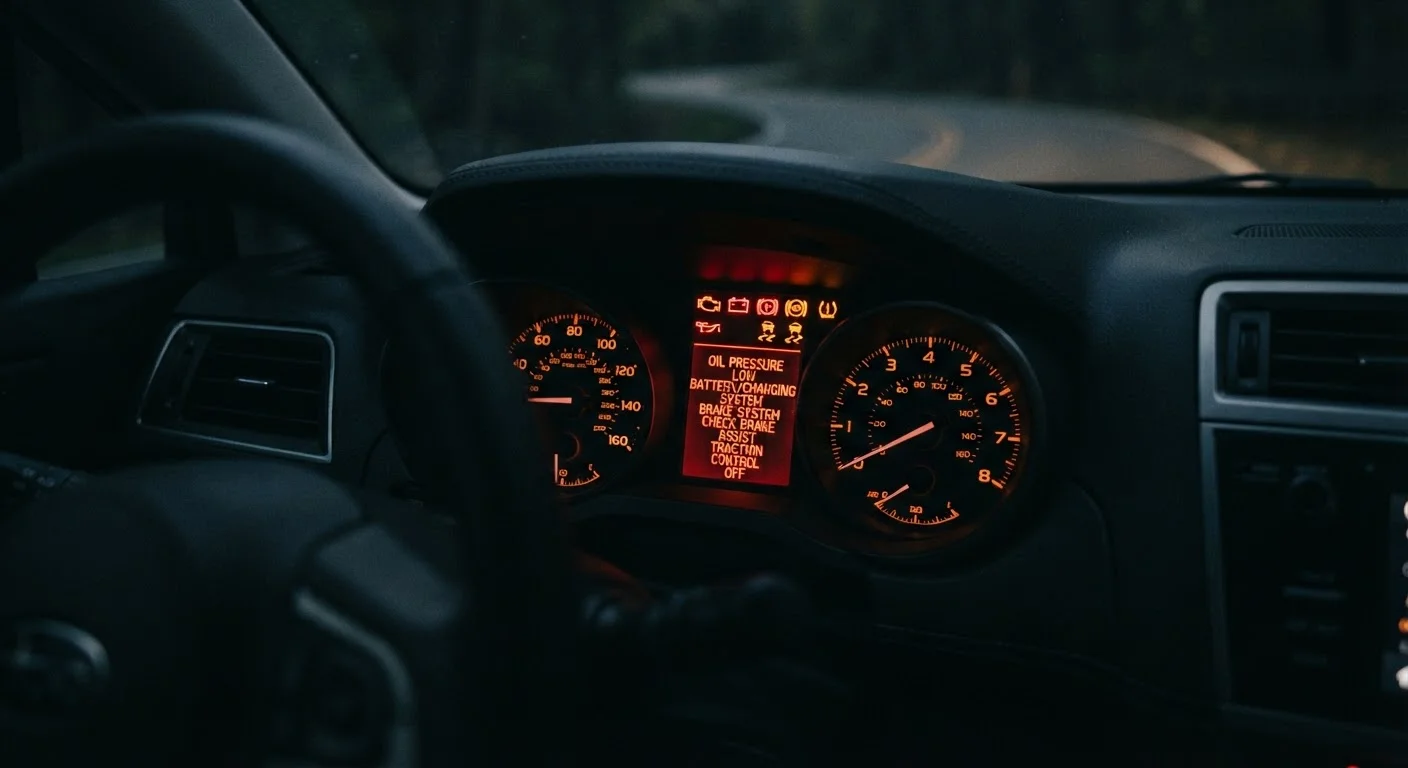
- Engine Temperature (red thermometer): Your engine is overheating. Pull over safely, switch off the engine, and do not open the radiator cap. Call roadside assistance. Even a short drive in this state can warp cylinder heads - a repair that frequently runs into thousands of dollars.
- Oil Pressure (red oil can): The engine is not receiving adequate oil pressure. Stop immediately; running without oil pressure destroys internal components within minutes.
- Battery / Charging System (red battery icon): The alternator may have failed, meaning the battery is now supplying all electrical power. The car will run until the battery is depleted - potentially only minutes on a highway. Drive directly to a workshop or pull over and call for help.
- Brake System (red exclamation mark or BRAKE text): First confirm the parking brake is fully released. If the light remains on, treat it as urgent - a brake system fault is not something to drive through.
Unusual sounds often accompany these failures before or after the light appears. Learn what different car noises mean so you can connect the dots early.
Amber Lights: Address Soon, Not Later
Amber or yellow lights generally mean something needs attention in the near future - not an immediate stop, but within days rather than weeks.
1 in 4
US cars driving with Check Engine light on
CarMD's Vehicle Health Index reports have consistently found roughly a quarter of vehicles on the road have an active MIL at any given time.
11,000+
Annual US crashes linked to tire failures
NHTSA research consistently associates under-inflated or failed tires with thousands of crashes each year in the United States.
~$400
Median cost of a Check Engine repair
CarMD data suggests the median repair triggered by a Check Engine light is in the low hundreds of dollars, though costs vary widely depending on the fault code.
- Check Engine / MIL (amber engine outline): A steady light means a fault code has been logged - schedule a diagnostic scan soon. A flashing Check Engine light is more serious: it indicates an active engine misfire that can damage the catalytic converter. Reduce speed and get it checked the same day.
- TPMS (amber tire cross-section with exclamation mark): One or more tires is 25% or more below the recommended pressure. Under-inflated tires handle poorly, wear unevenly, and blow out more easily. Check pressure at the next gas station; use the figure on the driver's door jamb sticker, not the number molded into the tire sidewall.
- Low Fuel (amber fuel pump): Habitually running near empty can accelerate fuel pump wear over time, since the pump draws cooling from the surrounding fuel.
- Traction Control (amber car with squiggly lines): A brief flash while accelerating on a slippery surface is normal system operation. A light that stays on without driver input can point to a wheel-speed sensor fault worth investigating.
Building the Dashboard Habit
The most practical step costs nothing: glance at your instrument cluster every time you start the car. Most vehicles illuminate all warning lights briefly on startup as a self-test - any that remain lit after the engine catches deserve your attention before you pull out of the driveway.
Pairing dashboard awareness with a quick physical check is even more effective. Our two-minute pre-drive safety routine covers checks that can catch problems before warning lights ever appear. To understand what's happening under the hood - particularly the fluids whose low levels trigger many warnings - this fluid reference guide explains what each one does and when it needs attention.
Malfunction Indicator Lamp (MIL)
The official name for the 'Check Engine' light. It signals that the vehicle's onboard diagnostic system has logged a fault code, which can range from a loose gas cap to a failing catalytic converter.
OBD-II
Onboard Diagnostics II - a standardized system built into all US vehicles sold after 1996 that monitors engine and emissions performance. Mechanics plug a scanner into the OBD-II port to read stored fault codes.
TPMS
Tire Pressure Monitoring System - a federally mandated sensor system required on all US passenger vehicles built after 2007 that alerts you when one or more tires drops significantly below the recommended pressure.
Coolant Temperature
A measure of how hot the fluid circulating around your engine is. When this exceeds a safe operating range, the engine can suffer severe and expensive damage within minutes.
Charging System
The combination of your car's battery and alternator. The alternator generates electricity while the engine runs; if it fails, the battery drains and the vehicle will eventually stop running.
Oil Pressure
The force at which engine oil is circulated through the engine's moving parts. A loss of oil pressure - distinct from simply being low on oil - can destroy internal engine components very quickly.
When a warning light does appear, photograph the dashboard and note whether the light is steady or flashing, and whether you noticed any change in how the car drives. That information helps a mechanic diagnose the fault faster and gives you a record if the light clears before your appointment.
This article is for general educational purposes only and is not a substitute for diagnosis by a qualified mechanic. Do not attempt repairs beyond your skill level, particularly work involving brake systems or electrical components.