

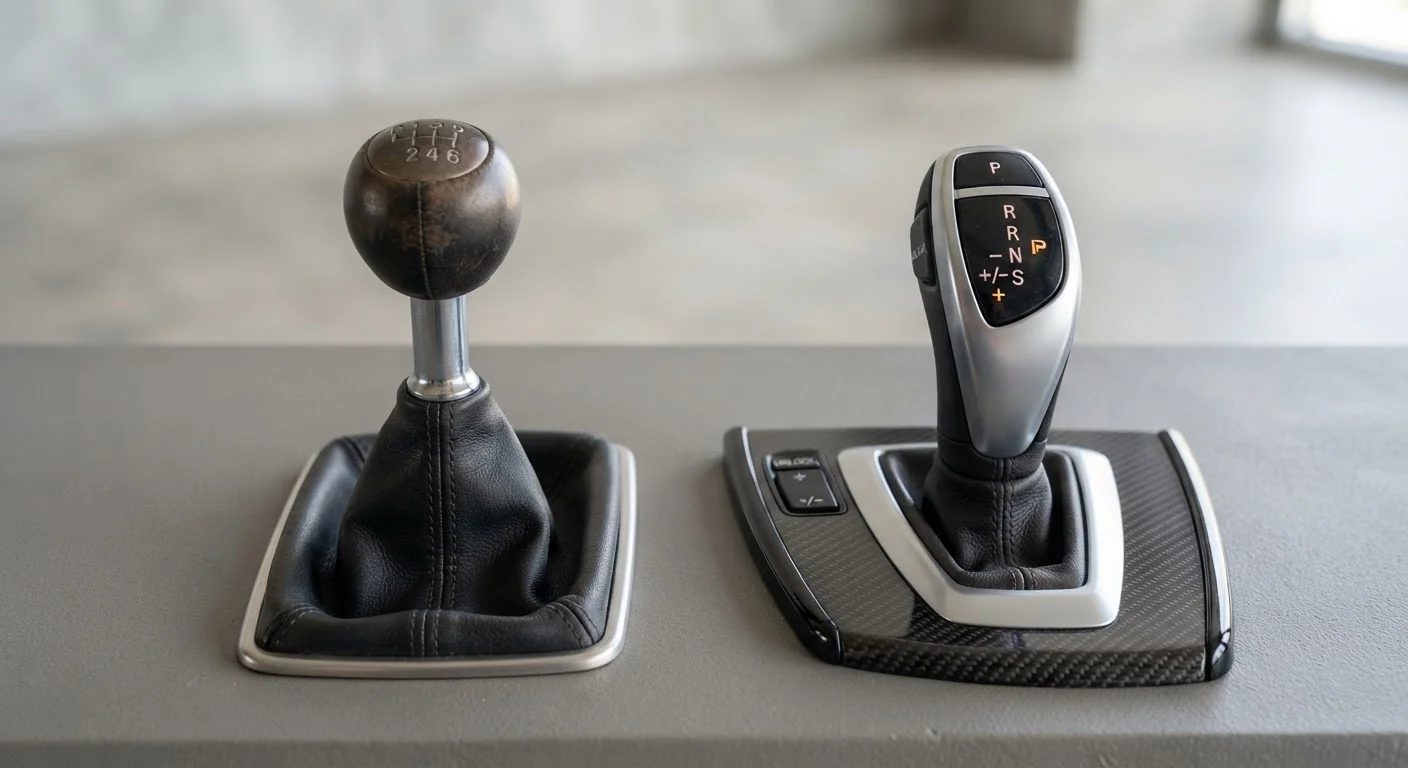
Key Takeaways
Option A
Manual Transmission
The hands-on, driver-in-control experience.
Best for: Drivers who want full engagement with the car and are willing to invest time learning clutch and gear coordination.
Option B
Automatic Transmission
The streamlined, lower-learning-curve choice.
Best for: Drivers who want to focus on road awareness and traffic rather than managing gears, especially in stop-and-go conditions.
If you're a brand-new driver focused on building road confidence
Automatic Transmission
Removing gear management from the equation lets you direct full attention to mirrors, spacing, and hazard awareness - skills that matter most in early driving.
If you want maximum flexibility for future driving situations
Manual Transmission
Learning manual means you can drive virtually any vehicle you encounter, including rentals abroad, work trucks, or older vehicles.
If you drive primarily in heavy urban stop-and-go traffic
Automatic Transmission
Repeated clutch engagement and gear changes in dense traffic is tiring and increases wear; automatics handle this workload seamlessly.
If you enjoy the physical and mental engagement of driving
Manual Transmission
Many drivers report that manual transmissions make routine drives feel more purposeful and keep attention more naturally focused on the road.
What It Actually Feels Like to Drive a Manual
Driving a manual transmission is a physical conversation with the car. Before you move, you're already managing three inputs simultaneously: the clutch pedal on your left, the throttle on your right, and the gear lever with your left hand. Getting rolling from a stop - called the bite point - means slowly releasing the clutch until you feel the car begin to pull forward, then balancing it with throttle. Do it too fast and the car stalls. Too slow and you lurch.
In the beginning, this process takes real concentration. Most new manual drivers stall at least a few times before the muscle memory locks in, and hills add a meaningful layer of difficulty because the car will roll backward if you release the brake before the clutch catches. A technique called hill starts - using the handbrake to hold position while you find the bite point - is a standard skill that instructors teach specifically for this reason.
Once you're moving, every gear change requires you to briefly disengage the engine by pressing the clutch, select the appropriate gear, and smoothly re-engage. In normal traffic, this happens every few seconds. The payoff is that you feel directly connected to how the engine is working - experienced manual drivers often describe it as knowing what the car is about to do before it does it. That feedback loop can actually reinforce good driving habits like anticipating speed changes early.
For new drivers already managing mirrors, signals, road position, and other traffic, the added cognitive load of manual gear changes is real. Give yourself a lower-stress environment - empty parking lots, quiet residential streets - to build the coordination before taking on busy roads. See our guide to your first solo drive for tips on staging your early practice sessions.
What It Actually Feels Like to Drive an Automatic
In an automatic, the car selects and changes gears for you using a hydraulic or electronic system that reads engine load and speed. From a driver's perspective, you press D for Drive, release the brake, apply throttle, and go. The transmission's shifts are largely invisible - you may notice a faint smoothing of power delivery as the car moves through gears, but there's nothing you need to do about it.
This simplicity is a genuine advantage for new drivers. Rather than dividing attention between clutch management and road observation, you can concentrate fully on steering, spacing, speed, and hazards. Research from driving safety organizations consistently points to divided attention as a risk factor in new-driver incidents, and removing one major coordination task reduces that load meaningfully.
| Criterion | Manual | Automatic |
|---|---|---|
| Learning curve | Steep - requires clutch coordination | Gentle - focus stays on road |
| Driver input required | Constant gear and clutch management | Throttle and steering only |
| Stop-and-go traffic | Fatiguing with repeated clutch use | Low effort, handles shifts automatically |
| Driving engagement | High - direct engine feedback | Lower - shifts largely invisible |
| Key maintenance item | Clutch assembly (wear-dependent) | Transmission fluid changes |
| Vehicle availability (US) | Roughly 4% of new car sales | Roughly 96% of new car sales |
| Flexibility to drive other vehicles | Can drive manual and automatic | May be limited with manual vehicles |
That said, automatics aren't completely passive. Selecting L (low gear) or using paddle shifters on vehicles that have them gives you some manual override capability - useful for engine braking on steep descents, for example. Modern automatics also include a Park (P) position that mechanically locks the transmission; always engage Park before leaving the vehicle, in addition to the handbrake.
The main adjustment for new automatic drivers is throttle sensitivity. Because you're not consciously managing gear engagement, it's easy to apply too much throttle in low-speed maneuvers like parking. Slow, deliberate inputs matter just as much here as they do in a manual.
Maintenance Differences Worth Knowing
Both transmission types require maintenance, but the nature and intervals differ. Manual transmissions use a clutch assembly that wears over time - how quickly depends heavily on driving style. Riding the clutch (keeping your foot partially depressed when not changing gears) accelerates wear significantly. Clutch replacement is a substantial repair cost, making driving technique a direct maintenance variable.
Automatic transmissions rely on transmission fluid to lubricate and cool internal components. Many manufacturers specify fluid changes every 30,000 to 60,000 miles, though interval recommendations vary widely by vehicle. Check your owner's manual rather than assuming a universal interval applies. For a broader look at how service intervals work, our car maintenance schedule explainer breaks it down clearly.
Transmission Fluid Is Not Engine Oil
New drivers sometimes confuse transmission fluid with engine oil - they serve different systems and have separate reservoirs. Automatic transmission fluid (ATF) is typically checked via a dedicated dipstick or sealed system, depending on the vehicle. Consult your owner's manual for the correct check procedure and fluid type. For a primer on engine oil specifically, see our engine oil guide for new drivers.
Automatic transmissions are generally more complex mechanically, which can mean higher repair costs if problems develop. However, with proper fluid maintenance and avoiding aggressive driving patterns - like shifting from Reverse to Drive while still moving - they're typically reliable across normal driving lifespans. Whichever type you drive, building a pre-drive safety check routine is a low-effort habit that catches problems before they grow.