

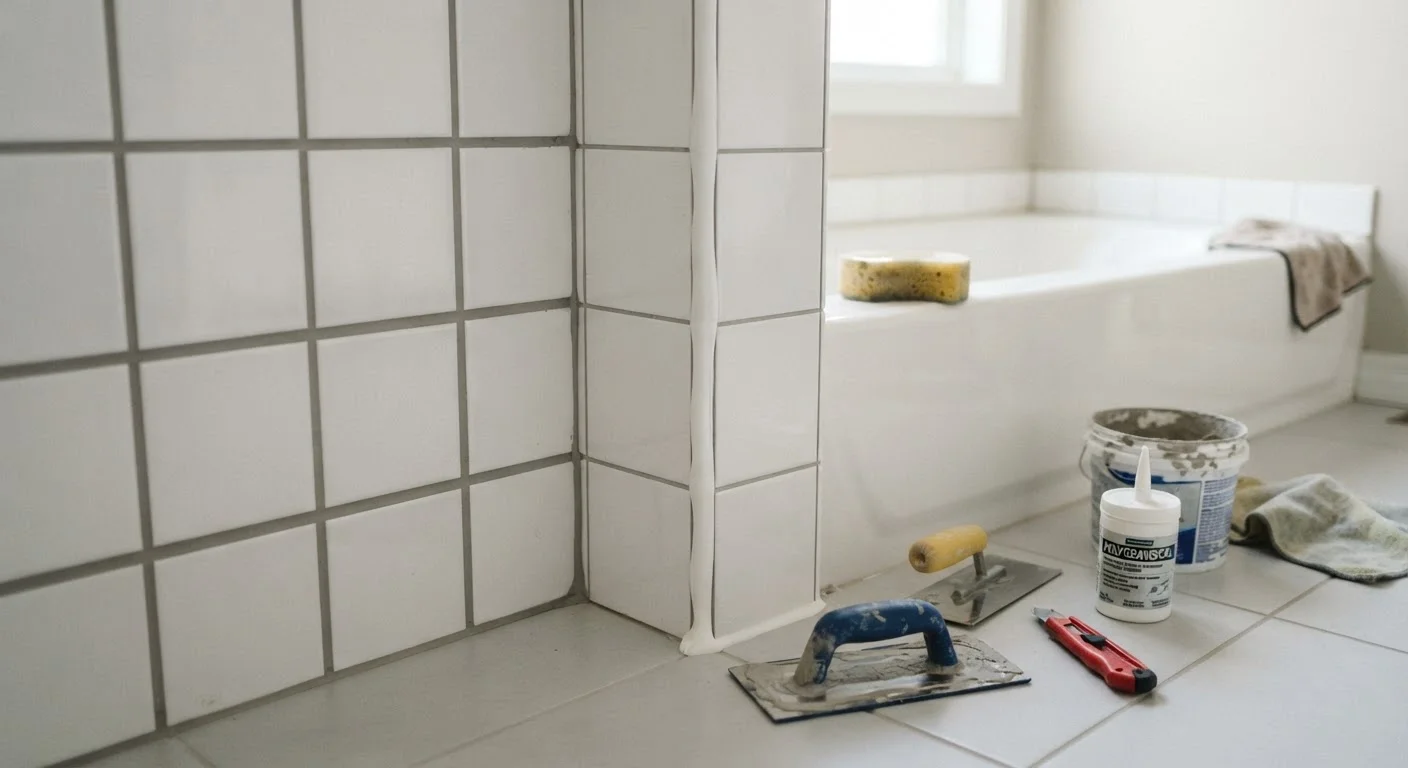
Key Takeaways
Option A
Grout
The rigid, durable filler for stable tile fields.
Best for: Filling the joints between tiles on flat, non-moving surfaces like floors and shower walls.
Option B
Caulk
The flexible, waterproof sealant for movement-prone joints.
Best for: Sealing corners, transitions, and any joint where two surfaces meet at an angle or shift with temperature.
If you are filling the joints between wall or floor tiles on a flat surface
Grout
Grout is hard-wearing and bonds tile edges together on stable planes. It resists the compressive forces of foot traffic and daily use without flexing.
If you are sealing the corner where your shower wall meets the tub or floor
Caulk
Corners experience micro-movement as the building settles and materials expand with heat. Only flexible caulk can absorb that movement without cracking.
If you are repairing a joint that keeps cracking every year
Caulk
Recurring cracks in a filled joint almost always signal movement. Switching to caulk accommodates that movement and breaks the repair cycle.
If you need a watertight seal around a fixture like a sink or bathtub rim
Caulk
Fixtures flex under weight and vibration. Caulk maintains a continuous watertight bond even as the fixture moves slightly, which grout cannot do.
What Makes Grout and Caulk Different
Grout and caulk are both used to fill gaps in tiled spaces, and from a distance they can look nearly identical once dried. But their chemistry and physical properties are fundamentally different - and those differences determine exactly where each material belongs.
Grout is a cement-based (or sometimes epoxy-based) compound that cures hard and rigid. It is designed to fill the uniform joints between tiles and bond their edges together, creating a stable, cohesive surface. Because it does not flex, it performs best on flat planes where the substrate beneath does not shift.
Caulk is a silicone, latex, or acrylic compound that remains slightly pliable after curing. That flexibility is its key advantage: caulk can stretch and compress slightly without losing its seal, making it ideal for joints that experience any movement at all.
| Criterion | Grout | Caulk |
|---|---|---|
| Composition | Cement- or epoxy-based | Silicone, latex, or acrylic |
| Flexibility when cured | Rigid | Slightly pliable |
| Best joint type | Flat, same-plane tile joints | Corners, transitions, fixture edges |
| Water resistance | Good when sealed | Excellent (especially silicone) |
| Handles movement | No - cracks under movement | Yes - designed for movement |
| Typical lifespan (wet area) | Decades if stable | 2-5 years before reapplication |
| Beginner application difficulty | Moderate | Relatively straightforward |
A useful rule of thumb: if a joint will ever experience movement - from building settlement, thermal expansion, moisture, or the weight of someone stepping in or out of a tub - that joint needs caulk, not grout.
Where Each Material Belongs in a Bathroom
The bathroom is where the grout-versus-caulk decision matters most, because both water exposure and structural movement are constant factors. Getting the placement wrong does not just look bad - it can allow water to penetrate behind tiles and cause serious damage over time.
Use grout for:
- Joints between wall tiles on a flat shower surround
- Joints between floor tiles
- Any tile field where the tiles sit on a single plane and the substrate is rigid
Use caulk for:
- The corner where the shower floor meets the shower walls (an inside corner)
- The joint where a tub deck meets the tiled wall above it
- Around the perimeter of a sink, toilet base, or any fixed fixture
- Anywhere two different building materials meet, such as tile meeting drywall or wood trim
For a deeper look at bathroom-specific placement, see our guide to grout and caulk placement in bathrooms.
Matching Caulk Color to Your Grout
When replacing grout in a corner with caulk, appearance matters. Most tile suppliers and home improvement retailers stock sanded caulk formulated to closely match common grout colors. Choosing a color-matched caulk keeps the transition visually seamless. Apply a small test bead and allow it to dry before committing to a full run, since caulk colors can shift slightly as they cure.
Application and Maintenance: What to Expect
Beyond placement, grout and caulk differ in how they are applied, how long they last, and what maintenance they require.
2-5 years
Typical caulk lifespan in wet areas
Industry guidance from tile and waterproofing professionals generally recommends inspecting shower caulk annually and replacing it every few years.
~$5-15
Approximate cost of a caulk tube
Resealing a shower corner is one of the most cost-effective preventive maintenance tasks available to homeowners, compared to the expense of water-damage repairs.
Applying grout involves mixing the powder to a smooth consistency, spreading it diagonally across the tile joints with a rubber float, and then wiping away the excess before it hardens. Once dry, sanded grout lines are typically sealed with a penetrating grout sealer to reduce staining and moisture absorption.
Applying caulk is generally more straightforward for beginners: cut the nozzle at an angle, apply a continuous bead along the joint, and smooth it with a wet finger or caulk tool. The surface must be completely dry and free of old caulk or soap residue, or the new caulk will not bond properly.
In terms of longevity, well-applied grout in a stable location can last decades. Caulk in a wet area like a shower corner typically requires reapplication every two to five years as it gradually breaks down from moisture and movement. If you notice caulk that is cracked, peeling, or discolored, replacing it promptly is one of the most effective ways to prevent water infiltration. Our article on why caulking fails and how to fix it walks through the most common failure points and repair steps.