

Key Takeaways
Risk-Return Trade-Off
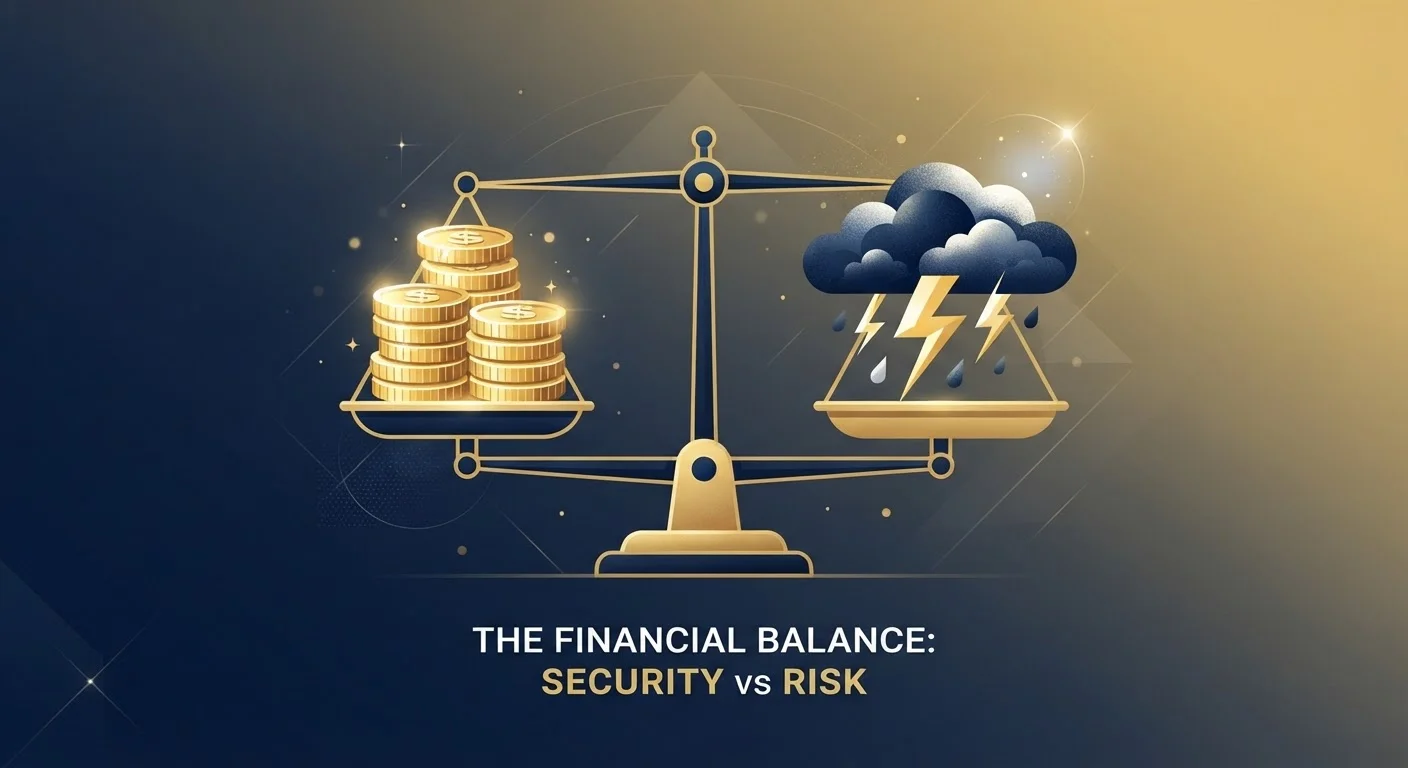
The risk-return trade-off is the fundamental investing principle that higher potential gains require accepting a greater chance of loss. Investments that offer the possibility of strong growth also carry more uncertainty about outcomes. Conversely, lower-risk investments tend to offer more predictable - but smaller - returns.
In finance, risk is often measured as the volatility or standard deviation of an asset's returns over time. Assets with wider swings in price are considered higher-risk, regardless of direction.
Why Risk and Return Are Always Linked
If you could earn high returns with zero chance of loss, everyone would pile into that investment until the opportunity disappeared. That's essentially why the risk-return trade-off exists: markets price assets in ways that reflect their uncertainty. An investment that could double your money in two years must, by its nature, also carry a meaningful possibility of significant loss - otherwise rational investors would flood in and eliminate the excess return.
This principle applies across the entire investing landscape. Government bonds from stable economies pay modest, predictable interest because they carry relatively low default risk. Shares in a single early-stage company might offer dramatic upside, but the odds of that company failing are also real. Neither option is objectively better - they simply represent different positions on the risk-return spectrum.
If you're still building a foundation, see what investing actually means before exploring how risk fits into the picture.
~10%
Average annual US stock market return (historical)
The S&P 500 has averaged roughly 10% annual returns before inflation over the long run, according to widely cited historical data - though individual years vary dramatically and past performance does not guarantee future results.
30%+
Typical peak-to-trough decline in a bear market
Major US market downturns have historically produced peak-to-trough declines of 30% or more, illustrating the real short-term risk that accompanies the long-run return potential of equities.
~2-3%
Average annual US inflation rate (long-run)
Based on long-run CPI data, inflation steadily erodes purchasing power - underscoring that 'safe' cash savings carry their own form of risk if returns fall below inflation.
The Different Flavors of Investment Risk
Risk is not a single, uniform thing - several distinct types can affect an investment's outcome:
- Market risk: The possibility that overall market conditions cause prices to fall, affecting nearly all investments simultaneously.
- Concentration risk: The danger of having too much exposure to one company, sector, or geography, so a single bad outcome hits your portfolio hard.
- Inflation risk: The slow erosion of purchasing power when investment returns don't keep pace with rising prices - a very real concern for cash savers.
- Liquidity risk: The chance that you can't convert an investment to cash quickly when you need to, without accepting a steep discount on its value.
- Credit risk: Relevant for bonds - the possibility that the borrower (a company or government) cannot make interest or repayment obligations.
Understanding which risks are present in a given investment helps you evaluate it more clearly. For a breakdown of how different asset types carry different risk profiles, see stocks, bonds, and funds explained.
Beware of 'Low Risk, High Return' Claims
If an investment is marketed as offering high returns with little or no risk, treat that claim with serious skepticism. The risk-return trade-off is one of the most durable principles in finance - genuine exceptions are extraordinarily rare. Promises that defy this relationship are a common feature of investment fraud.
Finding Your Risk Tolerance
Risk tolerance is not a fixed personality trait - it's shaped by your circumstances. Three questions help frame it:
- What is your time horizon? Money you won't need for 20 years can ride out market downturns. Money needed in 18 months cannot afford significant volatility.
- What is your financial cushion? If your invested funds represent your entire savings, a 30% drop becomes a crisis. If you have an emergency fund and stable income, the same drop is painful but manageable.
- What is your emotional response to losses? Some investors can watch their portfolio fall and hold steady; others panic-sell at the worst moment, locking in losses. Honest self-assessment here matters more than most people admit.
No single risk level is correct for everyone. A 25-year-old investing toward retirement operates in a fundamentally different context than someone approaching a major purchase in two years. The goal is alignment - matching the risk level of your investments to the realistic demands and timelines of your life.
One of the most practical tools for managing risk without abandoning return potential is diversification. Diversification explained covers how spreading exposure across different assets reduces concentration risk in practical terms.
This article is for general educational purposes only and does not constitute personalized financial or investment advice. Please consult a qualified financial adviser for guidance specific to your circumstances.