

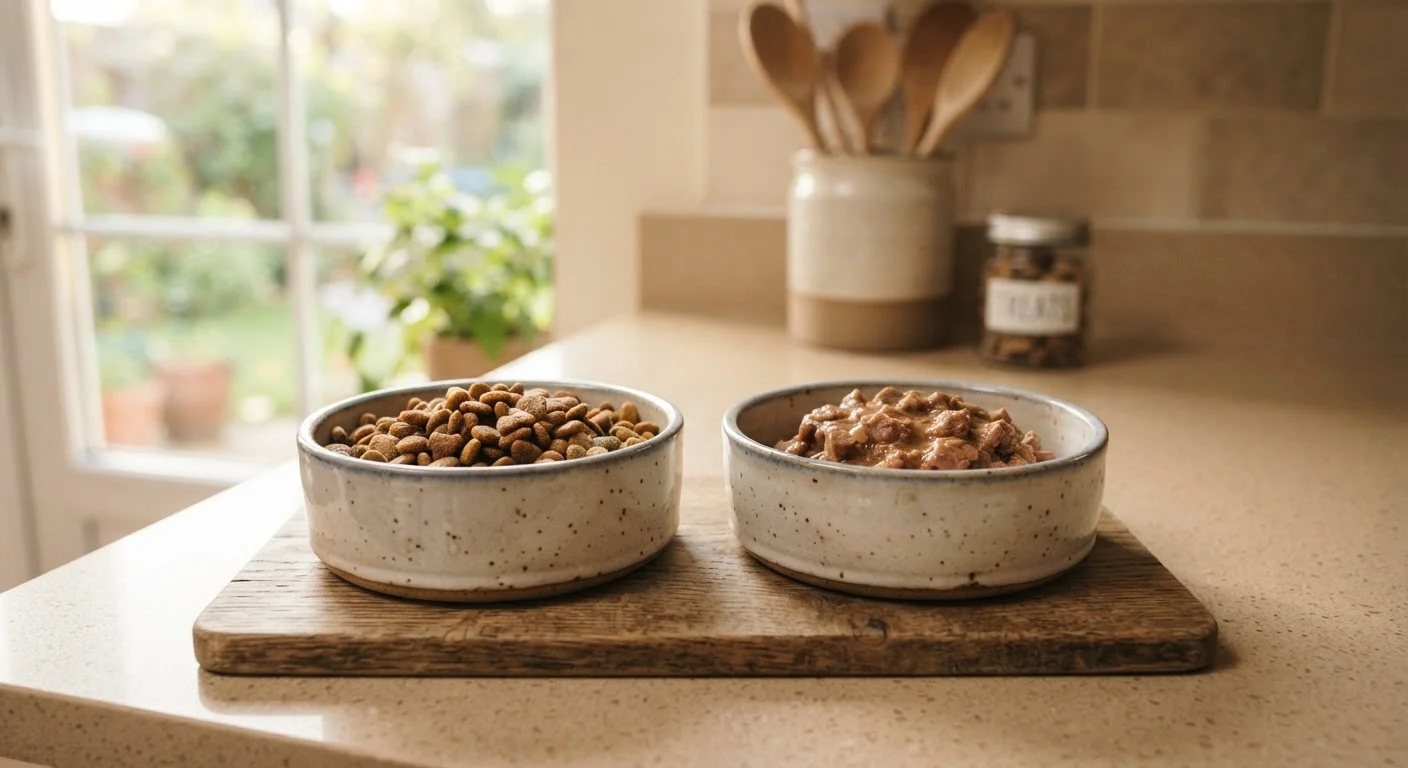
Key Takeaways
Option A
Dry Cat Food (Kibble)
The convenient, long-lasting everyday staple.
Best for: Owners seeking affordable, easy-to-store meals for healthy adult cats with no hydration concerns.
Option B
Wet Cat Food
The moisture-rich option that mirrors a cat's natural diet.
Best for: Cats prone to urinary issues, picky drinkers, seniors, or kittens needing extra hydration and palatability.
If your cat has a history of urinary tract issues or kidney disease
Wet Cat Food
The high moisture content (roughly 70-80%) supports urinary tract health and encourages overall fluid intake, which vets commonly recommend for these conditions.
If budget and convenience are your top priorities
Dry Cat Food (Kibble)
Kibble costs significantly less per serving and can be left out for free-feeding without spoiling, making it practical for busy households.
If you have a senior cat with reduced appetite or dental loss
Wet Cat Food
Wet food's soft texture is easier to chew and its strong aroma is more appealing to older cats whose sense of smell may have diminished.
If you want a balanced approach for a healthy adult cat
Dry Cat Food (Kibble)
A quality dry food supplemented with occasional wet food provides nutritional variety while keeping costs manageable - discuss ratios with your vet.
If your cat is overweight and needs careful calorie management
Wet Cat Food
Wet food's lower calorie density per gram makes it easier to feed satisfying portion sizes without overshooting daily caloric targets.
How Dry and Wet Cat Food Actually Differ
At their core, dry and wet cat foods differ in one fundamental way: water content. Dry kibble typically contains about 10% moisture, while wet food generally contains 70-80%. This distinction has a cascade of effects on nutrition, digestion, and long-term health.
Both formats are formulated to meet cats' specific nutritional requirements - including their need for animal-derived protein and taurine (an amino acid cats cannot synthesize in adequate amounts on their own). The difference lies not so much in what nutrients are present, but in how they're delivered and how a cat's body processes them.
Dry food concentrates calories into a small volume, which makes it easy to measure and store - a sealed bag can last weeks. Wet food, once opened, must be refrigerated and used within a day or two. Understanding these practical realities helps first-time owners plan feeding routines that actually work for their lifestyle. For more on how diet fits into broader cat care, see our guide on routine vet care across life stages.
| Criterion | Dry Food (Kibble) | Wet Food |
|---|---|---|
| Moisture content | ~10% | 70-80% |
| Calorie density | High per ounce | Lower per ounce |
| Hydration support | Minimal | Significant |
| Storage convenience | Weeks in sealed bag | 1-2 days once opened |
| Typical cost per serving | Lower | Higher |
| Palatability for picky eaters | Variable | Generally higher |
| Suitability for seniors | Depends on dental health | Often preferred |
| Dental benefit evidence | Modest, product-specific | Minimal |
Hydration, Urinary Health, and Why Moisture Matters
Cats evolved as desert animals, which means their thirst drive is relatively low compared to dogs. In the wild, they obtained most of their water from prey. A cat eating only dry kibble may chronically consume less water than is ideal, which can increase the risk of urinary tract problems and, over time, contribute to kidney strain.
Wet food can be a useful tool for boosting fluid intake without relying on a cat to drink more from a bowl. Veterinary guidance often recommends wet food - or at least incorporating it regularly - for cats with a history of urinary crystals, bladder disease, or chronic kidney disease. That said, a cat drinking adequate water from a fountain or multiple bowls can do well on dry food too. The key is monitoring your individual cat's hydration rather than assuming one format always solves or creates problems.
70-80%
Moisture content in wet cat food
Compared to roughly 10% in dry kibble, wet food closely mirrors the water content found in whole prey animals.
~50%
Estimated cats with urinary issues benefiting from increased hydration
Veterinary literature broadly associates low fluid intake with higher risk of feline lower urinary tract disease (FLUTD).
2-4×
Typical cost premium of wet vs. dry food
Per-calorie calculations generally show wet food costs significantly more, making mixed feeding a common budget-conscious compromise.
Dental Health, Weight, and Cost Considerations
Dental health: Dry food is often marketed as better for teeth because the crunching action may reduce plaque buildup. The evidence here is modest - most kibble shatters rather than scraping teeth the way a dental chew does. The Veterinary Oral Health Council (VOHC) certifies specific products that meet plaque-reduction standards; the food format alone isn't a reliable proxy for dental benefit. Regular toothbrushing or vet-recommended dental care remains the most effective approach.
Weight management: Because kibble is calorie-dense, free-feeding (leaving food out all day) can make it easy for a cat to overeat. Measured meals, whether dry or wet, are generally recommended by veterinarians for cats prone to weight gain. Wet food's lower calorie density can give owners more flexibility in portion sizes.
Cost: Dry food is consistently more affordable per calorie. High-quality wet food - particularly pâté or meat-based varieties - can run two to four times the cost of equivalent dry nutrition. A mixed feeding approach, using wet food as a supplement rather than the sole diet, is one way to capture some benefits of both formats without dramatically increasing food costs. This kind of practical balance is worth discussing at your next vet visit. See our overview of what to expect at routine vet appointments for context on when to raise nutrition questions.
Matching Food Format to Your Cat's Life Stage
A cat's nutritional needs shift considerably from kittenhood through senior years. Kittens generally benefit from wet food's high protein content and palatability during rapid growth phases - it's also easier for small mouths. Adult cats in good health often thrive on quality dry food with adequate water access. Senior cats, particularly those with dental loss or diminished appetite, frequently do better with wet food's softer texture and stronger aroma.
Cats with specific medical conditions - hyperthyroidism, diabetes, inflammatory bowel disease, kidney disease - may have dietary requirements that make one format clearly preferable. In these cases, your veterinarian's recommendation should take precedence over general guidance. If you've recently adopted a cat and are unsure where to start, our article on adopting a kitten vs. an adult cat covers how age affects care decisions more broadly.
When transitioning between food types - or introducing any new formula - do so gradually over seven to ten days to minimize digestive upset. Mix a small amount of the new food into the current food, slowly increasing the proportion. Abrupt switches can cause vomiting or diarrhea even with high-quality foods.
This article provides general educational information about cat nutrition and is not a substitute for personalized veterinary advice. Always consult a licensed veterinarian before making changes to your cat's diet, especially if your cat has existing health conditions.