

Key Takeaways
Why Cat Introductions Go Wrong
Most people assume that because cats are small and domesticated, they'll work things out on their own if you simply put them in the same room. That assumption causes the majority of multi-cat household failures. Domestic cats are fundamentally territorial animals. Your resident cat has mentally mapped every inch of your home and considers it their exclusive resource. A stranger appearing without warning registers as a genuine threat - not an opportunity for friendship.
The stress response this triggers isn't just behavioral. Cats under sustained social stress are more prone to hiding, over-grooming, inappropriate elimination, and suppressed immune function. Getting the introduction right protects both animals' physical and mental health. If you're still in the planning stages, our guide to setting up a cat-friendly home covers the vertical space and resource placement that makes cohabitation easier from the start.
Patience Is Doing the Work
The most common mistake owners make is accelerating the timeline because things look fine on the surface. Two to four weeks is a normal introduction window - some cats take longer. Moving too fast resets progress and can create fear responses that are much harder to undo than going slowly in the first place.
What You'll Need Before You Begin
Preparation matters as much as execution. Before the new cat arrives, gather your supplies and designate spaces.
What you will need
Separate safe room
Gives the new cat a controlled, low-stress space and prevents unsupervised contact during early phases.
Extra litter box
Prevents resource competition - one of the most common triggers of inter-cat aggression in shared households.
Soft cloth or sock for scent transfer
Used to rub each cat's cheeks and transfer their individual scent to the other's space without direct contact.
Puzzle feeder or food-dispensing toy
Keeps the new cat mentally occupied during isolation and reduces anxiety-driven pacing.
Baby gate with a cat door or small gap
Allows visual contact with a physical barrier during the middle introduction phases.
The Step-by-Step Introduction Process
Follow these steps in order. Do not skip phases because things seem to be going well - each stage builds a layer of trust that the next stage depends on.
Set up the safe room before the new cat arrives
Place a litter box, food, water, bedding, and at least one hiding spot (a cardboard box works) in the designated room. The new cat should go directly into this room when they arrive and stay there exclusively for the first three to five days. Do not allow the resident cat access to this room.
Begin scent swapping - no visual contact yet
After two to three days, take a soft cloth and gently rub it along the new cat's cheeks and face. Place that cloth near the resident cat's food bowl. Do the same in reverse - a cloth carrying the resident cat's scent goes into the safe room. Repeat once or twice daily. The goal is for each cat to associate the other's smell with something neutral or positive (proximity to food is ideal).
Swap living spaces temporarily
Once both cats seem calm around the scent cloths, briefly swap their environments while keeping them separated. Let the new cat explore the main living area while the resident cat spends time in the safe room. This deepens scent familiarity with the actual territory, not just a cloth, and reduces the shock of eventual face-to-face contact.
Introduce shared meals through a closed door
Feed both cats on opposite sides of the safe room door at the same time, bowls placed close enough to the door that they can smell each other while eating. Start with bowls a few feet from the door and move them gradually closer over several days as both cats eat without signs of distress. This step builds the most durable positive association in the entire process.
Allow limited visual contact with a barrier
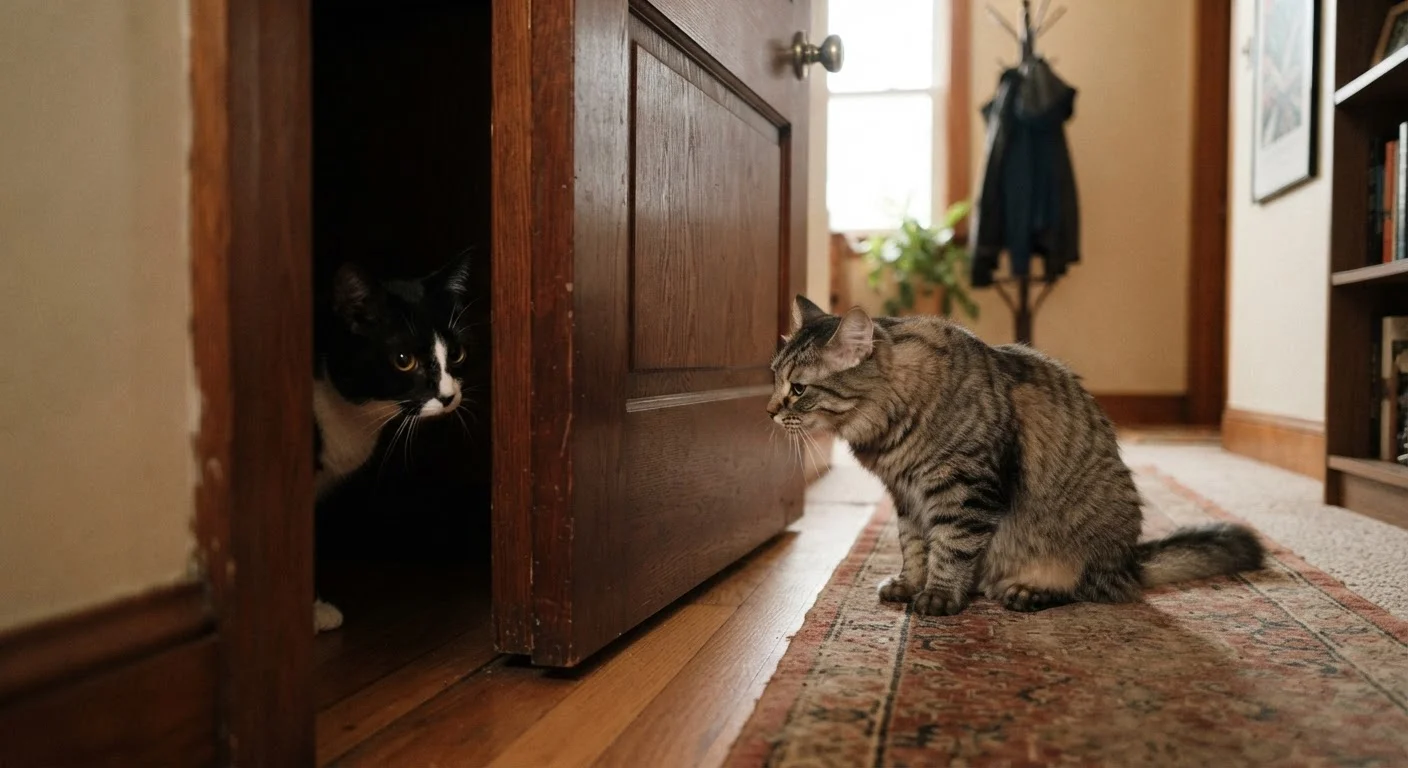
Crack the door an inch, use a baby gate, or prop the door with a doorstop that creates a gap too small to pass through. Let both cats approach voluntarily - never force proximity. Sessions should be short (five to ten minutes) and always supervised. End on a calm note; if tension escalates, separate them and try again the next day.
Supervised face-to-face meetings in a neutral space
Once both cats can see each other through a barrier without sustained hissing or avoidance, allow brief, fully supervised access in a shared space. Stay calm and present - do not hover anxiously, as cats read human stress. Keep sessions short and distract with wand toys or treats if tension rises. Gradually extend time together as both cats demonstrate they can share the space without sustained conflict.
Never Punish Hissing or Growling
These vocalizations are your cats communicating discomfort - suppressing them doesn't reduce the underlying stress, it just removes your visibility into how each cat is coping. Punishment during introductions can cause the cats to associate each other with something negative, making successful cohabitation harder to achieve.
Reading the Signals: Normal vs. Concerning
Knowing what to expect prevents you from intervening too early - or too late. Normal early behaviors include hissing, growling, puffed tails, and retreating. These are communication signals, not attacks. They typically diminish over one to two weeks as familiarity grows.
Concerning behaviors that warrant slowing down or separating the cats again include: sustained stalking, cornering, screaming fights with physical contact, or one cat refusing to eat or use the litter box. If those appear, return to an earlier phase and consult your veterinarian or a certified animal behaviorist.
Once your cats are comfortably coexisting, enrichment becomes the next priority. A bored cat is a more reactive cat - our indoor cat enrichment guide offers practical ideas grounded in feline instinct. And if you're still learning the ropes with your first cat, bringing your first cat home covers the fundamentals that often get overlooked.
This article is for general informational purposes only and is not a substitute for advice from a qualified veterinarian or certified animal behaviorist.