

Key Takeaways
Start here
What Engine Oil Actually Does
Next
Decoding Viscosity Ratings
Build confidence
How to Check Your Oil Level
Stay on schedule
When to Change Your Oil
Stay alert
Warning Signs You Shouldn't Ignore
What Engine Oil Actually Does
Your engine contains hundreds of metal parts moving at high speed, often under extreme heat. Engine oil is what keeps those parts from grinding each other into scrap. It performs three essential jobs simultaneously: lubrication (creating a film that prevents metal-on-metal contact), cooling (carrying heat away from parts the coolant can't reach), and cleaning (suspending dirt, carbon deposits, and microscopic metal particles so they get trapped in the oil filter).
Without oil, an engine can seize and fail in a matter of minutes. With degraded or insufficient oil, damage accumulates gradually - quietly raising your future repair bill. That's why engine oil is the single most important fluid under your hood. For a look at what the other fluids do, see our reference guide to all under-hood fluids.
Viscosity
How thick or thin a fluid is and how easily it flows. Engine oil viscosity affects how well it lubricates parts, especially during cold starts or high heat.
Viscosity Grade
A standardized code (e.g., 5W-30) that tells you how an oil performs at cold and operating temperatures. Your owner's manual specifies the correct grade for your engine.
Oil Sump
The reservoir at the bottom of your engine that holds the oil when it's not actively circulating. The dipstick measures how much oil is in the sump.
Oil Filter
A replaceable component that traps dirt, metal particles, and contaminants as oil circulates through the engine. It's usually replaced at every oil change.
Oil Life Monitor
A system built into many modern vehicles that tracks driving conditions and calculates when an oil change is actually needed, rather than relying on a fixed mileage interval.
Full Synthetic Oil
A chemically engineered oil that offers more consistent performance across temperatures and typically longer service intervals than conventional (petroleum-based) oil.
Decoding Viscosity Ratings
Every bottle of engine oil has a label like 5W-30 or 10W-40. This is the oil's viscosity rating - a measure of how it flows at different temperatures. The number before the W (which stands for Winter) describes cold-weather flow; the number after describes flow at normal operating temperature. A lower first number means the oil stays thinner in cold weather, helping your engine start cleanly on freezing mornings.
The right grade for your car is not guesswork - it's printed in your owner's manual and sometimes on the oil cap itself. Using the wrong viscosity can reduce fuel efficiency, increase engine wear, or in some cases affect oil pressure. Don't rely on what was used at your last oil change if you're unsure; look it up directly. Your owner's manual is the authoritative source.
Find Your Grade in 30 Seconds
Open your glove box and look up 'engine oil' or 'motor oil' in your owner's manual index. The required viscosity grade is usually listed clearly in the engine specifications section. Some cars also print it directly on the oil filler cap. Using this grade - not a generic recommendation from a store shelf - is the safest choice for your engine.
How to Check Your Oil Level
Checking your oil is a two-minute task that costs nothing. Here's how:
- Park on a flat, level surface and let the engine cool for at least 10 minutes.
- Open the hood and locate the dipstick - usually a brightly colored loop or handle near the engine block.
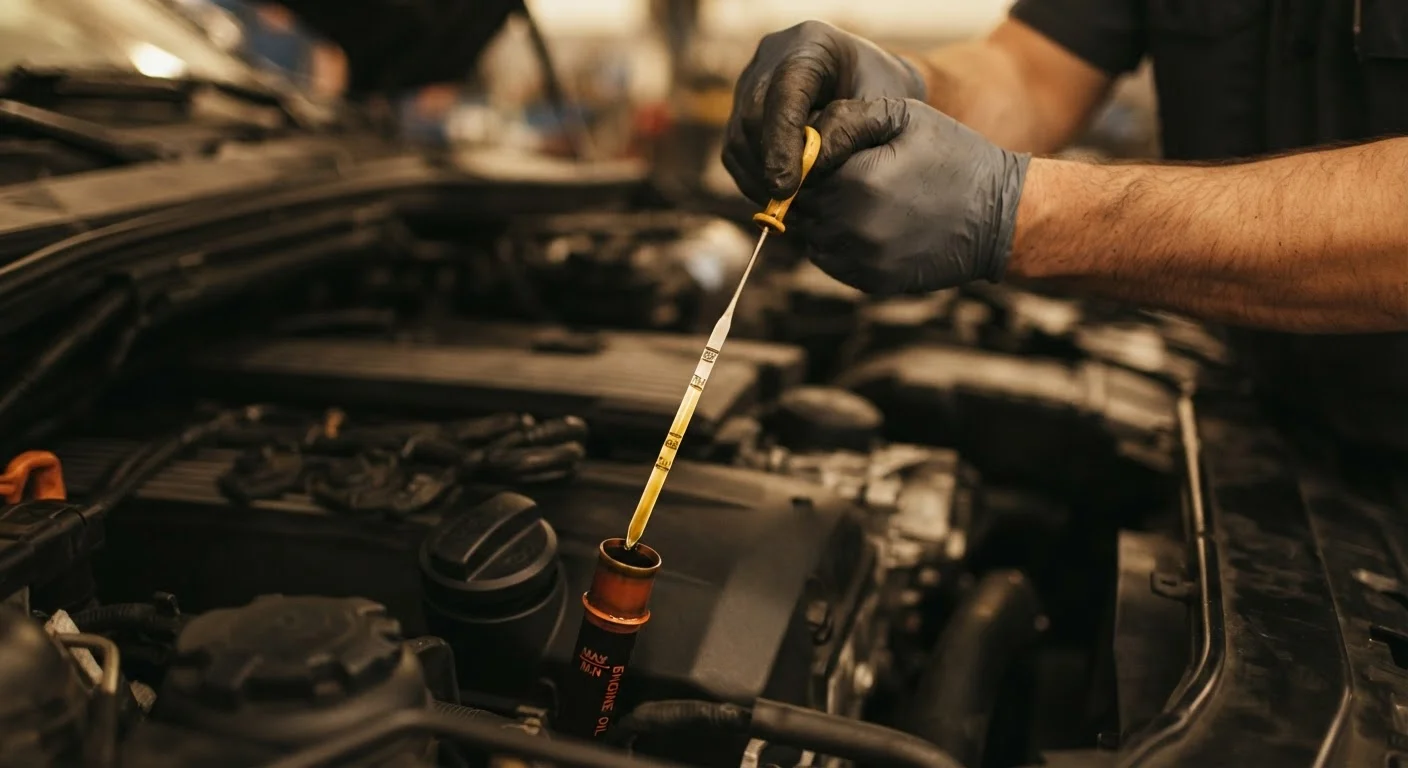
- Pull the dipstick out, wipe it clean with a rag, reinsert it fully, then pull it out again.
- Read the oil level against the MIN and MAX markings. The oil film should sit between the two marks.
- Also note the oil's appearance: it should be amber or dark brown. Milky, foamy, or gritty oil is a warning sign.
If the level is below the MIN mark, add the correct grade of oil in small amounts, rechecking as you go. Overfilling above the MAX mark can also cause problems, so don't rush it. Make this a monthly habit - it takes less time than unlocking your phone.
When to Change Your Oil
The old rule of thumb - change your oil every 3,000 miles - is outdated for most modern vehicles. Today's engines and oil formulations have significantly extended typical intervals. As a general guideline:
- Conventional oil: roughly every 3,000-5,000 miles
- Full synthetic oil: often 7,500-10,000 miles or more
Your owner's manual sets the authoritative interval for your specific engine. Many newer vehicles also have an oil-life monitoring system that calculates when a change is actually due based on real driving data - trust that system over a fixed mileage guess.
Driving conditions matter too. Frequent short trips (under 10 miles), lots of idling, extreme heat or cold, and towing all count as severe conditions and typically call for shorter intervals. This is covered in detail in our breakdown of your car's full maintenance schedule. For new drivers building a complete preventive care routine, the preventive maintenance roadmap for a first car is a useful companion read.
Warning Signs You Shouldn't Ignore
Your car communicates oil problems in several ways. Knowing what to look for helps you act before a minor issue becomes an expensive repair.
Never Ignore the Oil Pressure Light
An illuminated oil pressure warning light (the red oil can icon) is not a 'check when convenient' alert - it signals that your engine may not be receiving adequate lubrication right now. Continuing to drive risks severe and often irreversible engine damage. Pull over safely, switch off the engine, and assess the situation before proceeding. If the oil level is normal and the light remains on, have the vehicle towed to a qualified mechanic.
- Oil pressure warning light
- This is a red light shaped like an oil can. If it illuminates while driving, pull over safely and turn the engine off as soon as it's safe to do so. Do not continue driving. Low oil pressure can cause catastrophic engine damage within minutes. Check the oil level and call for assistance if the level is fine but the light stays on.
- Check engine light with oil context
- If this appears alongside other symptoms - burning smell, rough idle - have the vehicle diagnosed promptly by a qualified mechanic.
- Burning oil smell or blue smoke
- Blue-tinged exhaust smoke often indicates the engine is burning oil internally. This needs a mechanic's attention, not just a top-up.
- Unusually noisy engine
- Knocking or ticking sounds, especially on startup, can signal insufficient lubrication. Check the oil level immediately.
Staying on top of oil maintenance is one of the most cost-effective things you can do as a new owner. Paired with the right insurance - see our plain-language car insurance guide - it gives you a solid foundation for responsible car ownership.