

Key Takeaways
Tyre Pressure
Tyre pressure is the amount of air inside a tyre, measured in pounds per square inch (PSI). Each vehicle has a manufacturer-specified PSI range - printed on a sticker inside the driver's door jamb - that keeps the tyre performing safely and efficiently. Running outside that range, even slightly, causes compounding problems for fuel economy, tyre life, and vehicle handling.
PSI is a measure of gauge pressure - the pressure above atmospheric. Most passenger vehicles specify 30-35 PSI, but always follow your vehicle's placard rather than the number moulded into the tyre sidewall, which indicates the tyre's maximum rated pressure, not the recommended operating pressure.
Why Tyre Pressure Matters More Than Most Drivers Realize
Tyres are the only part of your vehicle actually touching the road. Everything - braking, steering, acceleration - depends on four contact patches roughly the size of a hand each. Tyre pressure determines the shape, size, and stiffness of those patches. Get it wrong, and every system that depends on grip starts underperforming.
This isn't a minor tuning detail. The U.S. Department of Energy estimates that properly inflated tyres improve gas mileage by up to 3%, while the National Highway Traffic Safety Administration (NHTSA) links significantly under-inflated tyres to increased blowout risk. For a driver putting 15,000 miles a year on their car, the cumulative cost of ignoring pressure - in fuel, tyres, and potential repairs - adds up faster than most people expect. For a fuller picture of how these costs stack up, see our breakdown of total car ownership costs.
Up to 3%
Fuel economy lost to under-inflated tyres
The U.S. Department of Energy estimates properly inflated tyres can improve gas mileage by up to 3% compared to under-inflated ones.
~1 PSI
Pressure lost per month under normal conditions
Tyres naturally lose approximately 1 PSI per month, meaning a tyre checked in summer may be significantly low by winter without any puncture.
1 PSI per 10°F
Pressure change with temperature drop
For every 10°F decrease in outside air temperature, tyre pressure drops approximately 1 PSI - a key reason to recheck after seasonal changes.
Under-Inflation: The More Dangerous and Common Problem
Most drivers who have a pressure problem are running low, not high. Under-inflation happens gradually - tyres lose roughly 1 PSI per month under normal conditions, and cold weather accelerates that. A tyre that was fine in October can be noticeably low by January without a single puncture.
When a tyre is under-inflated, its sidewalls flex more than designed with each rotation. That flexing generates heat, and heat is the primary enemy of tyre rubber. Sustained heat build-up weakens the internal structure, and in severe cases leads to blowout - a sudden, dangerous loss of control. Even before reaching that extreme, under-inflation causes the outer edges of the tread to carry more load than the centre, wearing those edges down much faster. The result: you replace tyres earlier than you should have to.
Check Pressure When Tyres Are Cold
Always measure tyre pressure before driving or at least three hours after parking. Driving heats the air inside the tyre and temporarily raises PSI, which can make a low tyre appear correctly inflated. Morning checks before your first drive of the day give the most accurate reading.
Tyre condition and pressure work together - pressure alone won't save a tyre with worn tread. Learn what safe tread depth actually means and how to measure it at home.
Over-Inflation: Less Common but Still Costly
Over-inflation is less frequent but carries its own set of problems. A tyre inflated beyond the recommended PSI becomes rigid and reduces its contact patch with the road. Less rubber touching the road means less grip - braking distances increase, particularly on wet surfaces, and the car may feel skittish through corners.
Over-inflated tyres also wear in a predictable pattern: the centre of the tread degrades faster than the edges because that's the only part making firm contact. This uneven wear shortens overall tyre life just as under-inflation does, only in the opposite pattern. Neither extreme gets you the designed tyre lifespan or the fuel efficiency the manufacturer intended. This is one of several car ownership myths that quietly cost young drivers money.
How to Check and Maintain Correct Pressure
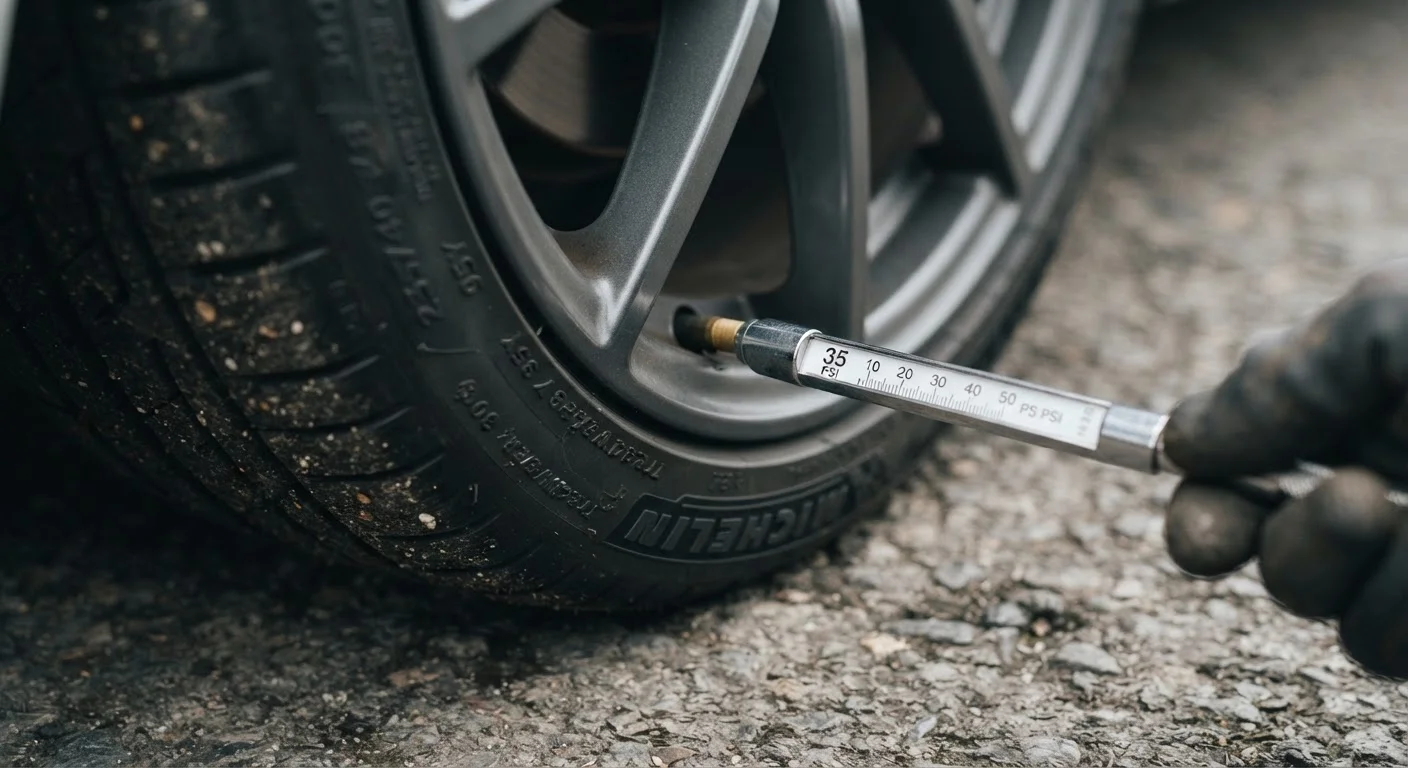
Checking tyre pressure requires only an inexpensive handheld gauge - digital or dial-style both work accurately. Check pressure when the tyres are cold, meaning the car has been parked for at least three hours or driven fewer than a mile. Driving heats air inside the tyre and temporarily raises PSI, giving a misleadingly high reading.
- Find your vehicle's recommended PSI on the driver's door jamb sticker or owner's manual.
- Remove the valve cap from each tyre and press the gauge firmly onto the valve stem.
- Compare the reading to the recommended PSI. Add air if low; release small amounts with the gauge's bleed valve if high.
- Replace valve caps securely to keep out dirt and moisture.
Do this monthly. Set a calendar reminder tied to a regular habit - the first of each month, payday, whenever works. The two minutes it takes are among the cheapest preventive maintenance you can do. Skipping checks consistently is the kind of small neglect that turns into much larger bills over time.