

Key Takeaways
Home Ventilation
Home ventilation is the process of replacing stale indoor air with fresh outdoor air on a continuous or controlled basis. It removes moisture, odours, allergens, and pollutants that build up inside any occupied space. Without adequate ventilation, humidity rises, surfaces become prone to mould, and indoor air quality declines noticeably.
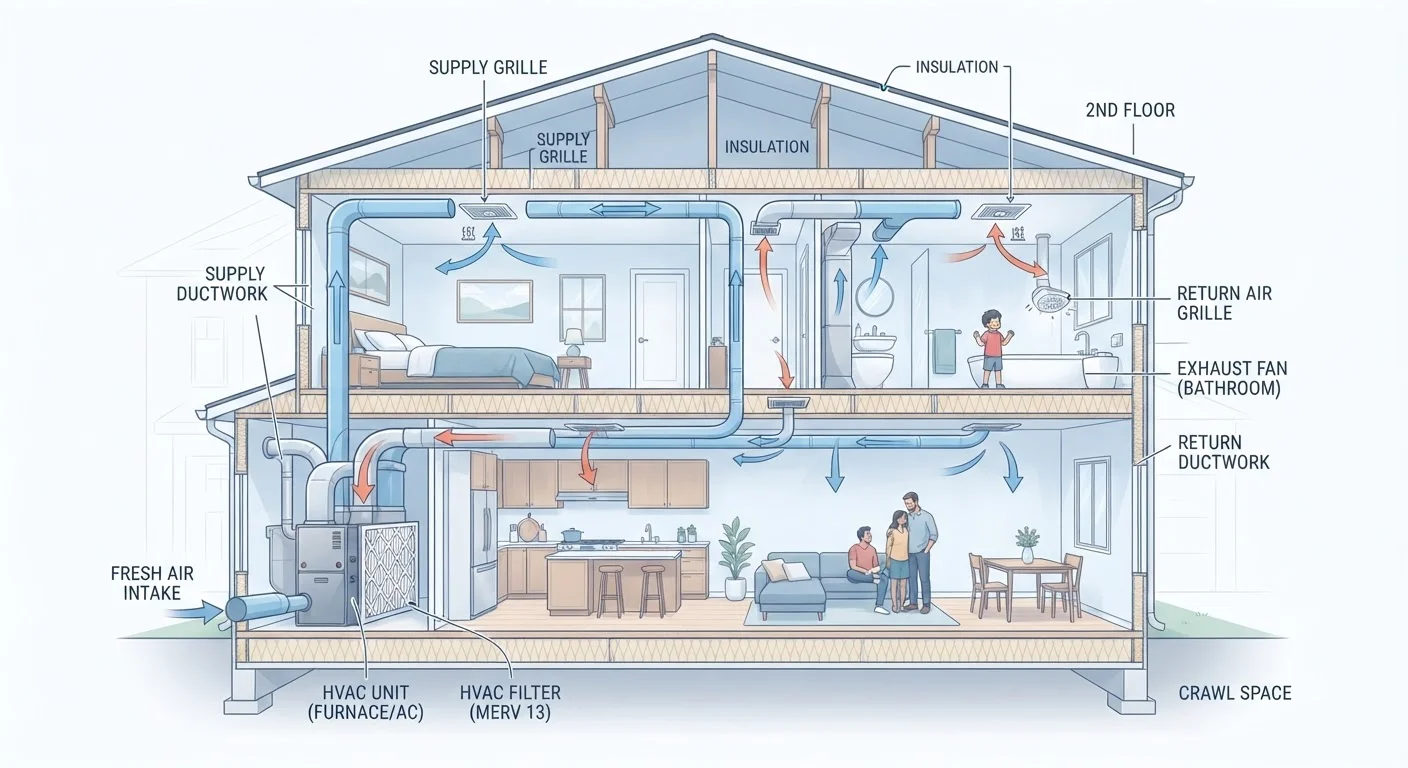
Ventilation is distinct from air conditioning - HVAC systems cool and circulate air but do not necessarily introduce fresh outdoor air unless specifically designed with a fresh-air intake or energy recovery ventilator (ERV).
Why Ventilation Matters More Than Most People Think
Indoor air can be significantly more polluted than outdoor air. Cooking fumes, cleaning product residues, dust mite debris, moisture from breathing and bathing - all of it accumulates inside a sealed space. Without a reliable way for that air to exit and fresh air to enter, you end up living in a slow-building soup of irritants.
Ventilation is the mechanism that prevents this. It's not just about comfort - adequate airflow helps control humidity, which is the single biggest driver of mould and condensation. If you've noticed persistent condensation on windows or musty smells in corners, poor ventilation is often a contributing factor. For a detailed look at how moisture problems develop differently, see our guide on damp, mould, and condensation.
The good news: most ventilation improvements are low-cost and genuinely manageable for a first-time homeowner or renter with basic tools.
2-5×
How much more polluted indoor air can be
The U.S. Environmental Protection Agency (EPA) has noted that indoor air pollutant levels are often 2 to 5 times higher than outdoor levels, and occasionally up to 100 times higher in poorly ventilated spaces.
60-90 days
Typical HVAC filter replacement interval
Most HVAC manufacturers recommend inspecting standard 1-inch filters every 30 days and replacing them within 60-90 days under typical household conditions.
15-20 min
Post-shower exhaust fan run time recommended
Building science guidance generally recommends running bathroom exhaust fans for at least 15-20 minutes after a shower to remove residual moisture from the air.
The Three Types of Home Ventilation
Understanding what you're working with makes it easier to spot what's missing or failing in your own home.
Natural Ventilation
This relies on air pressure differences and wind to push fresh air through openings - windows, trickle vents built into window frames, and purpose-built wall vents. It's unpredictable and depends heavily on weather and building orientation, but it's free and silent.
Mechanical Ventilation
Fans and HVAC systems that actively move air. Bathroom exhaust fans, kitchen range hoods, and whole-house HVAC units all fall into this category. These are controllable and consistent, but they require maintenance to keep working properly.
Balanced or Heat-Recovery Ventilation
More common in newer or energy-efficient builds, these systems (often called HRV - HRV - or ERV - ERV) extract stale air and pre-warm incoming fresh air using the outgoing air's heat, reducing energy loss. These require professional installation and periodic filter cleaning but are increasingly recommended for well-sealed modern homes.
Air Filters: What They Do and What to Watch For
If your home has a forced-air heating or cooling system, it runs air through a filter to catch dust, pollen, pet dander, and other particulates. A clean filter keeps the system running efficiently and improves air quality. A clogged filter does the opposite - it restricts airflow, forces the system to work harder, and can allow debris to bypass the filter entirely.
Set a Filter Check Reminder Now
The easiest way to stay on top of filter maintenance is to tie it to something you already do monthly - paying rent, checking your bank statement, or the first day of each month. Pull the filter out, check its colour, and replace it if it looks grey or clogged. A new filter typically costs a few dollars and takes under five minutes to swap.
Filter ratings are measured using the MERV scale (MERV). A MERV 8 filter catches most household dust and pollen. MERV 11-13 captures finer particles like mould spores and some bacteria, which is worth considering for allergy-prone households. Higher ratings mean denser media, which also means greater resistance to airflow - check that your system can handle the rating before upgrading.
Beyond HVAC filters, don't overlook range hood filters (often washable, grease-clogged) and the lint trap and vent hose of your dryer. A blocked dryer vent is both an airflow problem and a fire hazard.
The Exhaust Fan Problem Nobody Talks About
Bathroom and kitchen exhaust fans are arguably the most important ventilation points in a typical home - and among the most neglected. Many homeowners either don't run them long enough, or discover too late that the fan is venting into the wall cavity rather than outside, which just moves moisture into the structure of the building.
A functioning exhaust fan should be audible and create enough suction to hold a piece of tissue paper against the grille when running. If yours doesn't pass that test, the grille may be clogged with dust (clean it), the fan motor may be failing, or the ductwork may be disconnected or obstructed.
Run bathroom fans during showers and for at least 15-20 minutes afterward. Kitchen range hoods should run whenever you're cooking, especially with gas burners, which add combustion byproducts to indoor air. This connects closely to the broader principle of controlled ventilation - you want air leaving the building through designed paths, not through random gaps. Our article on weathertight doors, windows, and draught sealing explains the other side of this equation.
A Simple Ventilation Check You Can Do This Weekend
You don't need specialist equipment to get a baseline picture of how your home is ventilating. Work through these checks room by room:
- HVAC filter: Pull it out and hold it up to light. If you can't see light through it, it needs replacing.
- Exhaust fans: Run each fan and hold a tissue near the grille. It should be drawn firmly toward the grille.
- Vent registers: Check that supply and return air vents are not blocked by furniture, rugs, or curtains. Even partial blocking reduces system efficiency.
- Window trickle vents: If your windows have small slots at the top frame, make sure they are open and unobstructed - many people close these not realising their purpose.
- Dryer vent: Check the external vent cap outside. It should open freely when the dryer runs and close when it stops.
For anyone who is new to home upkeep altogether, this kind of systematic check fits naturally into the habits covered in our home maintenance guide for beginners.
Balancing Ventilation with Draught Control
A common concern is that improving ventilation seems to contradict efforts to seal gaps and reduce draughts. In practice, these goals are compatible - the distinction is between uncontrolled air leakage (through gaps in skirting boards, around old window frames, under doors) and planned ventilation paths (exhaust fans, trickle vents, HRV systems).
Uncontrolled gaps waste energy without reliably providing fresh air, because air moves through them unpredictably. Planned ventilation paths move air where you want it, when you want it. Sealing the former while maintaining the latter is the goal. If you're interested in the draught-sealing side of this balance, our article on draught-proofing your home walks through the practical steps.
This article provides general home maintenance information for educational purposes. For work involving ductwork modifications, gas appliances, or structural ventilation changes, consult a licensed HVAC or building professional. Always verify local building codes and permit requirements before undertaking modifications.