

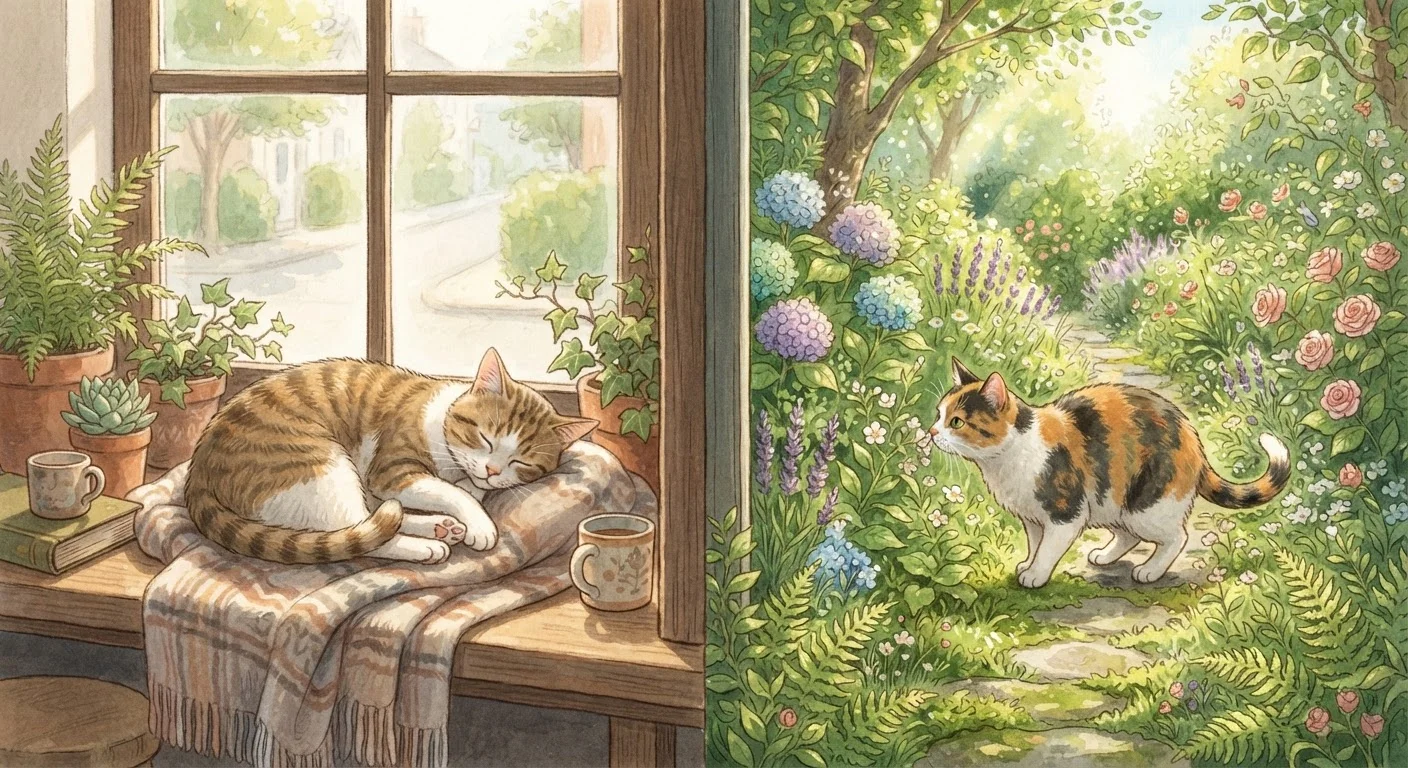
Key Takeaways
Option A
Indoor Cat
The protected, enrichment-dependent lifestyle.
Best for: Owners in urban or suburban settings who can commit to active play and environmental enrichment at home.
Option B
Outdoor Cat
The free-ranging, instinct-driven lifestyle.
Best for: Cats in low-traffic rural areas where supervised or managed outdoor access can be provided more safely.
If you live in a city or high-traffic suburban neighborhood
Indoor Cat
Traffic, urban predators, and higher disease exposure make outdoor access in dense areas significantly more dangerous for cats.
If your cat was already living outdoors before adoption
Outdoor Cat
Cats accustomed to outdoor life can experience stress when fully confined indoors; managed outdoor access with supervision may be the most humane approach.
If you want a low-maintenance daily supervision routine
Indoor Cat
Indoor cats don't require you to monitor outdoor hazards, track whereabouts, or deal with injury and illness from outdoor exposure.
If you live in a rural area with low traffic and space to roam
Outdoor Cat
Rural environments with minimal road traffic and safe territory can allow outdoor cats to express natural behaviors with comparatively lower risk.
If you want to give your indoor cat outdoor stimulation without the full risks
Indoor Cat
A catio (enclosed outdoor enclosure) or harness-trained leash walks can satisfy exploration instincts while keeping your cat protected.
The Core Difference: Safety vs. Stimulation
At its heart, the indoor vs. outdoor debate is a tension between two genuine cat needs: physical safety and behavioral enrichment. Neither lifestyle is automatically cruel or ideal - it depends heavily on your environment, your cat's history, and how much effort you're willing to invest in meeting their needs.
Indoor cats are shielded from cars, predators, parasites, and infectious diseases like feline leukemia virus (FeLV) and feline immunodeficiency virus (FIV). Veterinary organizations such as the American Veterinary Medical Association (AVMA) generally recommend keeping cats indoors or providing supervised outdoor access for these reasons. Studies have suggested that indoor cats may live significantly longer on average than cats with unrestricted outdoor access, though exact figures vary across sources.
Outdoor cats, on the other hand, get to express natural behaviors - hunting, climbing, patrolling territory, and responding to environmental stimuli - that are harder to replicate inside four walls. This freedom can support psychological wellbeing, particularly for cats already habituated to outdoor life.
| Criterion | Indoor Cat | Outdoor Cat |
|---|---|---|
| Average lifespan | Generally longer (10-15+ years) | Generally shorter (varies widely) |
| Disease exposure | Low (FeLV, FIV, parasites rare) | Higher (contact with other animals) |
| Injury risk | Low | High (traffic, predators, fights) |
| Behavioral enrichment | Requires active owner effort | Naturally abundant |
| Obesity risk | Higher without active play | Lower due to physical activity |
| Owner supervision needed | Enrichment and play daily | Monitoring health and whereabouts |
| Wildlife impact | Minimal | Can be significant |
Real Risks Worth Knowing
Outdoor risks are serious and well-documented. Traffic remains one of the leading causes of injury and death in free-roaming cats. Beyond cars, outdoor cats face exposure to toxins (such as antifreeze, pesticides, and rodenticides), fights with other animals that can cause abscesses and transmit disease, and parasites including fleas, ticks, and intestinal worms. In some regions, predators such as coyotes are a genuine threat even in suburban areas.
There's also an ecological dimension. Domestic cats are highly effective hunters, and free-roaming cats have been documented by wildlife researchers as a significant source of bird and small mammal mortality. This is worth factoring into your decision, particularly in areas with vulnerable native wildlife populations.
Indoor risks are different but real too. Cats confined without adequate stimulation can develop stress-related behaviors: over-grooming, aggression, hiding, or inappropriate elimination. Obesity is also more common in indoor cats due to reduced physical activity. These are manageable problems, but they require a proactive owner. See our guide to keeping an indoor cat mentally stimulated for enrichment strategies grounded in feline instinct.
10-15+ yrs
Typical indoor cat lifespan
Veterinary sources commonly cite indoor cats living into their mid-teens or beyond, compared to much shorter averages for free-roaming cats.
~1.3-4B
Birds killed annually by outdoor cats in the US
A widely cited 2013 study published in Nature Communications estimated free-ranging domestic cats kill between 1.3 and 4 billion birds per year in the United States.
~50%
Indoor cats that may be overweight
Veterinary obesity surveys consistently find that roughly half of domestic cats in the US are overweight or obese, with sedentary indoor lifestyles a contributing factor.
The Middle Ground: Supervised and Managed Access
Many veterinarians and cat behaviorists advocate for a middle path that offers outdoor stimulation without uncontrolled roaming. A few practical options include:
- Catios: Enclosed outdoor enclosures - ranging from window boxes to full backyard structures - that let cats experience fresh air, sights, and sounds without roaming freely.
- Leash training: Some cats adapt well to walking on a harness, particularly when introduced to it gradually. This provides exercise and novelty under direct owner supervision.
- Supervised yard time: Allowing brief, watched outdoor periods reduces (but doesn't eliminate) risk for cats in lower-traffic areas.
These compromises work best when introduced early, ideally as part of setting up your cat's environment from the start. Our room-by-room guide to cat-proofing your home covers vertical space and safety considerations that pair well with this approach.
Your cat's individual personality also matters. Shy or anxious cats may find outdoor environments overwhelming rather than enriching. Bold, high-energy cats may become frustrated when kept entirely indoors without ample stimulation. If you're deciding between a kitten and an adult cat, it's worth reading our comparison of kitten vs. adult cat adoption, since age and temperament affect how adaptable a cat is to each lifestyle.
This article provides general educational information about cat care and is not a substitute for advice from a licensed veterinarian familiar with your cat's individual health and circumstances.